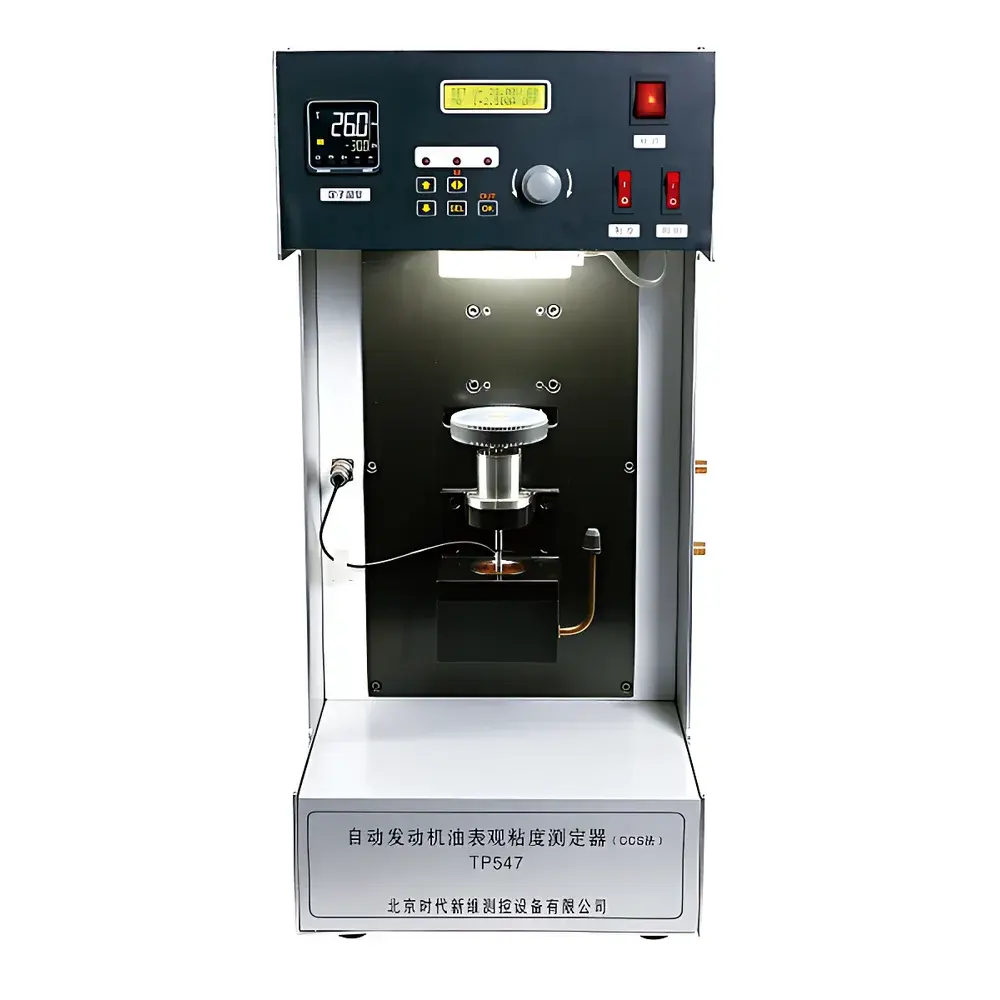
Timepower TP547 Apparent Viscosity Tester for Engine Oils
| Brand | Timepower |
|---|---|
| Model | TP547 |
| Type | Kinematic & Apparent Viscosity Tester |
| Compliance | GB/T 6538, ASTM D5293 |
| Temperature Range | −50 °C to +100 °C |
| Temperature Accuracy | ±0.1 °C |
| Bath Control Stability | ±0.05 °C |
| Viscosity Range | 1200–27,000 mPa·s |
| Shear Rate Range | 10⁴–10⁵ s⁻¹ |
| Operating Ambient | −40 °C to +30 °C |
| Power Supply | AC 220 V ±10%, 50 Hz ±10% |
| Total Power Consumption | ≤2 kW |
| Heating Power | ≤800 W |
| Refrigeration Range | −50 °C to ambient |
Overview
The Timepower TP547 Apparent Viscosity Tester is a precision-engineered instrument designed specifically for the low-temperature apparent viscosity measurement of engine oils under high-shear conditions. It operates on the principle of rotational viscometry in a controlled cold bath, applying standardized shear stress and shear rate profiles to simulate cranking and pumping behavior of lubricants at sub-zero temperatures. The system complies strictly with GB/T 6538 (Chinese national standard) and ASTM D5293 (Standard Test Method for Low-Temperature Viscosity of Engine Oils in the Mini-Rotary Viscometer), making it suitable for quality control, formulation development, and regulatory compliance testing in petroleum refining, OEM lubricant certification, and third-party inspection laboratories.
Key Features
- Integrated multi-threaded control architecture enabling fully automated operation—temperature regulation, motor speed acquisition, torque sensing, data logging, and viscosity calculation occur synchronously without manual intervention.
- Fuzzy logic-based temperature control system ensures rapid thermal response and exceptional stability (±0.05 °C) across the full operating range from −50 °C to +100 °C, critical for reproducible low-temperature rheological characterization.
- Dedicated cold bath with dual-mode refrigeration and resistive heating enables seamless transition between cryogenic and elevated temperature testing, supporting both ASTM D5293 and complementary viscosity protocols.
- PC-hosted control interface provides intuitive workflow navigation, real-time parameter monitoring, and configurable test sequences—including automatic curve-fitting algorithms compliant with the ASTM D5293 polynomial regression model for apparent viscosity determination.
- Built-in thermal printer supports immediate hardcopy output of test reports, including date/time stamp, bath temperature, measured torque, rotational speed, calculated apparent viscosity, and pass/fail status against specification limits.
Sample Compatibility & Compliance
The TP547 is optimized for Newtonian and non-Newtonian engine oil formulations—including conventional, synthetic, and low-SAPS (Sulfated Ash, Phosphorus, Sulfur) grades—within the specified shear rate window (10⁴–10⁵ s⁻¹) and temperature domain (−35 °C to −5 °C). Its design conforms to mechanical and procedural requirements outlined in ASTM D5293 Annex A1 for mini-rotary viscometer geometry, rotor/stator clearance tolerances, and drive motor calibration traceability. All thermal and rotational subsystems are validated per ISO/IEC 17025 calibration guidelines, and software functionality supports audit-ready data integrity practices aligned with GLP and GMP environments. Optional integration with LIMS via RS-232 or Ethernet facilitates electronic record retention compliant with FDA 21 CFR Part 11 requirements.
Software & Data Management
The proprietary Windows-based application provides role-based user access, version-controlled method templates, and timestamped raw data export in CSV and XML formats. Each test session automatically generates a structured metadata header containing instrument ID, operator login, calibration certificate expiry, environmental log (ambient T/RH), and hardware diagnostic flags. Curve-fitting routines implement the ASTM D5293-defined third-order polynomial (η = a + b·ω + c·ω² + d·ω³) to derive apparent viscosity at target shear rates. Audit trails record all parameter modifications, report generation events, and calibration interventions—enabling full traceability during internal audits or regulatory inspections.
Applications
- Low-temperature pumpability assessment of SAE 0W-x and 5W-x multigrade engine oils.
- Formulation screening for improved cold-start performance in passenger car motor oils (PCMO) and heavy-duty diesel engine oils (HDDO).
- Quality assurance testing in refinery QC labs and independent commercial testing facilities serving API licensing programs.
- Research-grade rheological profiling of base stock blends, viscosity index improvers (VIIs), and pour point depressants (PPDs).
- Compliance verification for OEM specifications requiring ASTM D5293 data submission (e.g., GM dexos®, Ford WSS-M2C945-A, MB 229.31).
FAQ
What standards does the TP547 comply with?
The instrument is engineered and verified to meet the mechanical, thermal, and procedural requirements of GB/T 6538 and ASTM D5293 for low-temperature apparent viscosity testing of engine oils.
Is drive current calibration required after installation?
Yes. Initial drive current measurement is mandatory upon commissioning or after replacement of motor, belt, or rotor assembly. Monthly verification is recommended for the first three months until drift stabilizes below 20 mA over consecutive intervals.
Can the TP547 be integrated into a laboratory information management system (LIMS)?
Yes. The device supports ASCII-based serial communication (RS-232) and TCP/IP network protocols for bidirectional data exchange, enabling automated result ingestion and electronic signature workflows.
What maintenance is required for long-term accuracy?
Routine validation includes annual temperature sensor calibration against NIST-traceable reference thermometers, periodic verification of bath fluid level and purity, and scheduled inspection of refrigeration compressor oil and condenser coil cleanliness.
Does the system support multiple user accounts with differentiated permissions?
Yes. The software implements hierarchical access control (administrator, technician, viewer) with password protection and session timeout enforcement to maintain data governance integrity.