
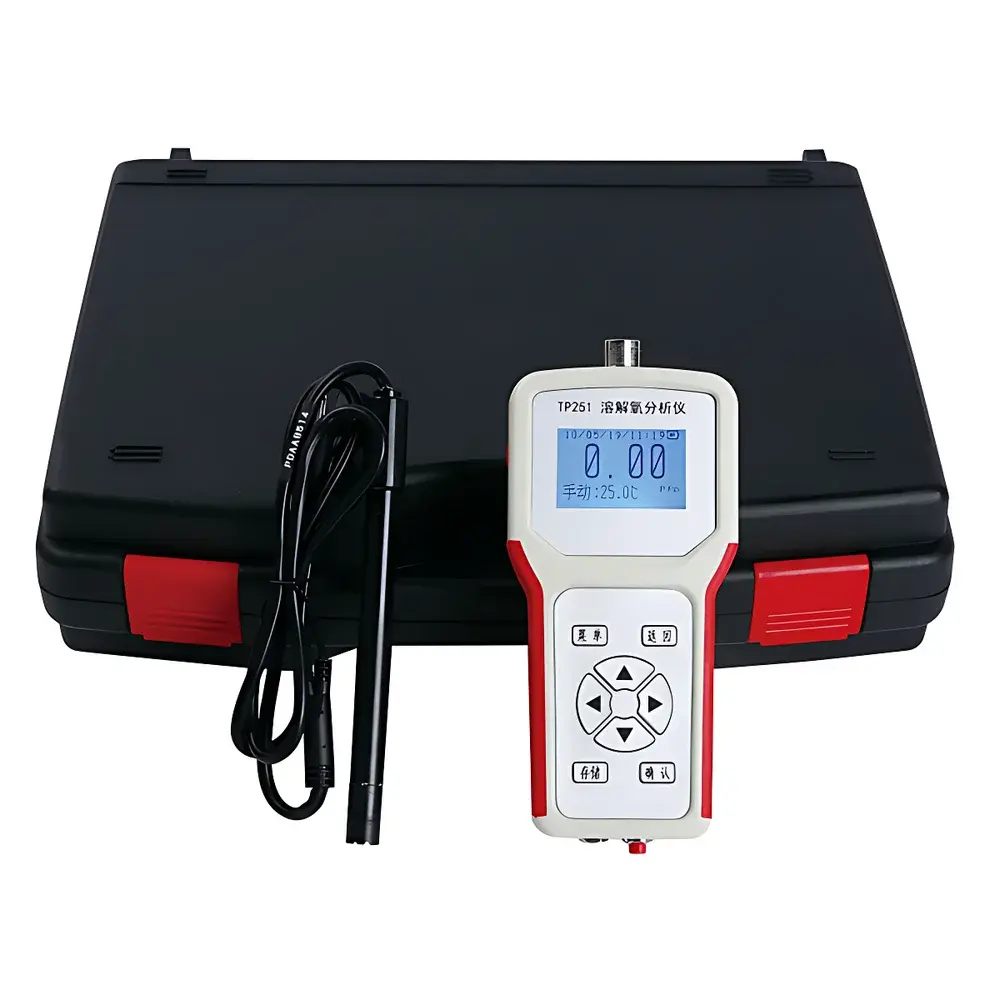
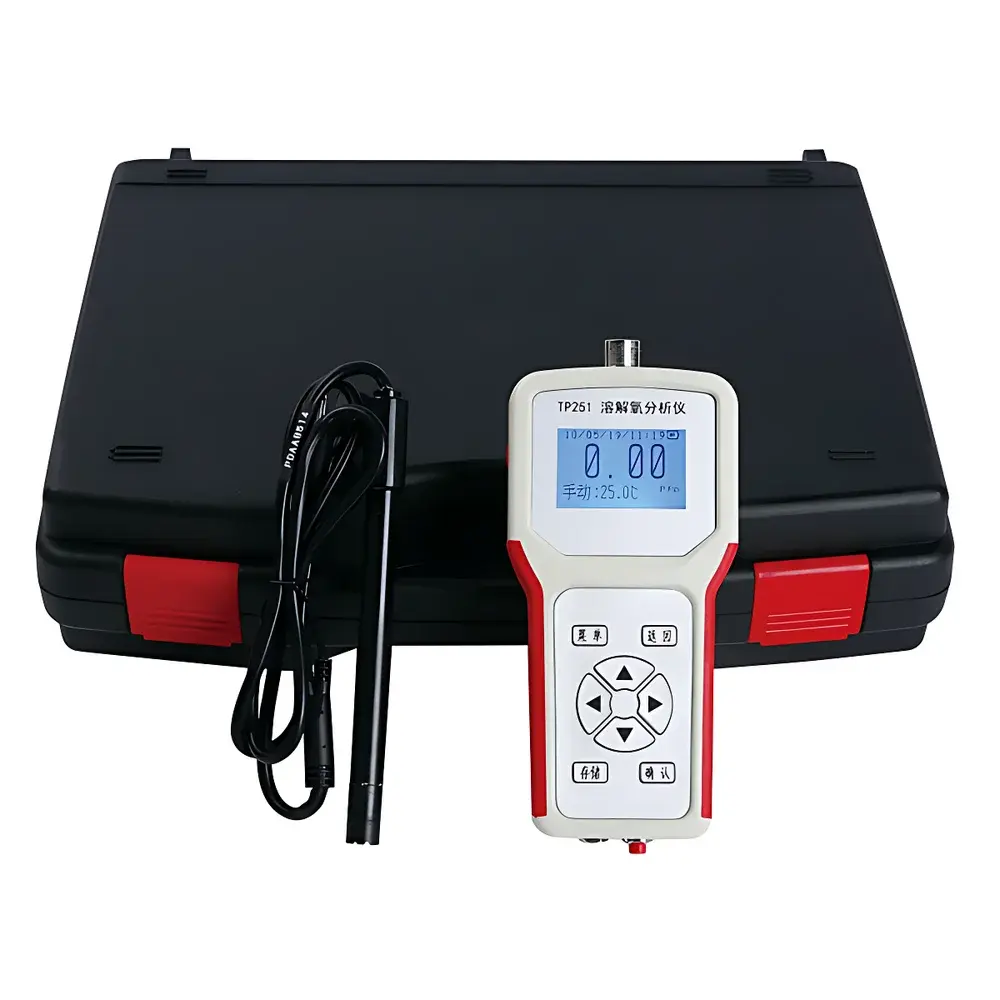
Timepower TP251 Portable Dissolved Oxygen Analyzer
| Brand | Timepower |
|---|---|
| Origin | Beijing, China |
| Manufacturer | Timepower Co., Ltd. |
| Type | Portable |
| Measurement Principle | Fluorescence Quenching Method |
| Range | 0.00–20.00 mg/L |
| Accuracy | ±1.5% FS |
| Repeatability | ±1% |
| Detection Limit | 2 ppb |
| Resolution | 0.01 mg/L |
| Response Time (T90) | <5 min at 25 °C |
| Temperature Compensation | Pt1000 sensor, 0–60 °C |
| Sample Temp. Range | 5–60 °C |
| Operating Ambient | 5–45 °C, ≤90% RH (non-condensing) |
| Storage Temp. | −25 to +55 °C (electrode excluded |
| Power Supply | AC 220 V ±10%, 50 Hz |
| Power Consumption | ≤0.5 W |
| Dimensions | 80 × 30 × 175 mm |
| Weight | 0.26 kg |
| Display | 128×64 dot-matrix LCD with Chinese interface |
| Data Storage | Cyclic memory with 10+ years offline retention (battery-backed) |
| Battery Life | Up to 8 hours continuous operation |
Overview
The Timepower TP251 Portable Dissolved Oxygen Analyzer is an engineered field-deployable instrument designed for high-fidelity, milligram-per-liter (mg/L) level dissolved oxygen (DO) quantification in aqueous environments. It employs the fluorescence quenching principle—where molecular oxygen modulates the lifetime and intensity of a luminescent ruthenium-based probe immobilized on the sensor surface—to deliver stable, reagent-free, and membraneless measurement. Unlike traditional electrochemical Clark-type sensors, the TP251 eliminates cathodic polarization, electrolyte depletion, and flow dependency, enabling robust performance in low-flow or stagnant samples—including wastewater effluents, surface waters, aquaculture ponds, and groundwater monitoring wells. Its compact form factor (80 × 30 × 175 mm), sub-300 g mass, and 8-hour battery endurance support extended unattended operation during multi-site surveys or emergency response deployments.
Key Features
- Fluorescence-based optical sensing architecture ensures zero oxygen consumption during measurement and eliminates drift associated with electrode aging or electrolyte drying.
- Integrated Pt1000 temperature sensor enables automatic, real-time compensation across 0–60 °C, critical for accurate DO reporting under variable thermal conditions.
- 24-bit analog-to-digital conversion circuitry delivers 0.01 mg/L resolution and maintains ±1.5% full-scale accuracy per NIST-traceable calibration protocols.
- Embedded microcontroller platform supports low-power operation (<0.5 W), rapid T90 response (<5 min at 25 °C), and stable baseline performance (±1% FS/4 h).
- 128×64 monochrome LCD with native Chinese character rendering simplifies field operation for domestic users while retaining ISO-compliant menu navigation logic.
- Cyclic data logging with non-volatile memory retains ≥10 years of timestamped records without external power—fully compliant with GLP audit trail requirements for environmental reporting.
Sample Compatibility & Compliance
The TP251 is validated for use in freshwater, seawater (with salinity correction applied manually), wastewater, industrial process streams, and biological treatment systems. It meets functional equivalence to ASTM D888-22 (Standard Test Methods for Dissolved Oxygen in Water) and supports alignment with ISO 5815-1:2016 (Water quality — Determination of biochemical oxygen demand after n days — Part 1: BODn by dilution and seeding method) through traceable DO input. While not certified to IEC 61000-6-2/4 for industrial EMC, its design conforms to IP65-rated ingress protection for temporary outdoor exposure. The device supports manual salinity and barometric pressure inputs to correct partial pressure effects, satisfying US EPA Method 360.1 adaptation requirements for field DO reporting.
Software & Data Management
Data export is supported via USB interface (no proprietary drivers required) to standard CSV format, compatible with LIMS platforms such as LabWare, STARLIMS, and Thermo Fisher SampleManager. Internal memory implements FIFO (first-in, first-out) overwrite logic with automatic timestamping (year/month/day/hour/minute), enabling chronological reconstruction of longitudinal monitoring campaigns. All stored entries include metadata: DO value, temperature, user ID (if assigned), and calibration status flag. Audit logs are immutable post-recording—consistent with FDA 21 CFR Part 11 principles for electronic records when paired with organizational procedural controls.
Applications
- Regulatory compliance monitoring for municipal wastewater discharge permits (e.g., NPDES in the U.S., EU Urban Wastewater Treatment Directive).
- In-situ profiling of hypolimnetic oxygen depletion in reservoirs and lakes to assess eutrophication risk.
- Process control in activated sludge bioreactors, where DO setpoints directly influence nitrification efficiency and energy consumption.
- Aquaculture health management—continuous verification of dissolved oxygen thresholds for salmonid or crustacean species.
- Groundwater redox characterization during site remediation, particularly in monitored natural attenuation (MNA) programs.
- Educational laboratory use in environmental science curricula requiring portable, maintenance-light instrumentation.
FAQ
Does the TP251 require routine membrane replacement or electrolyte refilling?
No. As a fluorescence-based analyzer, it contains no consumable membranes, cathodes, or liquid electrolytes—reducing lifecycle cost and calibration frequency.
Can the instrument be calibrated using the Winkler titration method as a reference?
Yes. Field calibration may be performed against iodometric (Winkler) results using single-point or two-point adjustment, provided the Winkler analysis follows ASTM D888-22 Section 10 protocol and accounts for interfering substances.
Is temperature compensation automatically applied during measurement?
Yes. The integrated Pt1000 sensor continuously feeds temperature data to the firmware, applying the Benson-Krause equation for oxygen solubility correction in real time.
What is the recommended recalibration interval under routine field use?
Timepower recommends verification every 30 days or prior to each critical sampling campaign; full recalibration is advised after exposure to extreme pH (10), hydrogen sulfide, or heavy metal contamination.
Does the device support Bluetooth or wireless data transmission?
No. The TP251 relies on wired USB connectivity to ensure electromagnetic immunity in electrically noisy field environments and prevent unauthorized remote access to environmental datasets.
Related Products







