
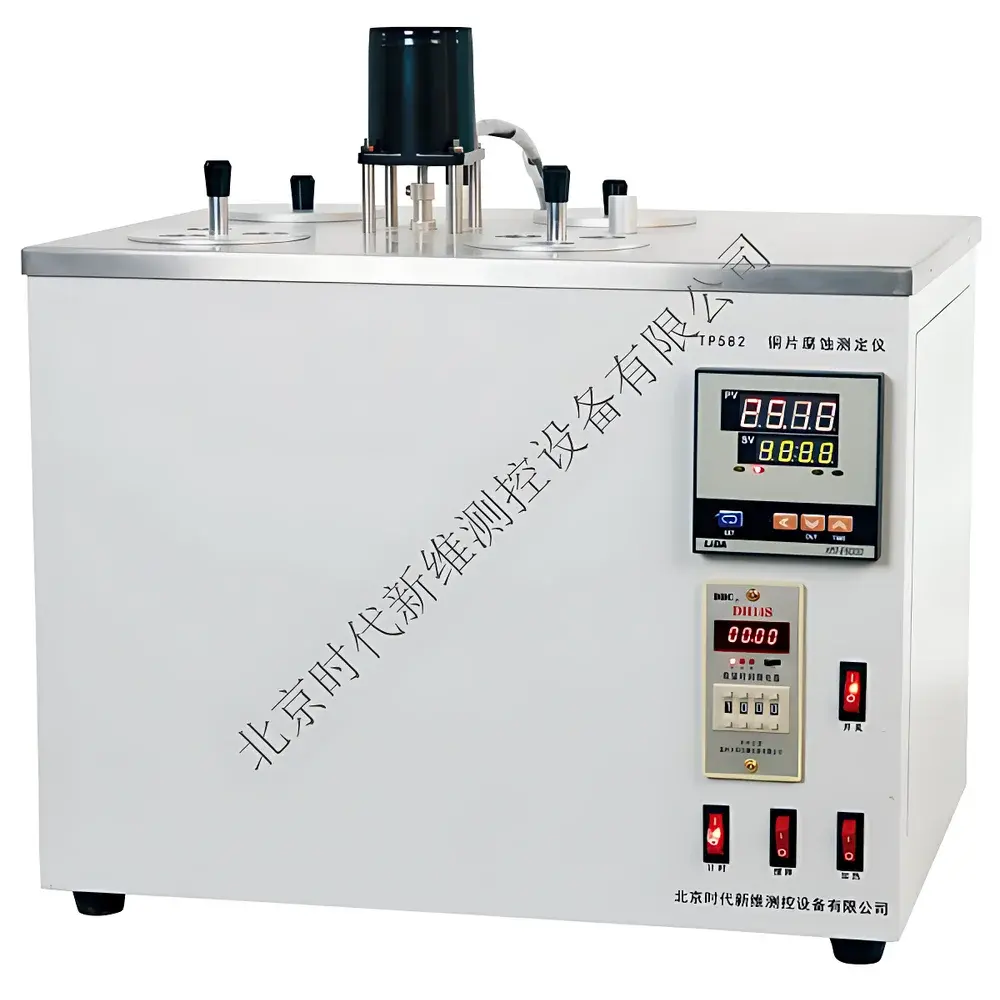
Timepower TP582 Copper Corrosion Tester for Petroleum Products
| Brand | Timepower |
|---|---|
| Origin | Shanghai, China |
| Manufacturer Type | Manufacturer |
| Country of Origin | Domestic (China) |
| Model | TP582 |
| Pricing | Upon Request |
Overview
The Timepower TP582 Copper Corrosion Tester is a precision-engineered benchtop instrument designed to evaluate the corrosive tendency of petroleum products toward copper surfaces under standardized thermal exposure conditions. It operates on the principle of controlled immersion corrosion testing—where polished copper strips are exposed to test samples in sealed vessels at specified temperatures and durations, followed by visual assessment of surface discoloration and tarnish against ASTM D130/ISO 6251 reference standards. This method is grounded in the electrochemical interaction between reactive sulfur compounds (e.g., mercaptans, sulfides, elemental sulfur) and metallic copper, forming characteristic copper sulfide films whose hue correlates with corrosion severity (rated 1a–4). The TP582 complies fully with GB/T 5096, GB/T 7326, ASTM D130, ASTM D4048, SH/T 0232, SH/T 0023, and ISO 6251—making it suitable for quality control laboratories operating under API, ASTM, and CNPC specifications, as well as those requiring alignment with ISO/IEC 17025-compliant testing workflows.
Key Features
- Metal-block heating bath with PID-based digital temperature regulation, ensuring thermal stability within ±1 °C across the full operating range (ambient to 150 °C).
- Four independent sample wells accommodating up to 12 copper strips per test cycle via modular rack configuration (including test bomb holders, tube racks, and observation tubes).
- Programmable digital timer (1 minute to 24 hours), featuring audible end-of-test alert and LED time display for unambiguous process tracking.
- Industrial-grade Pt100 platinum resistance thermometer integrated into the bath block for high-accuracy real-time feedback control.
- Dual-heating architecture: primary 600 W heating element for precise bath control + auxiliary 1000 W booster for rapid thermal ramp-up—optimized for reproducible start-up performance in ambient environments ranging from 5 °C to 40 °C.
- Robust mechanical design with aluminum alloy housing, front-accessible bath chamber, and ergonomic handling fixtures for routine maintenance and sample loading.
Sample Compatibility & Compliance
The TP582 supports a broad spectrum of hydrocarbon-based materials including aviation gasoline, jet fuel (Jet A/A-1), automotive gasoline, natural gasoline, naphthas, solvent oils, diesel fuels (EN 590, ASTM D975), distillate fuel oils, lubricating oils (mineral and synthetic), greases, and residual fuel oils—provided their Reid Vapor Pressure (RVP) does not exceed 124 kPa (930 mmHg). All test procedures adhere strictly to the sample preparation, strip polishing, cleaning, and rating protocols defined in ASTM D130 Annex A1 and ISO 6251 Clause 7. Instrument validation includes traceable calibration of temperature and time parameters; documentation supports GLP audit trails and meets baseline requirements for FDA 21 CFR Part 11–aligned data integrity when paired with compliant laboratory information management systems (LIMS).
Software & Data Management
The TP582 operates as a standalone hardware platform without embedded software or network connectivity. Temperature and timing parameters are managed exclusively through its front-panel digital interface. For regulated environments, users may integrate the instrument into broader QC workflows using external electronic lab notebooks (ELNs) or LIMS platforms that log operator ID, test date/time, setpoints, observed corrosion ratings, and pass/fail determinations per batch. While the device itself does not generate digital output files, its deterministic analog control architecture ensures full repeatability and eliminates firmware-related variability—a critical advantage in GMP-aligned refinery QA labs where validation scope must exclude software qualification burdens.
Applications
- Refinery final product release testing for copper corrosion compliance prior to pipeline shipment or blending.
- Monitoring sulfur scavenger efficiency in hydrotreated feedstocks and post-treatment streams.
- Research evaluation of additive packages (e.g., copper deactivators) in lubricant formulations.
- Contract laboratory services performing third-party certification per ASTM or national standards (e.g., CNAS-accredited testing).
- Educational use in petroleum engineering curricula for hands-on demonstration of corrosion mechanisms and standard test methodology.
FAQ
What safety precautions must be observed before powering on the TP582?
Never energize the unit unless the bath chamber contains an appropriate heat-transfer medium (water, silicone oil, or specified oil/water mixture) at or above minimum fill level. Dry operation will permanently damage the heating elements.
Is the Pt100 sensor field-replaceable?
Yes—the industrial Pt100 probe is mechanically secured and electrically connected via screw terminals; replacement requires only basic calibration verification using a certified reference thermometer.
Can the TP582 accommodate non-standard copper strip dimensions?
No—it is engineered exclusively for ASTM D130–compliant strips (75 mm × 12.5 mm × 1.5 mm); deviations compromise thermal mass uniformity and rating consistency.
Does the instrument support automatic data export?
No—the TP582 is a manually operated, analog-controlled tester with no USB, RS-232, or Ethernet interface; all records must be entered externally.
What maintenance intervals are recommended for long-term reliability?
Clean the metal bath interior quarterly with non-abrasive detergent; inspect heater contacts annually; verify temperature accuracy biannually using NIST-traceable calibration sources.
Related Products





