
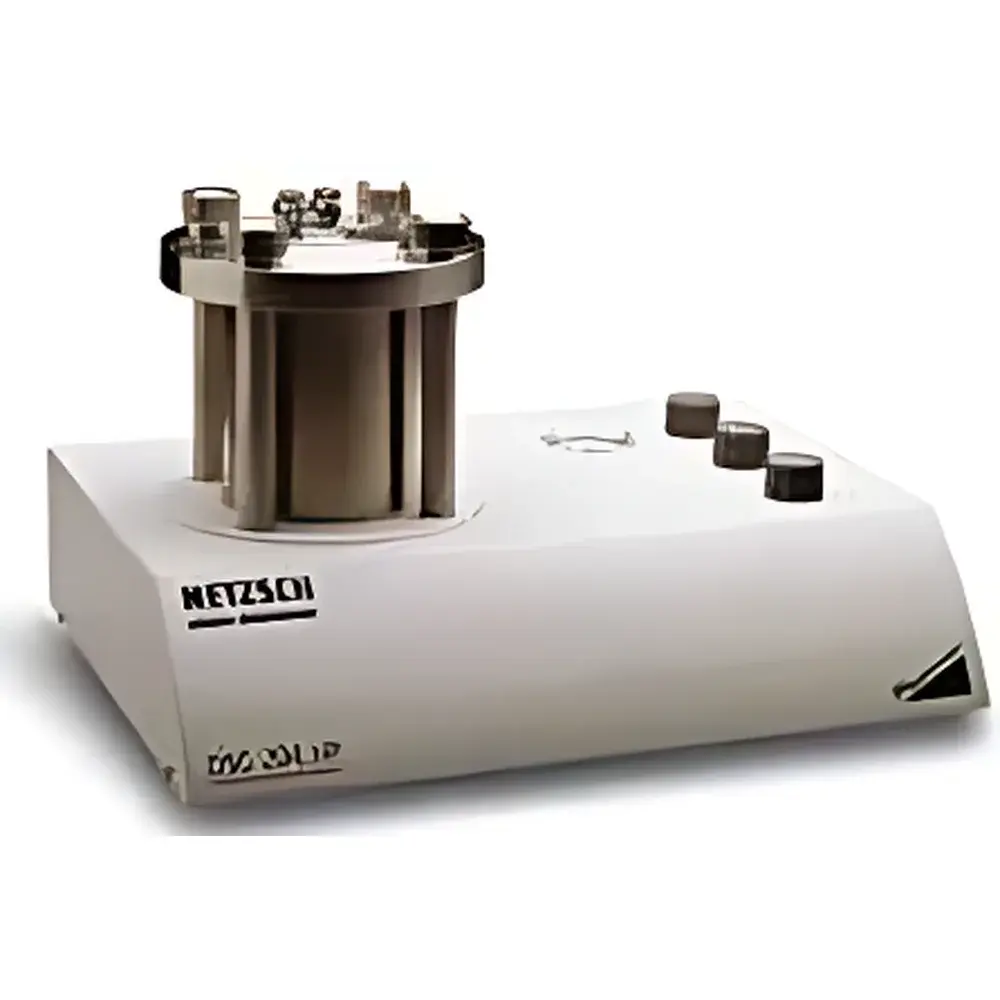
Netzsch DSC 204 HP High-Pressure Differential Scanning Calorimeter
| Brand | Netzsch |
|---|---|
| Origin | Germany |
| Model | DSC 204 HP |
| Temperature Range | –150 °C to 600 °C (with CC 200L cryo-cooler) |
| Heating/Cooling Rate | 0.01–100 K/min |
| Pressure Range | Vacuum to 15 MPa (150 bar) |
| Pressure Resolution | 0.002 MPa |
| Gas Flow Control | Up to 500 mL/min |
| Atmosphere Options | N₂, Ar, He, O₂, H₂, CO₂, CH₄, air, and custom gas mixtures |
| Sensor Type | Interchangeable high-stability DSC sensors |
| Furnace | Gold-plated corrosion-resistant cell |
Overview
The Netzsch DSC 204 HP is a high-pressure differential scanning calorimeter engineered for quantitative thermal analysis under precisely controlled gaseous environments. Unlike conventional DSC systems limited to ambient or low-pressure operation, the DSC 204 HP employs a hermetically sealed, gold-plated measurement cell capable of withstanding pressures up to 15 MPa (150 bar), enabling thermodynamic investigations under industrially relevant process conditions—such as catalytic oxidation, polymer degradation under pressurized CO₂, hydrogenation reactions, or supercritical fluid processing. Its measurement principle is based on heat-flux DSC, where the temperature difference between sample and reference crucibles is continuously monitored under identical thermal treatment, delivering high reproducibility and baseline stability. The system supports both static and dynamic gas atmospheres, with integrated electronic pressure regulation and mass-flow-controlled purge gas delivery ensuring sub-millibar pressure stability and precise stoichiometric control over reactive or inert environments.
Key Features
- Maximum operating pressure of 15 MPa—highest among commercially available DSC platforms, certified per PED 2014/68/EU and ASME BPVC Section VIII Div. 1
- Extended temperature range: –150 °C to 600 °C (achieved via optional CC 200L liquid nitrogen cooling unit and high-temperature furnace)
- Gold-plated sensor and furnace assembly providing exceptional resistance to oxidation, sulfidation, and halogen-induced corrosion—critical for long-term stability in aggressive atmospheres (e.g., H₂S, Cl₂, moist O₂)
- Interchangeable sensor modules optimized for sensitivity, dynamic response, or high-temperature linearity—enabling method-specific calibration traceable to NIST SRM 3451 and ISO 11357
- Real-time synchronized acquisition of DSC signal, absolute pressure, gas flow rate, and furnace temperature—each sampled at ≥10 Hz with timestamped metadata
- Integrated safety architecture including dual redundant pressure transducers, burst disc, mechanical pressure relief valve, and software-enforced operational limits compliant with IEC 61508 SIL 2
Sample Compatibility & Compliance
The DSC 204 HP accommodates standard crucibles (alumina, gold, platinum, stainless steel) and custom high-pressure capsules (e.g., titanium alloy micro-bombs). It supports solid, powder, gel, and viscous liquid samples up to 100 mg. Regulatory compliance includes full alignment with GLP and GMP documentation requirements: audit trail logging (21 CFR Part 11 compliant), electronic signatures, version-controlled method storage, and raw data immutability. All pressure-related test reports conform to ASTM E1269, ISO 11357-1/2/3, and USP , with optional validation packages supporting IQ/OQ/PQ protocols.
Software & Data Management
Controlled by Proteus® software (v12.x), the DSC 204 HP provides a unified interface for experiment design, real-time monitoring, and advanced post-processing. Proteus supports automated method sequencing—including multi-step pressure ramps coupled with linear/non-linear temperature programs—and exports ASCII, CSV, and universal .itx formats compatible with MATLAB®, Python (via PyMCA), and commercial LIMS. Core analytical functions include automatic peak detection with customizable onset/peak/endpoint algorithms; multi-baseline fitting (tangent, linear, polynomial); enthalpy integration with buoyancy-corrected mass normalization; and simultaneous Cp determination using quasi-isothermal modulation. Optional modules include Kinetics Neo™ for model-free and model-fitting kinetic analysis (ASTM E698, Ozawa-Flynn-Wall), Peak Separation for deconvolution of overlapping transitions, and DSC/DTA Calibration Suite for sensor response verification against certified standards.
Applications
- Thermal stability assessment of energetic materials (e.g., propellants, explosives) under pressurized inert or oxidizing atmospheres
- Phase behavior mapping of polymers in supercritical CO₂ for foaming or impregnation processes
- Catalyst deactivation studies under simulated reactor conditions (e.g., coke formation kinetics in H₂/N₂/H₂S mixtures at 5–10 MPa)
- Glass transition and cold crystallization analysis of amorphous pharmaceuticals under moisture-controlled or solvent-vapor-saturated environments
- Hydration/dehydration thermodynamics of metal–organic frameworks (MOFs) and zeolites at variable p(H₂O)
- Reaction enthalpy quantification for hydrogen storage materials (e.g., MgH₂, NaAlH₄) under equilibrium H₂ partial pressures
FAQ
What is the maximum allowable sample mass under full 15 MPa pressure?
The recommended upper limit is 50 mg for volatile or exothermic samples; 100 mg is permissible for thermally stable solids using high-strength crucibles.
Can the DSC 204 HP perform simultaneous TGA-DSC measurements?
No—it is a dedicated DSC platform; for coupled analysis, consider the Netzsch STA 449 F3 Jupiter HP or TG-DSC hybrid configurations.
Is remote operation supported for unattended overnight runs?
Yes—Proteus supports secure RDP-based remote access, email alerting on completion or fault conditions, and scheduled start/stop with hardware interlock verification.
How is pressure calibration verified during routine maintenance?
Calibration is performed using a NIST-traceable dead-weight tester (0–20 MPa range) and validated annually per ISO/IEC 17025 accredited procedures.
Does the system comply with explosion-proof requirements for Class I, Division 1 hazardous areas?
The base instrument is rated for general laboratory use (IP20); for hazardous location deployment, it must be installed within an externally certified explosion-proof enclosure meeting ATEX Directive 2014/34/EU Group II, Category 2G.



