
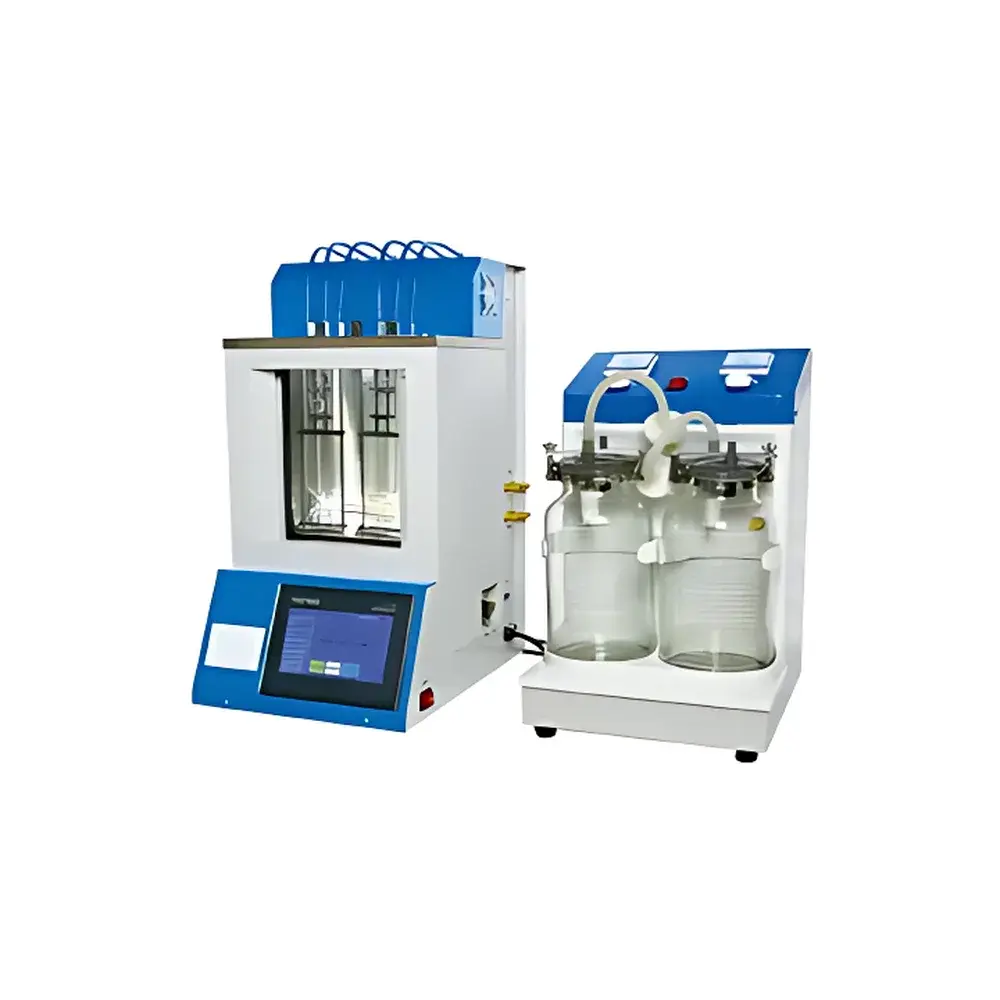
Timepower TP725 Fully Automated Kinematic Viscosity Tester
| Brand | Timepower |
|---|---|
| Origin | Beijing, China |
| Manufacturer Type | Direct Manufacturer |
| Country of Origin | China |
| Model | TP725 |
| Pricing | Upon Request |
Overview
The Timepower TP725 Fully Automated Kinematic Viscosity Tester is an ASTM D445- and ISO 3104-compliant instrument engineered for precise, repeatable determination of kinematic viscosity in petroleum-based liquids—including lubricating oils, transformer oils, diesel fuels, jet fuels, and crude oil fractions. It operates on the capillary efflux principle per GB/T 265–1988 (equivalent to ISO 3104), wherein a fixed volume of sample flows under gravity through a calibrated Ubbelohde-type capillary viscometer immersed in a thermostatically controlled bath. The instrument measures efflux time with high temporal resolution and computes kinematic viscosity (ν, mm²/s) using the viscometer’s calibration constant (C) via the fundamental equation ν = C × t. Designed for routine QC/QA laboratories in power generation, petrochemical refining, customs inspection, and R&D institutions, the TP725 eliminates manual timing, temperature drift, and operator-dependent variability—ensuring data integrity aligned with GLP and internal audit requirements.
Key Features
- Fully automated workflow: integrated heating, temperature stabilization, sample aspiration, efflux timing, calculation, capillary rinsing, and drying—all executed without user intervention.
- Dual independent test channels: enables asynchronous kinematic viscosity measurement of two samples simultaneously, improving throughput without cross-contamination risk.
- High-stability temperature control: microprocessor-regulated oil bath with ±0.01 °C accuracy across 20–100 °C range; resolution 0.01 °C; equipped with PID feedback and over-temperature protection.
- Advanced detection system: U.S.-sourced optical detection module with infrared liquid-level sensing—immune to ambient light interference and capable of detecting meniscus position with sub-millisecond response.
- Intelligent diagnostics: built-in self-diagnostic routines monitor bath level, heater status, sensor calibration, capillary blockage, and fluid path integrity—flagging anomalies before test initiation.
- Ergonomic human-machine interface: backlit LCD display with capacitive touch-sensitive controls; real-time clock (retains time during power loss); intuitive menu navigation in English.
- Modular thermal configuration: optional chiller integration supports low-temperature testing down to 0 °C for high-wax or low-pour-point samples.
Sample Compatibility & Compliance
The TP725 accommodates standard Ubbelohde viscometers (e.g., Cannon-Fenske Routine, BS 188, ASTM D445 Type I–IV) with nominal capillary diameters from 0.4 mm to 1.2 mm. It accepts transparent to lightly hazy petroleum products with kinematic viscosities ranging from 0.2 to 2500 mm²/s at test temperatures between 20 °C and 100 °C. All operational parameters—including bath temperature setpoint, dwell time, number of flow cycles, and rinse protocol—are configurable to meet method-specific requirements of ASTM D445, ISO 3104, GB/T 265, IP 71, and DIN 51562. The system supports 21 CFR Part 11–ready data logging when paired with compliant LIMS software (via RS232/USB export), including electronic signatures, audit trails, and immutable result archives.
Software & Data Management
Data acquisition and reporting are managed via embedded firmware with non-volatile memory storage for ≥1000 test records. Each record includes timestamp, operator ID (optional), bath temperature, efflux times (triplicate), calculated kinematic viscosity, uncertainty estimate (based on repeatability limits per ISO 4287), and pass/fail status against user-defined specification limits. Export formats include CSV and PDF (with customizable lab header). Optional PC-based TimepowerViscoSuite software provides advanced statistical process control (SPC) charts, trend analysis, calibration certificate management, and batch report generation compliant with ISO/IEC 17025 documentation standards.
Applications
- Transformer oil condition monitoring per IEEE C57.106 and IEC 60429.
- Jet fuel (Jet A-1, JP-8) viscosity verification prior to aircraft refueling.
- Crude assay labs quantifying API gravity–viscosity correlations.
- Refinery QC for lube base stock blending consistency.
- Research labs evaluating polymer-modified asphalt binder rheology.
- Third-party testing labs performing accredited viscosity certification per ISO/IEC 17025 scope.
FAQ
What capillary viscometers are compatible with the TP725?
Standard Ubbelohde-type viscometers certified per ASTM D446 or ISO 3105, with calibration constants traceable to NIST or CNAS-accredited labs.
Does the instrument support automatic calibration verification?
Yes—users may run certified reference oils (e.g., NIST SRM 2786) to validate system performance and generate calibration verification reports.
Can test results be exported to LIMS?
Yes—via ASCII-formatted serial output (RS232) or USB mass storage mode; compatible with major LIMS platforms supporting ASTM E1384 or HL7 messaging.
Is the oil bath drain port compatible with standard laboratory waste collection systems?
Yes—the rear-mounted stainless-steel drain valve connects directly to 1/2″ OD tubing and complies with ISO 14001 spill containment guidelines.
What maintenance intervals are recommended for long-term reliability?
Bath oil replacement every 12 months; capillary cleaning after every 50 tests or when efflux time deviation exceeds ±0.5%; annual verification of temperature sensor accuracy by accredited metrology lab.





