
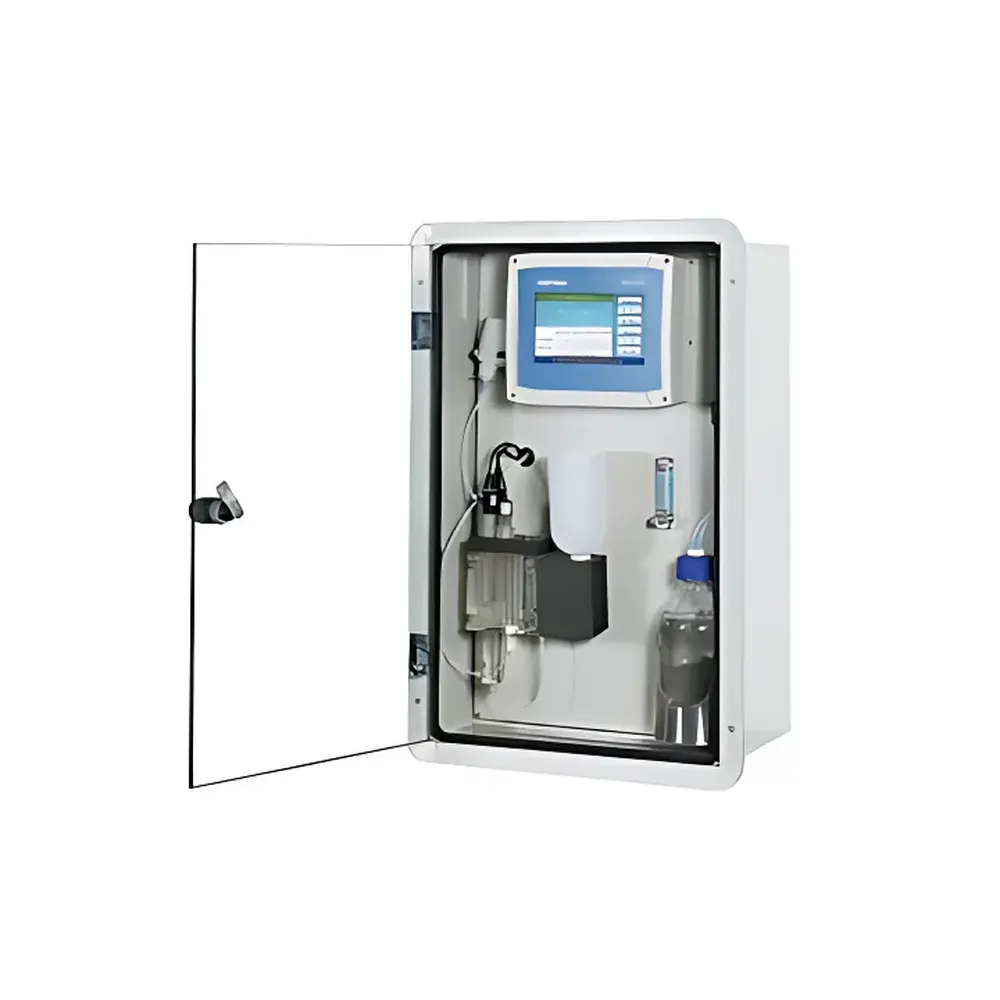
Timepower TP130 Multi-Channel Online Sodium Analyzer (1–4 Channels)
| Brand | Timepower |
|---|---|
| Origin | Beijing, China |
| Manufacturer Type | Direct Manufacturer |
| Product Origin | Domestic (China) |
| Model | TP130 |
| Pricing | Upon Request |
Overview
The Timepower TP130 Multi-Channel Online Sodium Analyzer is a precision electrochemical instrument engineered for continuous, real-time measurement of sodium ion activity (pNa), pH, and temperature in aqueous process streams. It operates on the Nernst principle—utilizing a selective sodium ion electrode whose potential shifts logarithmically with the activity of Na⁺ ions in solution. At 25 °C, the theoretical electrode slope is 59.16 mV per decade change in [Na⁺]; however, actual electrode performance varies due to membrane composition, hydration state, and interferences (e.g., H⁺, K⁺, NH₄⁺). The TP130 compensates for this through rigorous two-point calibration using certified standard solutions, enabling accurate quantification across an extended dynamic range. Designed for industrial reliability, it meets the operational demands of high-purity water monitoring in thermal power generation, chemical synthesis, pharmaceutical water-for-injection (WFI) systems, semiconductor ultrapure water (UPW) loops, and municipal drinking water treatment.
Key Features
- Configurable 1–4 independent measurement channels—enabling simultaneous monitoring of multiple sample points or redundant verification without hardware duplication.
- Sodium-selective composite electrode with optimized glass membrane formulation, delivering high selectivity (log KNa,H ≈ –4.5) and long-term stability under continuous flow conditions.
- Integrated triple-sensor architecture: pNa electrode + pH tri-combination electrode + PT1000 temperature sensor—ensuring automatic temperature compensation (0–60 °C) and cross-parameter correlation.
- 24-bit high-resolution analog-to-digital conversion with low-noise signal conditioning, achieving measurement repeatability ≤ ±1% of full scale and drift < ±0.02 pNa/24 h.
- 7.0-inch color TFT touchscreen interface with intuitive Chinese-language menu navigation—supporting guided calibration, alarm configuration, and historical data review.
- Robust industrial enclosure (IP65 front panel rating) with modular open-frame mounting design—facilitating rapid installation into control cabinets or wall-mounted panels (cutout: 670 × 410 mm).
- Non-volatile memory retains >10 years of calibration logs, event timestamps, and measured values—even during extended power loss.
Sample Compatibility & Compliance
The TP130 is validated for use with low-conductivity water matrices (typically < 1 µS/cm) where sodium contamination poses critical risk—such as boiler feedwater, condensate polishing loops, and clean steam generators. Sample requirements include flow rate 10–40 L/h, suspended solids < 5 µm (no colloidal content), and operating temperature 0–60 °C. It complies with fundamental metrological practices outlined in ISO/IEC 17025 for in-house calibration traceability and supports audit-ready documentation for GLP/GMP environments. While not FDA 21 CFR Part 11–certified out-of-the-box, its event-logged calibration history, user-accessible audit trail, and password-protected configuration align with ALCOA+ data integrity principles for regulated industries.
Software & Data Management
Data acquisition and system control are managed via embedded real-time OS with dual-mode output capability: isolated 4–20 mA (or 0–20 mA / 0–10 mA) analog signals for PLC/DCS integration, plus programmable relay outputs for high/low limit alarms and flow failure detection. All channel-specific events—including calibration timestamps, slope/offset validation results, and out-of-spec alerts—are timestamped and stored locally. Optional RS485 Modbus RTU communication enables centralized SCADA integration. No proprietary cloud platform or vendor-hosted software is required; raw data export is supported via USB flash drive in CSV format for offline analysis in Excel or LIMS environments.
Applications
- Power generation: Continuous sodium monitoring in turbine condensate and high-pressure boiler feedwater to prevent stress corrosion cracking (SCC) per ASTM D4582 and EPRI guidelines.
- Pharmaceutical manufacturing: Verification of sodium residuals in purified water (PW) and water-for-injection (WFI) distribution systems per USP and EU Annex 1.
- Chemical process control: Sodium tracking in caustic soda production, ion exchange regeneration cycles, and catalyst wash streams.
- Municipal water treatment: Final quality assurance of desalinated or softened water prior to distribution.
- Electronics-grade water: Monitoring sodium breakthrough in mixed-bed polisher effluent for semiconductor fab UPW specifications (SEMI F63).
FAQ
What is the minimum detectable sodium concentration?
The TP130 achieves a lower detection limit of 0.01 µg/L (equivalent to 9.36 pNa) under optimal calibration and low-interference conditions.
Is automatic temperature compensation (ATC) built-in?
Yes—integrated PT1000 sensor provides continuous ATC across 0–60 °C, applying the appropriate Nernst slope correction in real time.
Can the instrument perform single-point calibration?
No—two-point calibration using traceable standards (e.g., 200 µg/L and 20 µg/L Na⁺) is mandatory to determine both electrode slope and asymmetry potential.
What reagents are consumed during operation?
Only diisopropylamine (DIPA) is required as a pH suppressant to minimize hydrogen ion interference; typical consumption is ~1.5 L/month at standard flow rates.
Does the system support remote diagnostics or firmware updates?
Firmware updates are performed locally via USB; remote access is not enabled by default for cybersecurity compliance in industrial control networks.






