
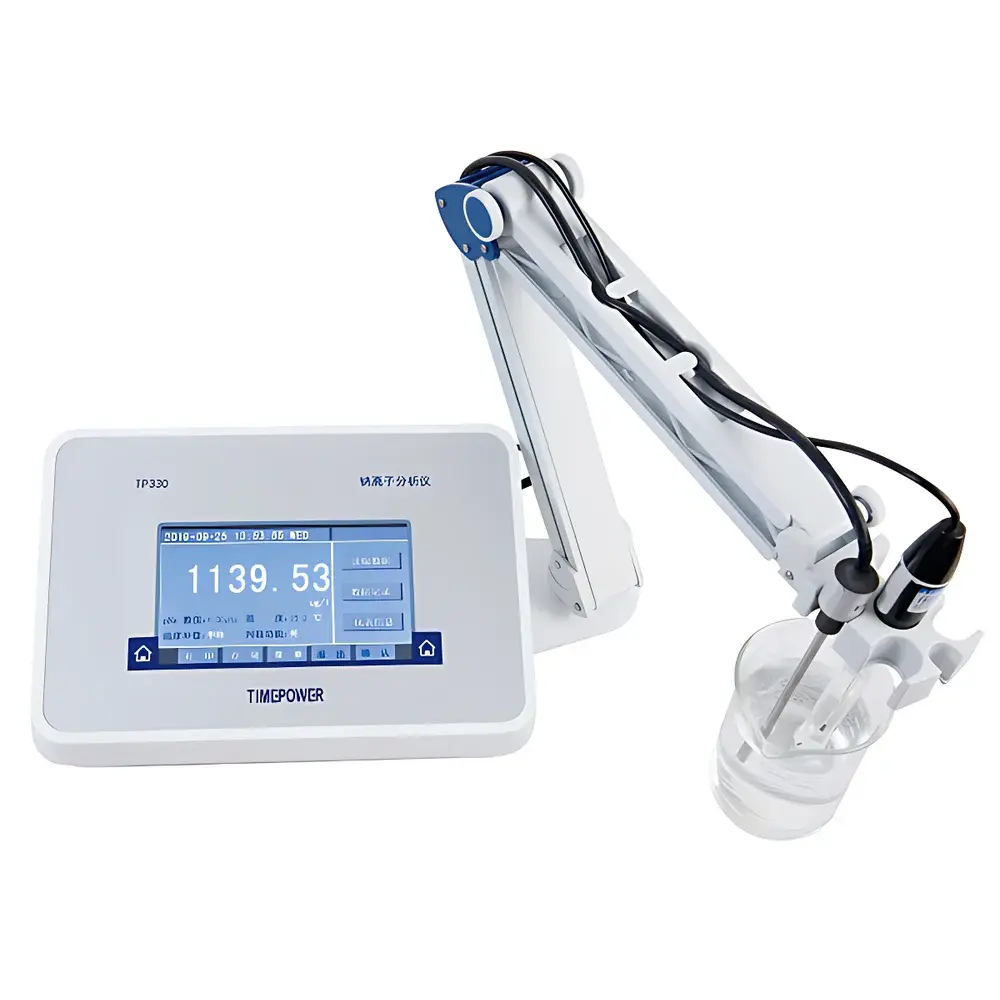
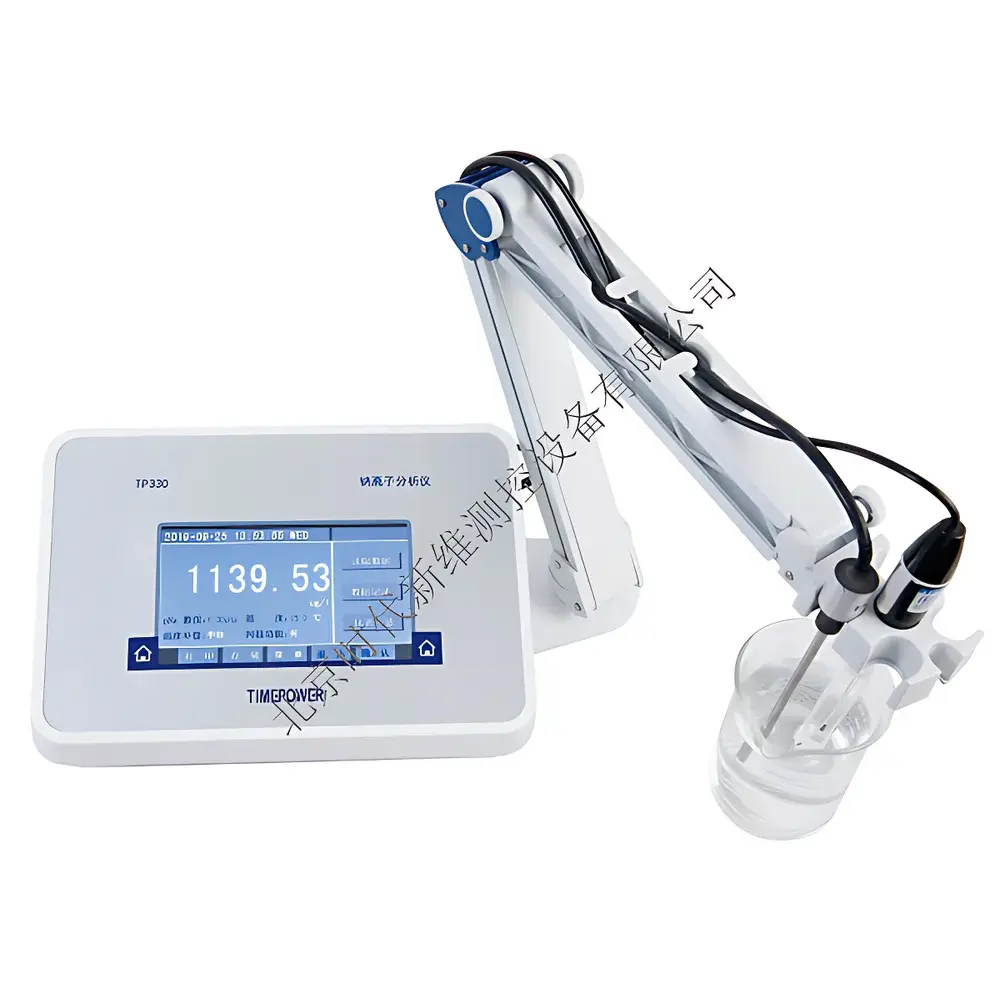
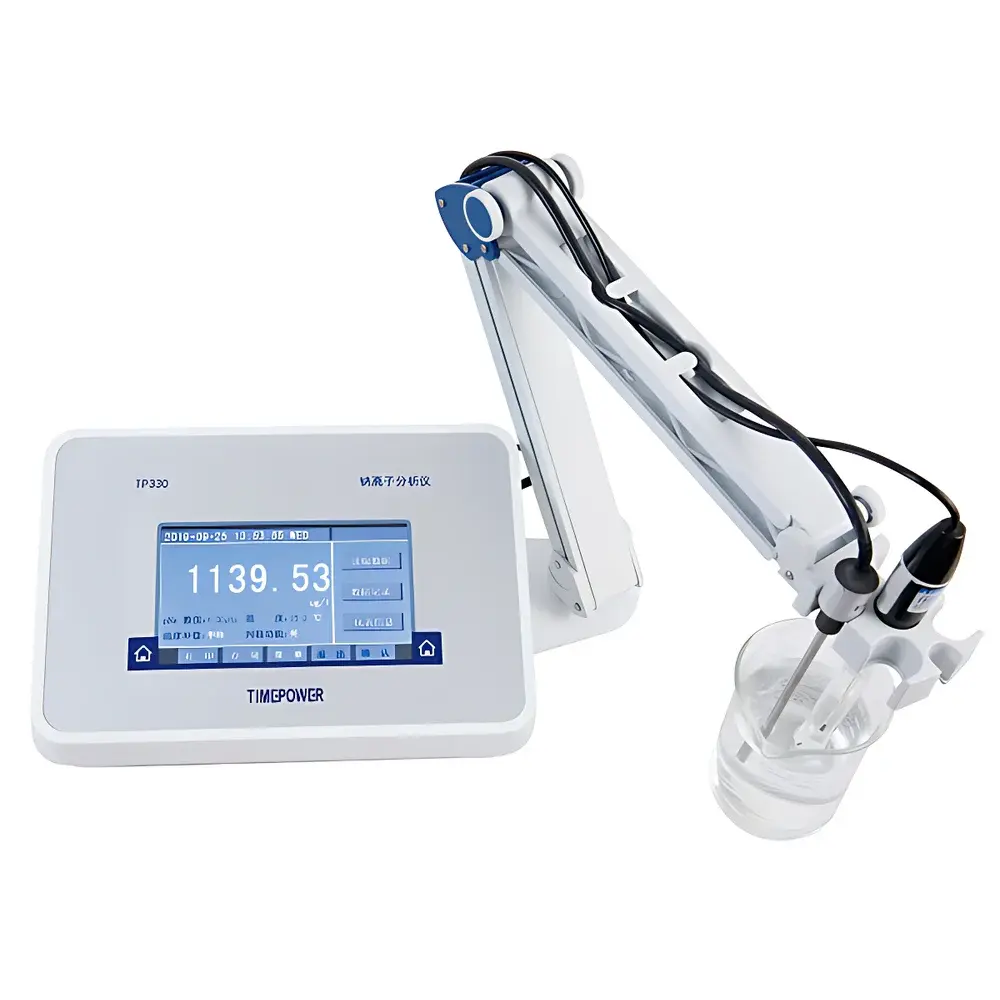
Timepower TP330 Laboratory Sodium Ion Analyzer
| Brand | Timepower |
|---|---|
| Origin | Beijing, China |
| Manufacturer Type | Manufacturer |
| Country of Origin | Domestic (China) |
| Model | TP330 Power Plant Sodium Ion Analyzer |
| Price | Upon Request |
Overview
The Timepower TP330 Laboratory Sodium Ion Analyzer is a benchtop potentiometric analyzer engineered for precise, trace-level sodium ion (Na⁺) quantification in aqueous samples. It operates on the fundamental principle of the Nernst equation, utilizing a solid-state or glass membrane sodium-selective electrode (ISE) to generate a millivolt potential proportional to the logarithm of sodium ion activity. At 25 °C, the theoretical electrode slope is 59.16 mV per decade change in Na⁺ concentration; however, real-world electrode performance deviates due to membrane composition, hydration state, and junction potential effects. The TP330 implements a two-point calibration protocol—using certified standard solutions—to empirically determine both the actual electrode slope and asymmetry potential (zero point), ensuring metrological traceability and measurement integrity across the full analytical range.
Key Features
- 5.0-inch capacitive touch color LCD with intuitive Chinese-language interface—designed for rapid method setup and real-time parameter monitoring.
- High-impedance input circuitry (≥1 × 10¹² Ω) optimized for low-current ISE signal acquisition, minimizing polarization errors and drift.
- 24-bit analog-to-digital conversion with programmable gain and offset compensation, delivering high-resolution pNa and µg/L readouts with ≤0.01 µg/L resolution.
- Integrated Pt1000 temperature sensor with automatic temperature compensation (ATC) across 0–60 °C, correcting for thermal dependence of electrode response per ISO 17025-compliant practice.
- Embedded microcontroller architecture featuring low-power consumption (<5 W), robust EMI shielding, and surface-mount technology (SMT) for long-term stability under laboratory conditions.
- Non-volatile memory with 10-year data retention (battery-backed or EEPROM-based), supporting cyclic storage of up to 1,000 measurement records with timestamp, sample ID, and calibration history.
Sample Compatibility & Compliance
The TP330 is validated for use with low-conductivity water matrices typical of power plant boiler feedwater, condensate, and ultra-pure process streams (e.g., pharmaceutical WFI, semiconductor rinse water). It complies with GB 12156–89 “Methods for analysis of boiler and cooling water—Determination of sodium—Static method”, aligning with international practices referenced in ASTM D4582–20 (Standard Practice for Measuring Sodium in High-Purity Water) and IEC 62321-7-2 (for low-level cation analysis in environmental and industrial waters). While not FDA 21 CFR Part 11–certified out-of-the-box, its audit-trail-capable data logging supports GLP/GMP documentation workflows when deployed with controlled procedures and electronic signature protocols.
Software & Data Management
The instrument operates autonomously without PC dependency; all calibration, measurement, and data review functions are executed via the onboard GUI. Calibration data—including standard concentrations, measured mV values, calculated slope (%Nernst), and zero offset—is stored with metadata (date/time, operator ID if assigned). Measurement records include pNa, µg/L, temperature, electrode impedance status, and pass/fail flags based on user-defined acceptance criteria (e.g., slope tolerance ±3% of theoretical). Export is limited to manual screen capture or USB-stick transfer of CSV-formatted logs—no proprietary software or cloud sync is required or supported, preserving data sovereignty and simplifying IT validation.
Applications
- Power generation: Monitoring sodium breakthrough in mixed-bed demineralizers and steam cycle purity control per IAPWS TR-1001 guidelines.
- Pharmaceutical manufacturing: Verifying sodium residuals in purified water (PW) and water-for-injection (WFI) systems per USP and EP 2.2.38.
- Microelectronics: Quantifying Na⁺ contamination in ultrapure rinse water where sub-ppq levels impact wafer yield.
- Environmental labs: Analyzing sodium in low-TDS natural waters and effluents where alkalinity interference is minimized by pH adjustment and ionic strength buffering.
- Academic research: Teaching potentiometric principles, ISE selectivity coefficients, and error propagation in trace ion analysis.
FAQ
What is the minimum detectable sodium concentration?
The instrument achieves a lower limit of quantitation (LLOQ) of 0.01 µg/L (equivalent to ~4.3 pNa) under optimal conditions—requiring clean electrodes, degassed standards, and proper sample conditioning (e.g., addition of ionic strength adjuster).
Can the TP330 measure sodium in high-salinity samples like seawater?
No. Its design targets trace sodium (0.01 µg/L–23 g/L) in low-ionic-strength matrices. Direct analysis of seawater (>10,000 mg/L Na⁺) would saturate the electrode and violate the linear Nernstian region; dilution and matrix-matching are mandatory.
Is electrode maintenance documented in the user manual?
Yes. The manual specifies cleaning protocols for glass membrane fouling (e.g., dilute HCl soak for silicate deposits, EDTA for calcium scaling), storage conditions (3 M KCl solution), and performance verification using slope checks before each analytical batch.
Does the analyzer support multi-point calibration?
It implements only two-point calibration (low/high standards) per GB 12156–89 and standard ISE practice; multi-point calibration is neither required nor supported, as nonlinearity in the working range is negligible within ±0.03 pNa accuracy.
What safety certifications does the unit carry?
It conforms to GB 4793.1–2018 (IEC 61010-1) for electrical safety in laboratory equipment, including dielectric strength testing, creepage/clearance compliance, and overcurrent protection—certified by CNAS-accredited Chinese laboratories.





