
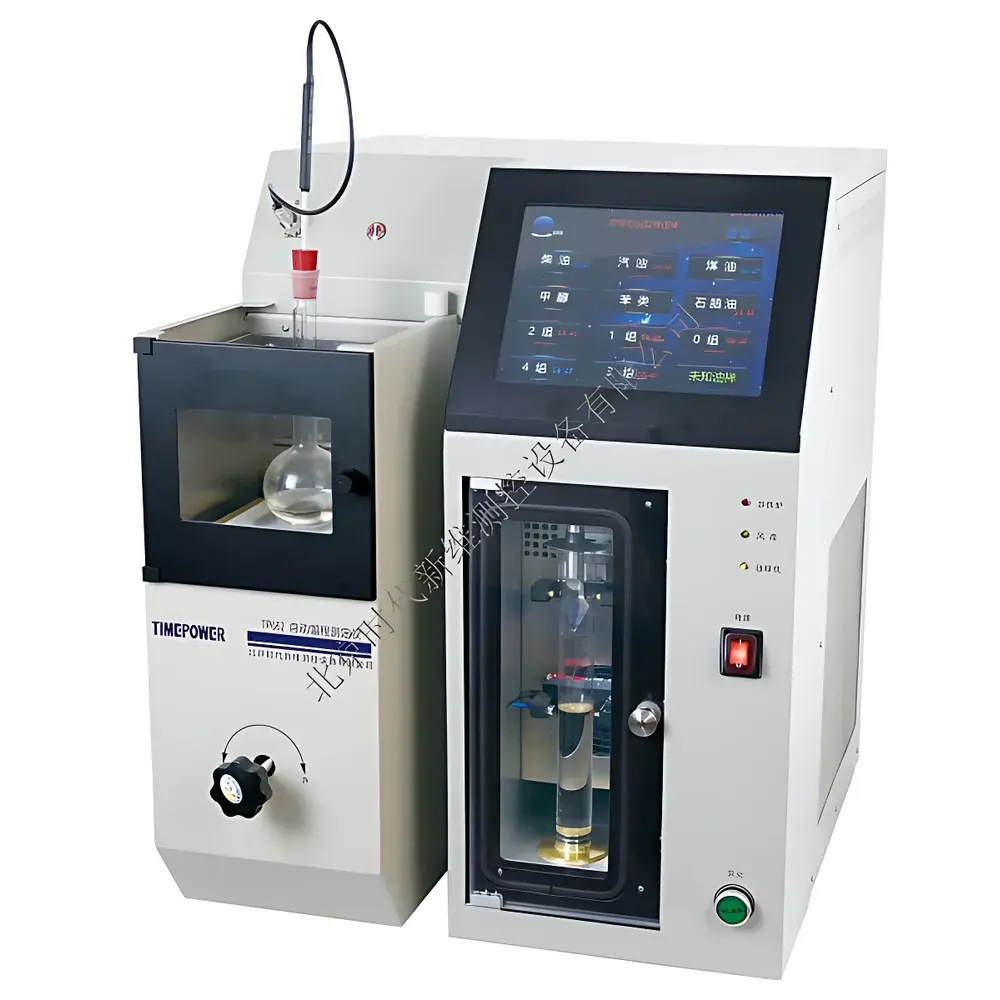
TimePower TP662 Automated Distillation Apparatus for Petroleum Products
| Brand | TimePower |
|---|---|
| Origin | Beijing, China |
| Manufacturer | TimePower Co., Ltd. |
| Model | TP662 |
| Temperature Range | 0–400 °C |
| Temperature Accuracy | ±0.1 °C |
| Cold Bath Temperature Range | 0–60 °C |
| Distillation Rate | 1–11 mL/min |
| Volume Measurement Range | 1–111 mL |
| Volume Resolution | 0.1 mL |
Overview
The TimePower TP662 Automated Distillation Apparatus is a fully integrated, microprocessor-controlled instrument engineered for precise determination of distillation characteristics in petroleum products and volatile organic liquids according to standardized test methods including ASTM D86, ASTM D1078, ISO 3405, IP 123, and GB/T 6536. It implements a closed-loop control architecture based on real-time feedback from high-stability Pt100 temperature sensors and optical volume tracking, enabling reproducible measurement of initial boiling point (IBP), final boiling point (FBP), and intermediate recovery percentages (e.g., 10%, 50%, 90% recovered) under controlled heating and condensation conditions. The system conforms to the fundamental principles of atmospheric distillation—where sample vaporization, fraction condensation, and volumetric collection occur under regulated thermal gradients and ambient pressure compensation—ensuring traceable, auditable, and method-compliant results required for refinery QC, fuel certification, and regulatory submissions.
Key Features
- 10.4-inch high-resolution color touchscreen interface with intuitive graphical workflow navigation and real-time parameter visualization.
- Imported optoelectronic liquid-level tracking system (Germany-sourced sensor module) delivering ±0.1 mL volumetric accuracy across the full 1–111 mL measurement range.
- Danfoss (Secop) hermetic compressor-based cold bath system, maintaining stable condenser temperatures between 0 °C and 60 °C with rapid thermal response and low noise operation.
- Automated barometric pressure sensing and real-time correction to standard atmospheric pressure (101.3 kPa), ensuring temperature data compliance with ASTM D86 Annex A1 and ISO 3405 Clause 7.3.
- Programmable endpoint logic: test termination configurable by either steam temperature threshold or cumulative recovered volume, supporting both specification-driven and method-flexible workflows.
- Integrated safety subsystem including manual nitrogen purge activation for emergency flame suppression, mitigating thermal runaway risk during high-boiling or unstable feedstock analysis.
- Pt100 Class A temperature sensors (imported from Germany) calibrated to NIST-traceable standards, providing 0.1 °C resolution and long-term drift stability over extended operational cycles.
Sample Compatibility & Compliance
The TP662 is validated for use with gasoline, aviation gasoline, jet fuels (Jet A-1, JP-8), naphthas, kerosene, diesel fuels, solvent naphthas, and industrial organic solvents exhibiting initial boiling points above 30 °C and final boiling points up to 400 °C. Its mechanical design accommodates standard ASTM D86 glassware assemblies (125 mL flask, 100 mL graduated cylinder, thermometer well) and supports optional carbon-silicon heating plates for uniform thermal distribution. All electronic and thermal subsystems meet IEC 61010-1:2010 safety requirements for laboratory equipment. Data integrity functions—including timestamped result logs, operator ID entry, and parameter audit trails—are structured to support GLP and GMP environments aligned with FDA 21 CFR Part 11 expectations for electronic records and signatures.
Software & Data Management
Embedded firmware enables standalone operation without external PC dependency. All test parameters (heating rate profile, cold bath setpoint, recovery volume trigger, atmospheric correction offset) are stored in non-volatile memory with version-stamped configuration backups. Real-time plots of temperature vs. recovered volume are displayed during analysis and exportable via USB to CSV or PDF formats. Each report includes instrument ID, calibration status, ambient pressure reading, operator annotation field, and digital signature placeholder. Optional Ethernet connectivity (via RS-485/Modbus RTU or TCP/IP gateway) permits integration into LIMS or centralized QA dashboards for automated data ingestion and statistical process control (SPC) charting.
Applications
- Refinery quality assurance: monitoring cut-point consistency in crude distillation units and hydrotreater product streams.
- Fuel certification testing per ASTM D4814 (gasoline), ASTM D1655 (jet fuel), and EN 590 (diesel).
- Raw material verification for chemical manufacturing—assessing volatility profiles of solvents such as toluene, xylene, and acetone.
- Research and development of alternative fuels, including bio-blends and synthetic hydrocarbons, where distillation curve shape correlates with combustion behavior and emissions performance.
- Regulatory compliance reporting for EPA, CE marking, and national petroleum standards authorities requiring documented distillation curves with metrological traceability.
FAQ
Does the TP662 comply with ASTM D86 and ISO 3405?
Yes—the instrument’s thermal ramp control, condenser temperature regulation, and volume measurement algorithms are specifically implemented to satisfy the procedural requirements and precision criteria outlined in both standards.
Can the system operate without a connected PC?
Yes—full test execution, data logging, and report generation are performed autonomously using the onboard processor and touchscreen interface.
What maintenance is required for the optical volume sensor?
The imported photodetector module requires only periodic cleaning of the optical window with lint-free cloth and isotope-grade alcohol; no recalibration is needed under normal operating conditions.
Is atmospheric pressure compensation mandatory for compliant testing?
Yes—ASTM D86 Section 7.3 and ISO 3405 Clause 7.3 explicitly require correction of observed temperatures to 101.3 kPa; the TP662 performs this automatically using its integrated barometer.
How is data integrity ensured for audit purposes?
All test records include immutable timestamps, operator identification, calibration certificate references, and parameter change logs—structured to satisfy GLP documentation requirements and facilitate FDA or ISO 17025 laboratory accreditation audits.






