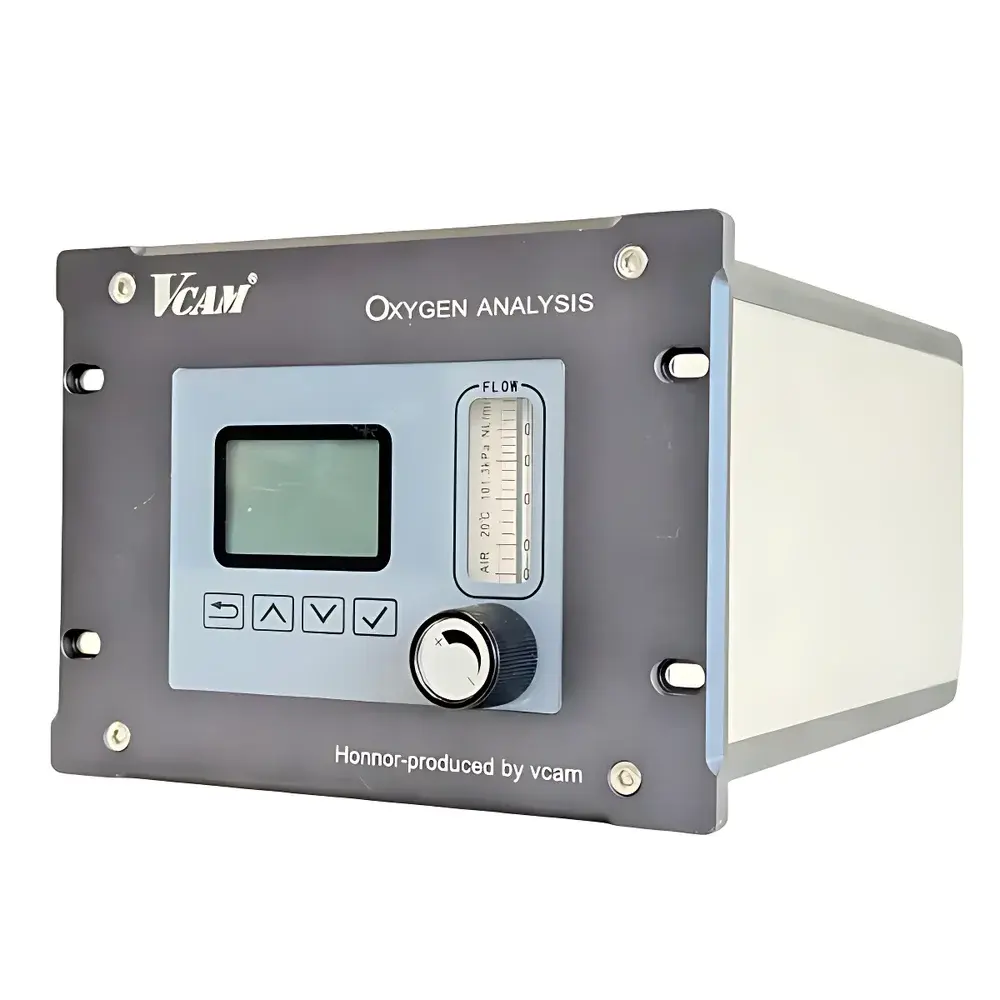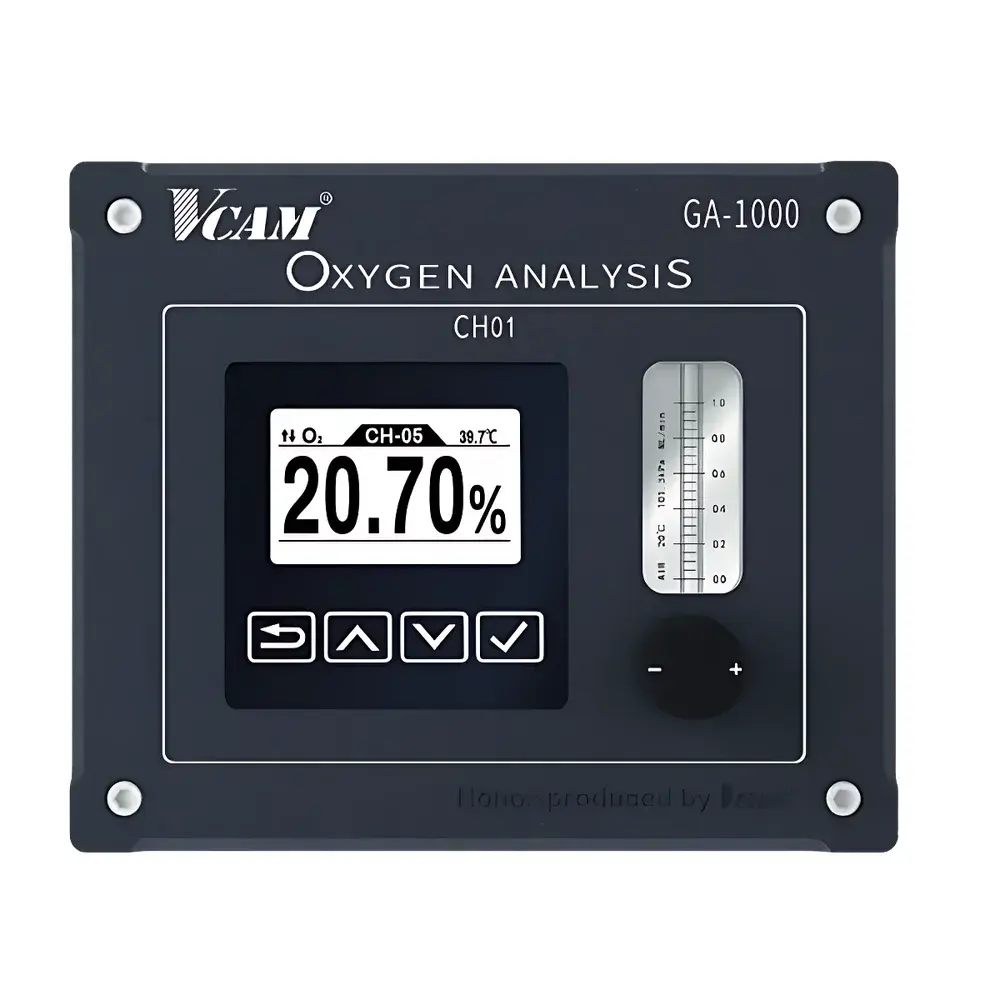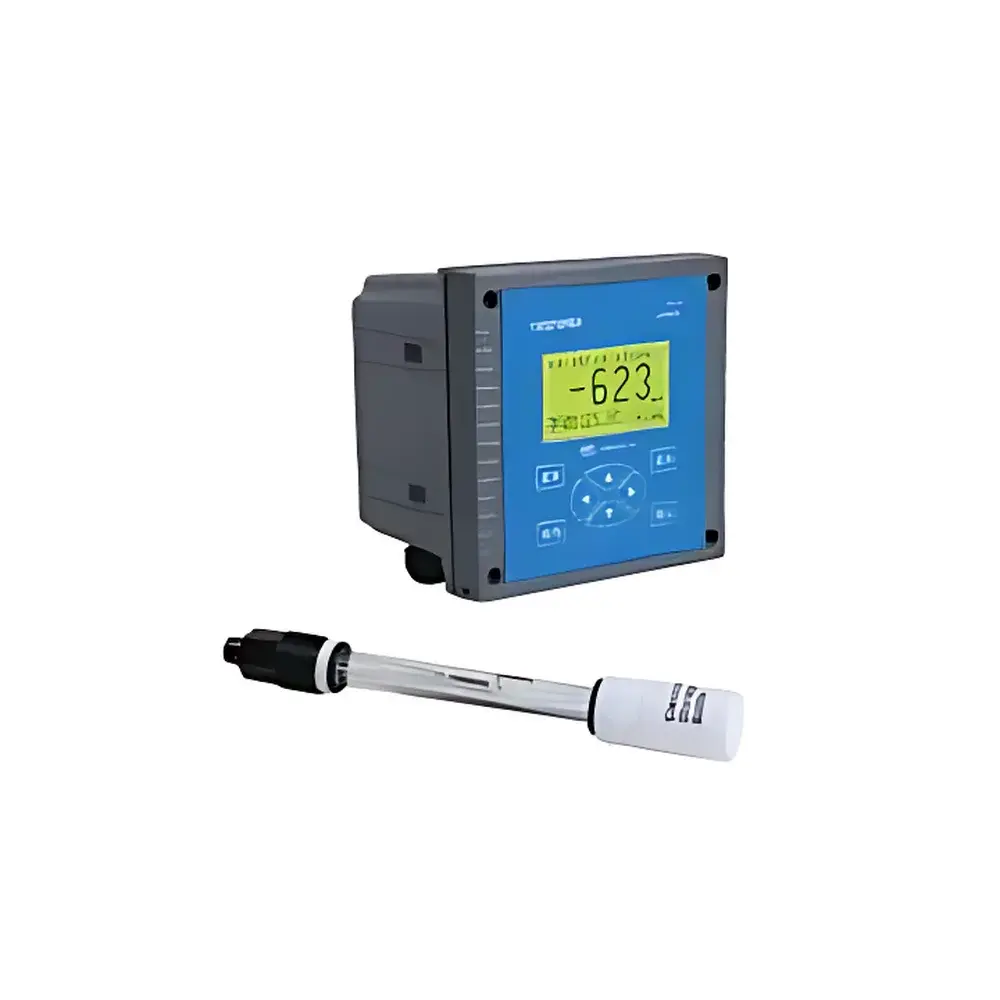
TimePower TP110 Online pH Analyzer
| Brand | TimePower |
|---|---|
| Model | TP110 |
| Measurement Principle | Potentiometric (Electrochemical Cell) |
| pH Range | 0.00–14.00 pH |
| Accuracy | ±0.02 pH |
| Resolution | 0.01 pH |
| Temperature Compensation | Pt1000 sensor, 0–60 °C |
| Sample Temp. | 5–60 °C |
| Max. Sample Pressure | < 0.6 MPa |
| Output Signals | 4–20 mA / 0–20 mA / 0–10 mA (isolated, load < 300 Ω) |
| Relay Outputs | 2 SPST (AC220 V / DC30 V, 3 A) |
| Display | 128×64 dot-matrix LCD, Chinese interface |
| Data Storage | Cyclic memory with >10-year power-loss retention |
| Enclosure Rating | IP65 |
| Power Supply | AC 85–265 V, 45–65 Hz |
| Power Consumption | ≤15 W |
| Dimensions (H×W×D) | 145×120×150 mm |
| Panel Cutout | 138×138 mm |
| Weight | 0.64 kg |
| Operating Ambient | 5–45 °C, ≤90% RH (non-condensing) |
| Storage Temp. | −25–55 °C |
| Electrode Options | Tri-combined pH electrodes for ultrapure water, general-purpose water, wastewater, flat-surface mounting, and sterilizable high-temp applications |
| Mounting Options | Panel-mount (flush), wall-mount, rack-mount, flow-through, immersion, flanged, or custom-engineered configurations |
Overview
The TimePower TP110 Online pH Analyzer is an industrial-grade potentiometric measurement system engineered for continuous, real-time monitoring of hydrogen ion activity in aqueous process streams. It operates on the fundamental Nernst equation principle: the measured electromotive force (EMF) generated between a pH-sensitive glass indicator electrode and a stable reference electrode—immersed in the sample—is directly proportional to the logarithm of hydrogen ion activity. This electrochemical cell configuration enables precise conversion of chemical potential into a quantifiable voltage signal, which the analyzer digitizes and compensates for temperature-dependent drift using an integrated Pt1000 sensor. Designed for deployment in demanding environments—including power plant feedwater systems, pharmaceutical purified water loops, municipal wastewater treatment basins, and chemical process lines—the TP110 delivers metrologically traceable pH data compliant with routine operational requirements under ISO/IEC 17025-informed quality frameworks.
Key Features
- Potentiometric measurement architecture with tri-combined pH electrode compatibility—optimized for low-conductivity ultrapure water, high-ionic-strength wastewater, and thermally challenging sterilization cycles.
- High-stability analog front-end featuring 24-bit A/D conversion and precision low-drift amplification, ensuring long-term baseline integrity and repeatability better than 1% RSD.
- Embedded microcontroller platform with ultra-low-power consumption (<15 W) and robust electromagnetic interference (EMI) immunity per IEC 61326-1 Class A specifications.
- IP65-rated enclosure with corrosion-resistant housing, enabling reliable operation in humid, chemically aggressive, or outdoor-mounted installations.
- Configurable dual relay outputs supporting fail-safe alarm logic (e.g., high/low pH thresholds, sensor fault, temperature out-of-range), programmable via intuitive Chinese-language menu navigation.
- Non-volatile cyclic data logging with automatic overwrite management; retains calibration history, timestamped measurements, and event logs for ≥10 years without auxiliary power.
Sample Compatibility & Compliance
The TP110 accommodates a broad spectrum of liquid media across industrial verticals: boiler feedwater (conductivity ≥0.1 µS/cm), reverse osmosis permeate, activated sludge effluent, bioreactor broth, and clean-in-place (CIP) rinse solutions. Its tri-combined electrode variants include specialized junctions and reference electrolytes engineered to minimize clogging, liquid junction potential drift, and KCl leaching—critical for sustained accuracy in low-ionic-strength or suspended-solid-laden matrices. While not certified to FDA 21 CFR Part 11 out-of-the-box, the device supports audit-ready operation when integrated with validated SCADA or DCS platforms that implement electronic signature and change-control protocols. It meets general requirements for GLP/GMP-aligned environmental monitoring per USP and ASTM D1293 for field-deployed pH instrumentation.
Software & Data Management
The TP110 operates as a standalone transmitter with no external software dependency. All configuration—including calibration slope/offset, temperature compensation mode (automatic/manual), output scaling, relay hysteresis, and display contrast—is performed locally via membrane keypad and 128×64 graphical LCD. Calibration routines support single-point (asymmetric) or two-point (symmetric) procedures using NIST-traceable buffer standards (pH 4.01, 7.00, 10.01). Logged data—accessible via scroll navigation—includes date/time stamps, raw mV readings, compensated pH values, temperature, and calibration status flags. For enterprise integration, the isolated 4–20 mA analog output interfaces seamlessly with PLCs, DCS historians, or cloud-based IIoT gateways supporting Modbus RTU (optional add-on module).
Applications
- Power generation: Continuous pH monitoring of condensate polishers, demineralizer effluent, and steam cycle chemistry control points.
- Pharmaceutical manufacturing: USP -compliant conductivity-pH correlation in purified water (PW) and water for injection (WFI) distribution loops.
- Municipal wastewater: Real-time feedback control of lime dosing in neutralization basins and biological nutrient removal (BNR) systems.
- Food & beverage processing: In-line verification of CIP solution concentration and post-rinse neutrality prior to product contact surfaces.
- Chemical synthesis: Reaction endpoint detection in acid/base titration-controlled batch processes and continuous hydrolysis reactors.
- Electroplating: Bath pH stabilization to maintain metal ion solubility and deposit uniformity in nickel, copper, and chromium plating lines.
FAQ
What electrode types are compatible with the TP110?
The analyzer supports multiple tri-combined pH electrodes—including low-resistance glass membranes for ultrapure water, double-junction designs for aggressive wastewater, flat-surface sensors for tank lids, and autoclavable variants rated to 135 °C.
Does the TP110 support automatic temperature compensation?
Yes—it integrates a Pt1000 RTD sensor and applies ISO 7027-compliant Nernstian temperature correction across 0–60 °C.
Can the device be mounted in hazardous areas?
No—the TP110 is rated for general-purpose use (IP65) and is not intrinsically safe or explosion-proof; hazardous area deployment requires external barrier systems and zone-specific certification.
Is calibration data exportable?
Calibration records are stored internally and viewable on-screen but are not exportable via USB or network; external data acquisition requires analog signal sampling or optional Modbus RTU interface.
What is the recommended calibration frequency?
Per ISO 5725-2 and typical industry practice, daily verification with one buffer is advised for critical applications; full two-point calibration is recommended weekly or after electrode replacement or process upset.