
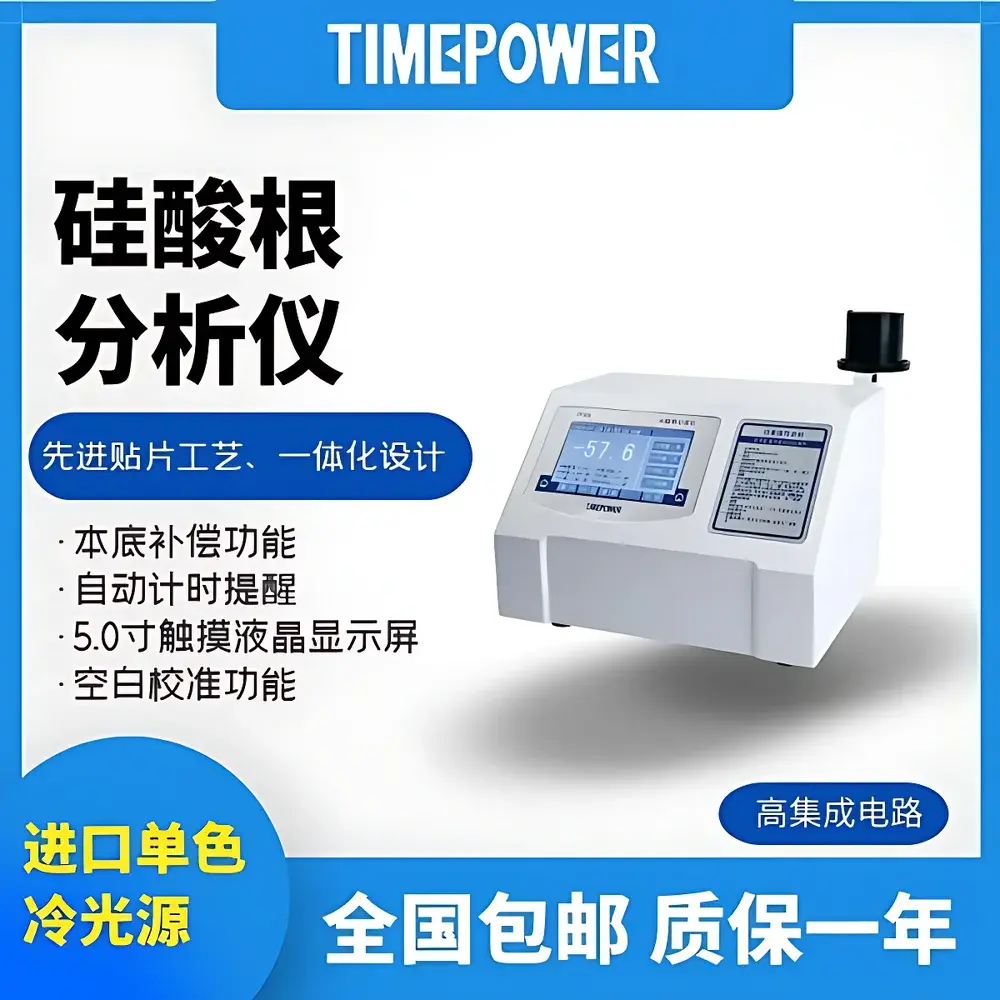
TimePower TP-306 Laboratory Silica Analyzer
| Brand | TimePower |
|---|---|
| Origin | Beijing, China |
| Manufacturer Type | Direct Manufacturer |
| Instrument Type | Benchtop Laboratory Analyzer |
| Model | TP-306 |
| Measurement Principle | Molybdenum Blue Colorimetric Method (Silicomolybdic Acid Reduction) |
| Display | 5.0-inch TFT color touchscreen with Chinese UI |
| Optical Source | Imported monochromatic cold-light LED source |
| Detection Range | Typical for soluble silica (SiO₂) in ultra-pure water (0–200 µg/L, configurable) |
| Calibration | Automatic blank calibration with zero-drift compensation |
| Data Storage | Cyclic memory for ≤256 measurement records |
| Power Supply | AC 220 V ±10%, 50/60 Hz |
| Compliance | Designed to support ISO 10523, ASTM D859, and GB/T 12149 (Chinese national standard for silica in boiler feedwater) |
Overview
The TimePower TP-306 Laboratory Silica Analyzer is a dedicated benchtop photometric instrument engineered for the precise quantification of dissolved silica—expressed as silicon dioxide (SiO₂)—in ultrapure water matrices. It operates on the internationally standardized molybdenum blue colorimetric method (also known as the silicomolybdic acid reduction assay), wherein orthosilicic acid reacts with ammonium molybdate under acidic conditions to form a yellow heteropolyacid complex, which is subsequently reduced to an intense blue chromophore proportional to silica concentration. This method is widely accepted in power generation, semiconductor manufacturing, pharmaceutical water systems, and high-purity process industries where sub-ppb to low-ppb silica control is critical to prevent deposition, scaling, and turbine blade fouling. The TP-306 is not intended for field or online deployment; it is strictly optimized for controlled laboratory environments requiring repeatable, trace-level analysis of steam condensate, demineralized feedwater, boiler water, and ultrapure water (UPW) used in wafer cleaning or injection processes.
Key Features
- 5.0-inch high-resolution TFT color touchscreen interface with intuitive Chinese-language navigation—designed for rapid method selection, calibration initiation, and result review without external PC dependency.
- Integrated optical architecture featuring an imported monochromatic cold-light LED source: delivers stable photometric output over extended operation cycles, minimizes thermal drift, and ensures long-term spectral consistency (peak wavelength centered at ~815 nm for optimal molybdenum blue absorbance).
- Dedicated baseline compensation algorithm that dynamically corrects for reagent blank variability and cuvette-specific light path deviations—critical for maintaining accuracy below 5 µg/L SiO₂.
- Automated timing sequence for digestion, reduction, and measurement phases—eliminates manual stopwatch reliance and reduces inter-operator variability in reaction kinetics.
- Onboard blank calibration routine that nullifies electronic zero drift and photodetector offset prior to each analytical batch—enhancing day-to-day reproducibility across multi-shift operations.
- Robust PCB layout utilizing surface-mount technology (SMT) and modular circuit isolation—engineered for electromagnetic compatibility (EMC) resilience in shared lab infrastructure with variable power quality.
Sample Compatibility & Compliance
The TP-306 accepts standard 10-mm rectangular quartz or high-transmittance optical glass cuvettes (10 × 10 × 45 mm). It supports sample volumes of 25–30 mL per analysis and accommodates matrix-matched calibration standards prepared from NIST-traceable silica reference materials (e.g., NIST SRM 2057 or equivalent). While the instrument itself does not carry CE or UKCA marking, its operational methodology aligns with ASTM D859-22 (“Standard Test Method for Silica in Water”) and ISO 10523:2022 (“Water quality — Determination of pH”), and it satisfies the procedural requirements of GB/T 12149-2019 (“Industrial circulating cooling water and boiler water — Determination of silica”). For regulated environments (e.g., pharmaceutical Grade A/B water systems), users may integrate TP-306-generated data into validated LIMS workflows compliant with FDA 21 CFR Part 11 when paired with external audit-trail-enabled software.
Software & Data Management
All measurement data—including date/time stamp, operator ID (manually entered), calibration status, raw absorbance values, and final SiO₂ concentration—are stored locally in non-volatile flash memory. The cyclic buffer retains up to 256 entries; overflow triggers automatic overwrite of the oldest record without user prompt. Export is limited to manual screen capture or USB-stick-assisted transfer of CSV-formatted logs (no built-in Bluetooth/Wi-Fi). No proprietary desktop application is bundled; however, the device’s ASCII-based serial output (RS-232, 9600 bps) enables integration with third-party SCADA or ELN platforms via simple terminal emulation or custom Python scripts. Audit trail integrity is maintained through immutable timestamping and absence of post-hoc data editing capability.
Applications
- Thermal power plants: Monitoring silica breakthrough in mixed-bed ion exchange effluent and condensate polishing loops to prevent superheater tube deposition.
- Semiconductor fabs: Verifying UPW compliance prior to wafer rinsing baths (ASTM F631-21) where silica >0.5 ppb risks particle adhesion and gate oxide defects.
- Pharmaceutical water systems: Supporting USP and EU GMP Annex 1 requirements for purified water and water-for-injection (WFI) silica specification verification (typically ≤100 µg/L).
- Chemical process streams: Quantifying silica leaching from catalyst supports or silica gel desiccants in fine chemical synthesis lines.
- R&D laboratories: Method development for silica speciation studies using sequential extraction protocols coupled with TP-306 endpoint detection.
FAQ
What is the lower limit of quantitation (LLOQ) for the TP-306 under typical operating conditions?
The practical LLOQ is 1.0 µg/L SiO₂ when using fresh reagents, calibrated cuvettes, and strict adherence to the 15-minute color development protocol specified in ASTM D859.
Can the TP-306 measure total reactive silica (TRS) and particulate silica separately?
No. The TP-306 measures only filterable (dissolved) reactive silica after 0.45-µm membrane filtration. Particulate or colloidal silica requires separate acid digestion pretreatment not supported by this platform.
Is the instrument compatible with international calibration standards such as NIST SRM 2057?
Yes—users may prepare working standards directly from NIST SRM 2057 or equivalent certified reference materials following ISO Guide 35 protocols.
Does the TP-306 support GLP-compliant electronic signatures or user access levels?
No. It lacks role-based authentication or digital signature functionality. GLP compliance must be achieved externally via procedural controls and manual logbook linkage.
What maintenance intervals are recommended for the optical system?
LED source lifetime exceeds 50,000 hours; annual verification of photometric linearity using neutral density filters is advised per ISO/IEC 17025 internal quality assurance guidelines.
Related Products







