
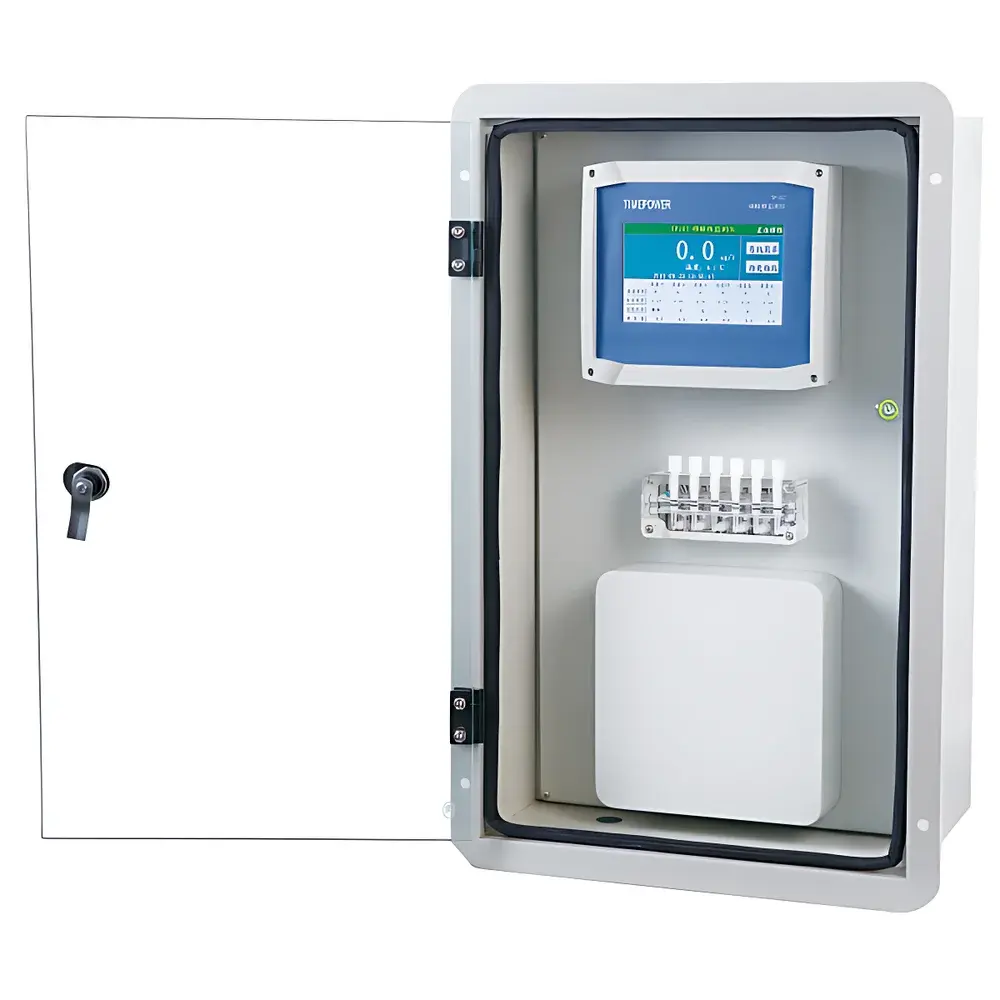
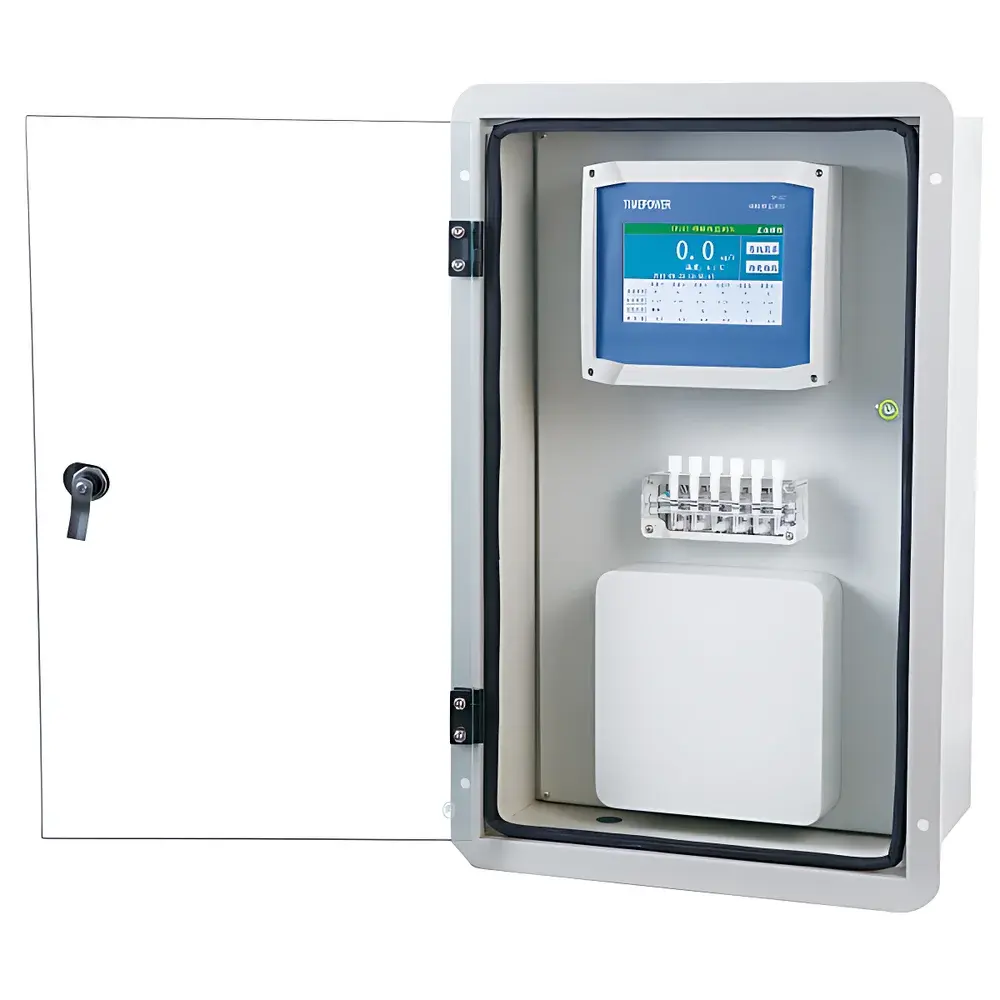
TimePower TP107 Online Phosphate Analyzer
| Brand | TimePower |
|---|---|
| Origin | Beijing, China |
| Manufacturer Type | Manufacturer |
| Regional Classification | Domestic (China) |
| Model | TP107 |
| Instrument Type | Online Analyzer |
| Pricing | Upon Request |
Overview
The TimePower TP107 Online Phosphate Analyzer is a dedicated photometric analyzer engineered for continuous, real-time quantification of orthophosphate (PO₄³⁻) in aqueous process streams. It operates on the phosphomolybdenum yellow colorimetric method—where phosphate ions in acidic medium react with ammonium metavanadate and ammonium molybdate to form a stable yellow heteropoly acid complex (phosphovanadomolybdate). Absorbance of this complex is measured at a fixed wavelength (typically ~400–420 nm) using a monochromatic cold light source. Quantification follows the Lambert-Beer law, establishing a linear relationship between absorbance and phosphate concentration within the calibrated range. Designed for industrial water quality management, the TP107 meets the analytical requirements of GB/T 6913–2008 (“Methods for analysis of boiler water and cooling water — Determination of phosphate”), and its measurement architecture supports long-term unattended operation in demanding thermal power, chemical, fertilizer, metallurgical, municipal water, and pharmaceutical applications.
Key Features
- Modular multi-channel configuration: 1 to 6 independent measurement channels housed in a single chassis—enabling cost-effective monitoring of multiple sample points without redundant instrumentation.
- High-reliability fluidic system: Equipped with imported precision solenoid valves ensuring accurate reagent dosing, consistent sample aspiration, and minimal carryover—critical for maintaining ±2% F.S. measurement accuracy over extended cycles.
- Automated calibration protocol: Supports user-defined periodic two-point standard calibration (zero and span), reducing manual intervention and preserving measurement integrity across weeks of continuous operation.
- Dual-mode optical detection: Features a stable, long-life monochromatic cold light source and high-sensitivity photodiode detector—delivering excellent signal-to-noise ratio and drift stability of ≤±1% F.S. per 24 hours.
- Integrated data logging: Stores up to 30 days of timestamped measurement records (including channel-specific values, calibration logs, alarm events, and system diagnostics) for traceability and root-cause analysis.
- Flexible analog output: Provides isolated 0–20 mA, 4–20 mA, or 0–10 mA current outputs per channel—fully programmable for seamless integration with DCS, PLC, or automated chemical dosing systems.
- Human-centric HMI: 7-inch full-color TFT-LCD touchscreen with intuitive Chinese interface; displays real-time concentration curves, historical trends, and status indicators simultaneously in differentiated color coding.
Sample Compatibility & Compliance
The TP107 is validated for use with clarified liquid samples meeting defined physical specifications: flow rate 10–40 L/h, temperature 5–50 °C, suspended solids <5 µm, and absence of colloidal or viscous interferences. It complies with national standard GB/T 6913–2008 for phosphate determination in boiler and cooling water systems. While not certified to ISO/IEC 17025 or ASTM D859, its design principles—including reagent blank compensation, temperature-compensated photometry, and closed-loop flow control—align with GLP-aligned operational practices. The instrument’s mechanical construction (IP54-rated enclosure), electrical isolation, and fail-safe alarm logic (flow loss, upper/lower limit, reagent depletion) support deployment in industrial environments requiring functional safety and regulatory audit readiness.
Software & Data Management
Data acquisition and system control are managed via embedded firmware with non-volatile memory. All measurement data, calibration timestamps, alarm triggers, and maintenance logs are stored locally with automatic time-stamping and channel tagging. Export is supported via USB interface for offline review in CSV format. The system does not include remote connectivity (e.g., Ethernet, Modbus TCP) or cloud-based platforms by default; however, analog outputs and discrete relay alarms provide interoperability with third-party SCADA or MES systems. Audit trails meet basic GLP documentation requirements, including operator-initiated calibrations and parameter changes—though it does not implement FDA 21 CFR Part 11 electronic signature functionality.
Applications
- Thermal power plants: Continuous monitoring of phosphate residual in boiler feedwater and condensate polishing loops to prevent scale formation and maintain alkalinity control.
- Chemical & fertilizer manufacturing: Process stream surveillance during phosphoric acid production, phosphate salt synthesis, and wastewater effluent compliance reporting.
- Municipal water treatment: Tracking orthophosphate levels in finished drinking water and tertiary-treated wastewater prior to discharge—supporting nutrient load reduction initiatives.
- Pharmaceutical & biotech utilities: Monitoring phosphate in purified water (PW) and water-for-injection (WFI) distribution loops where low-level phosphate may indicate membrane degradation or biofilm activity.
- Industrial cooling towers: Optimizing phosphate-based corrosion inhibitor dosing while avoiding excessive residual that promotes microbiological growth.
FAQ
What measurement principle does the TP107 employ?
It uses the phosphomolybdenum yellow colorimetric method, followed by photometric absorbance measurement at ~410 nm, in accordance with GB/T 6913–2008.
Is the TP107 suitable for turbid or particulate-laden samples?
No—samples must be pre-filtered to remove solids >5 µm and colloidal material; inline filtration is recommended for continuous operation.
Can the instrument operate unattended for extended periods?
Yes—its automated calibration, low reagent consumption (~3 L/month), and onboard data logging support stable operation for ≥30 days without manual intervention.
Does the TP107 support international communication protocols such as Modbus RTU or Profibus?
No—the standard configuration provides only analog current outputs and relay alarms; protocol expansion requires external signal converters.
What is the typical response time and measurement cycle per channel?
Analysis completes within <4 minutes; full cycle (sample intake, reagent addition, reaction, measurement, cleaning) takes approximately 3 minutes per active channel.







