
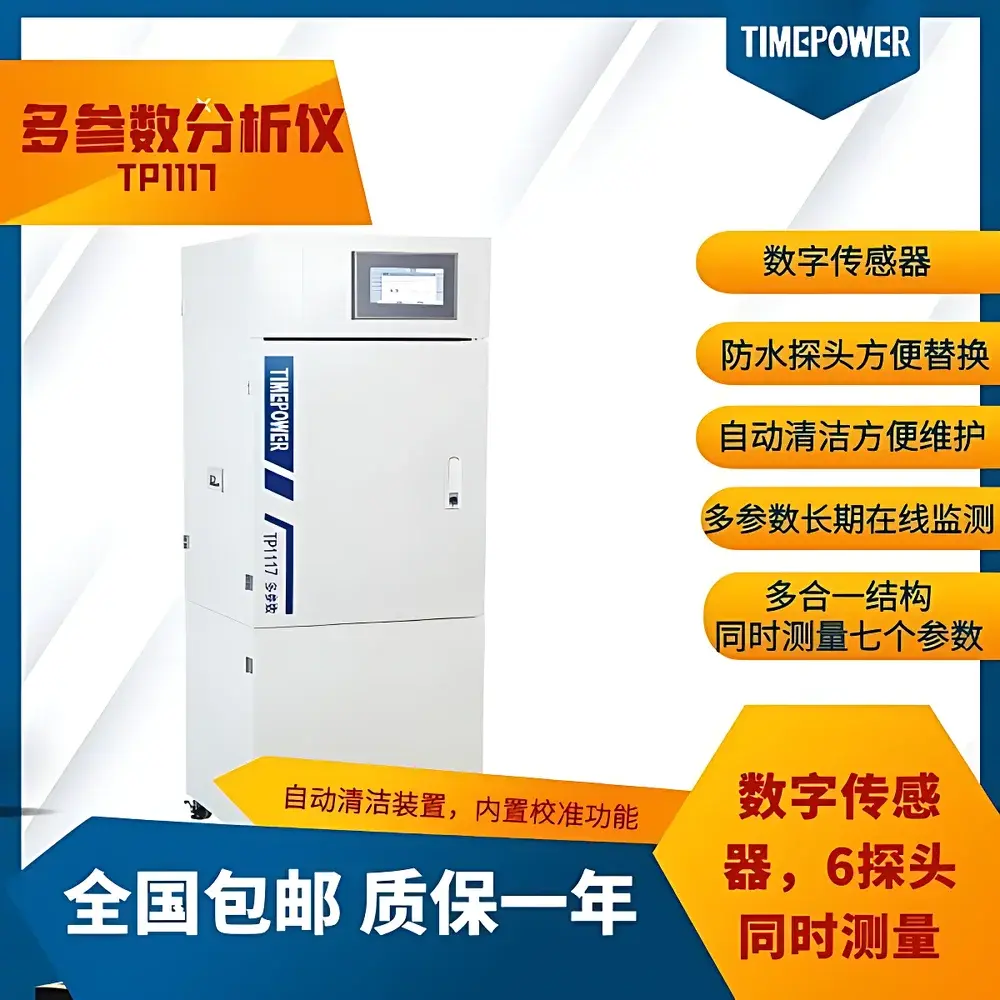
TimePower TP/1117 Multi-Parameter Online Water Quality Analyzer
| Brand | TimePower |
|---|---|
| Origin | Beijing, China |
| Manufacturer | TimePower Co., Ltd. |
| Model | TP/1117 |
| Instrument Type | Online Water Quality Analyzer |
| Measured Parameters | Total Phosphorus, Total Nitrogen, Conductivity, pH, ORP, Dissolved Oxygen (fluorescence-based), Turbidity (fiber-optic), Temperature, Optional: Chlorophyll-a, Oil-in-Water, Ammonia-Nitrogen |
| Sensor Interface | Digital RS485 with MODBUS RTU protocol |
| Max. Simultaneous Probes | 6 (up to 7 parameters) |
| Probe Mounting | Waterproof quick-connect interface |
| Maintenance | Integrated automatic cleaning system |
| Compliance | Designed for continuous operation in accordance with ISO 5667-22, ASTM D3370, and EPA Method 180.1 principles for online water quality monitoring |
Overview
The TimePower TP/1117 Multi-Parameter Online Water Quality Analyzer is an engineered platform for continuous, real-time assessment of critical physicochemical and nutrient parameters in surface water, wastewater, industrial effluent, and municipal distribution systems. Built upon a modular digital sensor architecture, the analyzer employs standardized RS485 communication with MODBUS RTU protocol—ensuring interoperability with SCADA, DCS, and PLC-based infrastructure across utility, environmental, and industrial facilities. Its core measurement principle integrates optical, electrochemical, and conductometric transduction methods: fluorescence quenching for dissolved oxygen (DO), four-electrode conductivity for high-accuracy salinity and TDS estimation, fiber-optic turbidity detection per ISO 7027, and temperature-compensated digital pH/ORP sensing. Unlike analog-based legacy systems, all calibration coefficients and sensor-specific metadata—including serial number, calibration date, and drift history—are stored directly within each probe’s onboard memory, eliminating manual configuration errors and enabling true plug-and-play replacement.
Key Features
- Modular six-channel digital input architecture supporting simultaneous integration of up to six smart probes—including optional fluorescence DO, four-electrode conductivity, fiber-optic turbidity, digital pH, digital ORP, chlorophyll-a, oil-in-water, and ammonia-nitrogen sensors.
- Integrated automatic mechanical cleaning system—programmable via software—to suppress biofouling and particulate accumulation on optical windows and electrode surfaces, extending calibration stability and reducing unscheduled maintenance intervals.
- Waterproof quick-connect probe interfaces (IP68-rated) with integrated O-ring seals and keyed alignment, enabling field-replaceable sensor modules without tools or system shutdown.
- Onboard data logging with configurable sampling intervals (1 min to 24 h), local storage capacity ≥ 30 days of 1-min resolution data, and timestamped event logging for calibration, cleaning, and fault conditions.
- Ruggedized enclosure rated IP66 for outdoor deployment; operating ambient temperature range: −10 °C to +50 °C; power supply: 24 VDC ±15%, with surge and EMI protection compliant with IEC 61000-4 series standards.
Sample Compatibility & Compliance
The TP/1117 is validated for use in raw surface water (rivers, lakes, reservoirs), secondary-treated wastewater, cooling tower recirculation loops, and industrial process streams with suspended solids ≤ 100 mg/L and chloride concentration < 20,000 mg/L. All sensor configurations adhere to fundamental metrological requirements outlined in ISO 5667-22 (water quality sampling—part 22: guidance on on-line analyzers), ASTM D3370 (standard practices for sampling water), and EPA Method 180.1 (total phosphorus in wastewater). The fluorescence DO module meets performance criteria equivalent to ISO 5814:2012; the fiber-optic turbidity sensor conforms to ISO 7027:2016 optical path length and wavelength specifications. For regulated environments, the system supports audit-trail-enabled calibration logs and user-access controls aligned with GLP/GMP documentation expectations.
Software & Data Management
The TP/1117 communicates natively via MODBUS RTU over RS485, allowing seamless integration into existing industrial automation frameworks. A dedicated Windows-based configuration and visualization software (TP-View v3.x) provides remote commissioning, real-time parameter trending, multi-point calibration wizards, and alarm threshold management (high/low, rate-of-change, deviation from historical mean). Data export supports CSV, XML, and Modbus TCP bridging for cloud ingestion (e.g., AWS IoT Core, Azure IoT Hub). All calibration events, cleaning cycles, and sensor diagnostics are time-stamped and stored with user ID attribution—facilitating 21 CFR Part 11–compliant electronic records when deployed with validated IT infrastructure and access control policies.
Applications
- Real-time compliance monitoring at wastewater treatment plant influent, bioreactor zones, and final effluent discharge points per national discharge permits.
- Early-warning detection of nutrient loading (total phosphorus, total nitrogen) in watershed monitoring networks to support eutrophication risk modeling.
- Process optimization in industrial cooling water systems—tracking conductivity for blowdown control, pH for corrosion inhibition, and turbidity for filtration efficiency verification.
- Long-term ecological assessment in protected aquatic habitats, where low-maintenance, fouling-resistant operation ensures data continuity across seasonal biofilm cycles.
- Integration into smart city water infrastructure platforms for predictive analytics on pipe integrity, source water variability, and demand-responsive treatment dosing.
FAQ
Does the TP/1117 support third-party MODBUS-compatible sensors?
Yes—the system accepts any RS485 MODBUS RTU slave device with standard function codes (03h, 06h, 10h); however, full parameter interpretation and diagnostic feedback require TimePower’s native probe firmware.
Can calibration data be transferred between identical probes?
Calibration coefficients are stored exclusively within each probe’s non-volatile memory and are not transferable; swapping probes retains individual calibration history without reconfiguration.
Is the automatic cleaning system compatible with aggressive chemical cleaners?
The mechanical wiper mechanism is designed for physical removal only; chemical cleaning agents must be applied externally and are not dispensed or circulated by the analyzer.
What is the maximum cable length between the analyzer and remote probes?
Up to 300 meters using shielded twisted-pair RS485 cable (AWG22, 120 Ω characteristic impedance) with proper termination and grounding per EIA/TIA-485-A.
How does the system handle sensor failure or signal loss?
The controller continuously monitors communication heartbeat and sensor self-diagnostic flags; it triggers configurable alarms, disables affected parameter displays, and maintains logging of valid channels without interruption.







