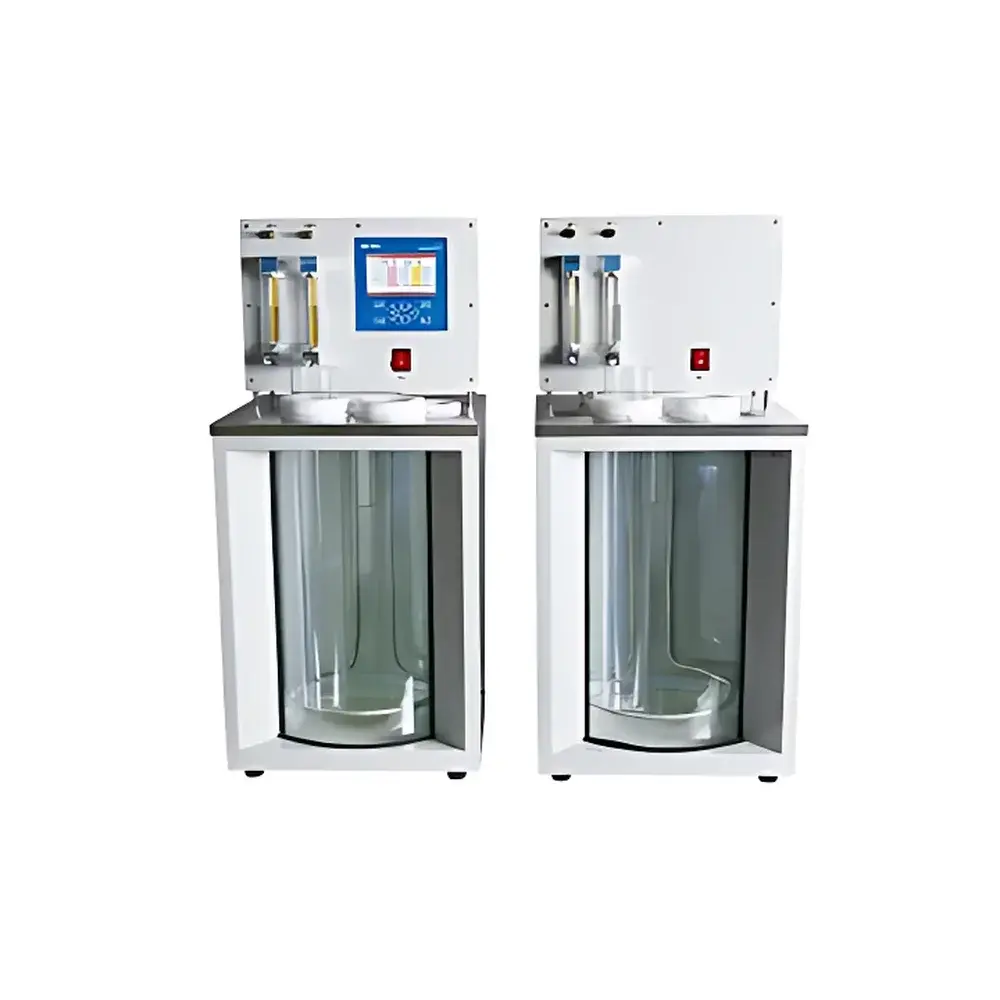
TimePower TP652 Foam Characteristics Analyzer
| Brand | TimePower |
|---|---|
| Origin | Beijing, China |
| Manufacturer Type | Manufacturer |
| Country of Origin | Domestic (China) |
| Model | TP652 |
| Pricing | Upon Request |
| Temperature Control Range | 0–100 °C |
| Temperature Accuracy | ±0.5 °C |
| Air Flow Rate | 16–160 mL/min (adjustable via rotameter) |
| Air Source | Integrated silent air pump (3 L/min) |
| Gas Diffusion Head Flow Capacity | 3000–6000 mL/min at 2.45 kPa |
| Timing Resolution | ±1 s (automated) |
| Display | LCD interface |
| Power Supply | AC 220 V ±10%, 50 Hz ±10% |
| Max Power Consumption | ≤2300 W |
| Dimensions | 340 × 340 × 740 mm |
| Net Weight | 23 kg |
| Ambient Operating Conditions | 5–40 °C, ≤85% RH |
| Compliance Standards | GB/T 12579, ISO 6247, ASTM D892 |
Overview
The TimePower TP652 Foam Characteristics Analyzer is an engineered solution for the quantitative evaluation of foam tendency and foam stability in lubricating oils and related petroleum-based fluids under standardized thermal and aerodynamic conditions. Based on the principle of controlled-air sparging through a calibrated gas diffusion head into a precisely temperature-regulated sample, the instrument measures foam volume evolution over time—first at 24 °C (low-temperature test), then after thermal conditioning at 93.5 °C followed by re-cooling to 24 °C (high-temperature sequence). This dual-temperature protocol aligns with internationally recognized methodologies for assessing both initial foam formation (foam tendency) and post-aeration persistence (foam stability), critical parameters in evaluating additive package efficacy and fluid degradation behavior.
Key Features
- PID-based digital temperature control system ensures thermal stability within ±0.5 °C across the full 0–100 °C operating range—enabling reproducible testing at both low- and high-temperature setpoints mandated by ASTM D892 and ISO 6247.
- Integrated quiet air supply (3 L/min nominal output) coupled with four independently adjustable rotameters (16–160 mL/min range) allows precise, repeatable airflow delivery to each test vessel—minimizing inter-run variability in bubble generation kinetics.
- Dual-bath design accommodates simultaneous or sequential testing at distinct temperatures; optional immersion-type chiller unit available for sub-ambient stabilization when ambient lab temperature exceeds 24 °C.
- Microprocessor-controlled operation with real-time LCD display provides intuitive navigation, automated timing (±1 s resolution), and on-screen status feedback—including temperature, elapsed time, and airflow confirmation.
- Thermal bath chamber constructed from corrosion-resistant stainless steel with optimized water circulation geometry ensures uniform heat distribution and rapid thermal equilibration.
- Thermal printer module supports direct hardcopy output (36-character width, Chinese/English bilingual support) for GLP-compliant record retention without external software dependency.
Sample Compatibility & Compliance
The TP652 is validated for use with mineral, synthetic, and semi-synthetic lubricants—including turbine oils, hydraulic fluids, engine oils, and greases—provided samples meet viscosity and volatility constraints defined in ASTM D892 Annex A1. Sample volume requirements conform to standard 100-mL graduated cylinder geometry (included), with diffusion head insertion depth and immersion level strictly maintained per ISO 6247 Section 6.2. The analyzer satisfies all mechanical, thermal, and timing specifications outlined in GB/T 12579–2021, ISO 6247:2019, and ASTM D892–22, making it suitable for regulatory submission, internal QC release testing, and R&D formulation screening. All firmware logic and data handling routines are designed to support audit-ready documentation practices aligned with ISO/IEC 17025 and GMP/GLP quality systems.
Software & Data Management
While the TP652 operates as a standalone benchtop instrument with embedded microcontroller firmware, its architecture supports traceable data capture through built-in timestamped thermal and temporal logging. Each test cycle stores start/end timestamps, setpoint vs. actual temperature profiles (sampled every 5 seconds), airflow confirmation flags, and final foam volume readings. The thermal printer generates permanent records compliant with FDA 21 CFR Part 11 principles—where handwritten annotations, operator ID, and date/time stamps are manually appended during QA review. For laboratories requiring electronic data archiving, optional RS-232 serial interface enables integration with LIMS or custom SCADA platforms using ASCII-based command-response protocols (documentation available upon request).
Applications
- Quality assurance of new lubricant batches against foam-related specification limits (e.g., ASTM D892 Class I–III pass/fail criteria).
- Accelerated aging studies evaluating foam inhibitor depletion kinetics during oxidative stress testing.
- Formulation development of anti-foam additives (e.g., silicone polymers, alkyl acrylates) via comparative foam decay rate analysis.
- Root-cause investigation of field-reported foaming incidents in steam turbines, hydraulic power units, and circulating oil systems.
- Third-party certification testing for ISO 50001 energy management programs where lubricant performance impacts system efficiency metrics.
FAQ
What calibration standards are required prior to daily operation?
Users must verify bath temperature accuracy using a NIST-traceable liquid-in-glass thermometer (Class A, ±0.1 °C tolerance) before each test series. Deviations exceeding ±0.3 °C require firmware offset adjustment via service menu.
Is the diffusion head interchangeable between test temperatures?
Yes—the sintered metal diffusion head (3000–6000 mL/min capacity at 2.45 kPa) is rated for continuous exposure up to 100 °C and must be cleaned with xylene followed by acetone rinse after each high-temperature run to prevent residue buildup.
How is moisture managed in the air supply path?
A replaceable desiccant tower containing indicator-grade silica gel (blue → pink transition signals saturation) is installed upstream of the flow control manifold. Replacement is mandatory when >30% of beads exhibit pink coloration.
Can the instrument operate unattended overnight?
No—per ASTM D892 Section 7.3, manual observation is required during foam collapse phases. The system lacks automatic endpoint detection for foam dissipation and requires operator intervention to initiate the second cooling phase.