
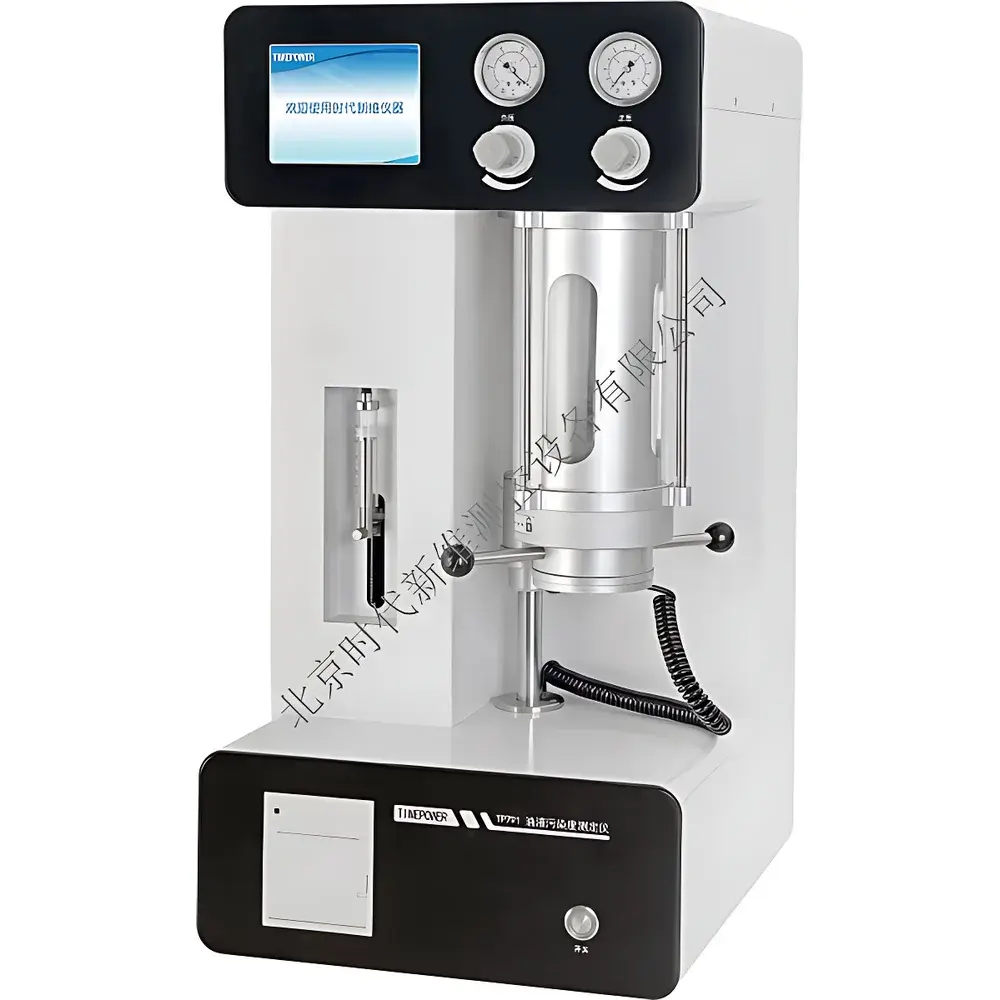
Timepower TP791 Oil Particle Counter & Fluid Contamination Analyzer
| Brand | Timepower |
|---|---|
| Origin | Beijing, China |
| Manufacturer Type | OEM Manufacturer |
| Country of Origin | China |
| Model | TP791 |
| Pricing | Available Upon Request |
Overview
The Timepower TP791 Oil Particle Counter & Fluid Contamination Analyzer is a precision laboratory instrument engineered for quantitative assessment of solid particulate contamination in liquid media—primarily hydraulic oils, lubricants, insulating oils (e.g., transformer oil), turbine oils, gear oils, aviation fuels, and water-based hydraulic fluids. It operates on the internationally standardized light extinction (light blockage) principle defined in ISO 11171, ASTM F312-22, and GB/T 18854. In this method, particles suspended in a flowing liquid stream pass through a precisely dimensioned sensing zone intersected by a collimated semiconductor laser beam. Each particle obstructs a portion of the incident light proportional to its projected area, generating a transient voltage pulse whose amplitude correlates directly with particle size. Pulse counting and amplitude classification across 16 user-defined channels enable simultaneous quantification of particle concentration per size bin and derivation of contamination grades per multiple international standards.
Key Features
- ISO 11171-compliant optical detection system utilizing a high-stability semiconductor laser source with low noise and superior signal-to-noise ratio
- 16-channel configurable particle sizing, supporting user-defined thresholds from 0.8 µm to 600 µm (dependent on sensor configuration)
- Precision syringe pump sampling mechanism with programmable volume selection (0.2–1000 mL) and volumetric accuracy better than ±0.5%
- Dual-pressure (positive/negative) sample handling system enabling automatic degassing and reliable analysis of fluids up to 650 cSt viscosity
- Built-in calibration libraries compliant with NAS 1638, ISO 4406:2021, GJB 420B, SAE AS4059F, DL/T 432, GB/T 14039, and GOCT 17216—supporting automatic grade assignment and cross-standard conversion
- Integrated color touchscreen interface with Chinese/English language support, on-device data storage, and thermal printer for immediate report generation
- RS232 serial interface for bidirectional communication with LIMS or laboratory data management platforms
- Robust mechanical architecture with modular pneumatic subsystem (max. +0.8 MPa / −0.08 MPa chamber pressure), compact footprint (360 × 370 × 700 mm), and CE-aligned electrical safety design (AC 220 V ±10%, 50 Hz ±10%, ≤200 W)
Sample Compatibility & Compliance
The TP791 is validated for use with mineral- and synthetic-based hydrocarbon oils, ester-based dielectric fluids, polyalkylene glycols (PAGs), phosphate esters, and aqueous emulsions. Its dual-pressure sampling architecture accommodates low-volatility, high-viscosity samples without manual pre-filtration or dilution. All measurement protocols align with regulatory and quality assurance frameworks including ISO/IEC 17025 accredited testing practices, FDA 21 CFR Part 11–compatible data integrity requirements (when paired with validated software), and GLP/GMP traceability expectations for aerospace (AS9100), power generation (IEEE C57.106), and defense (MIL-STD-1246C) applications. Optional metrological certification from national calibration institutes is available upon request.
Software & Data Management
Onboard firmware supports real-time histogram generation, cumulative distribution plots, and auto-classification against selected contamination codes. Raw pulse data and metadata—including date/time stamp, operator ID, sample ID, viscosity correction factor, and environmental temperature—are stored in non-volatile memory with timestamped audit trails. Export formats include CSV and PDF reports compatible with laboratory information management systems (LIMS). When connected via RS232, the device supports remote command execution (SCPI-like syntax), scheduled automated testing, and integration into centralized QC dashboards compliant with ISO 13485 or IATF 16949 workflows.
Applications
The TP791 serves critical roles in predictive maintenance programs across aviation hydraulics (per SAE ARP4205), turbine oil condition monitoring (per ASTM D6224), transformer oil acceptance testing (per IEEE Std C57.106), and military fluid certification (per GJB 380.4A). It is routinely deployed in OEM manufacturing QA labs for hydraulic component cleanliness validation, in-service oil analysis laboratories for fleet reliability tracking, and R&D environments evaluating filter efficiency, additive stability, and wear debris evolution under accelerated aging protocols.
FAQ
What particle size ranges does the TP791 support?
The instrument supports configurable detection from 0.8 µm to 600 µm, subject to sensor selection and calibration curve alignment per ISO 11171.
Can the TP791 analyze non-oil liquids such as polymer solutions or organic solvents?
Yes—provided the liquid exhibits sufficient optical contrast with suspended particles and falls within the specified viscosity limit (≤650 cSt) and chemical compatibility envelope of wetted materials (stainless steel 316, fused silica, PTFE seals).
Is the instrument suitable for field use or only laboratory environments?
It is designed for controlled laboratory settings (0–60°C ambient, stable power supply); however, its modular pneumatic unit allows transport between adjacent test bays when operated with external uninterruptible power supplies.
How is calibration traceability maintained?
Calibration utilizes NIST-traceable, ISO 11171-certified reference particle suspensions; multi-point verification across the full dynamic range is performed during initial commissioning and annually thereafter per ISO/IEC 17025 guidelines.
Does the TP791 meet requirements for regulated industries such as pharmaceuticals or medical devices?
While not specifically designed for USP or , its hardware architecture and data integrity features support qualification for non-sterile fluid cleanliness testing in Class 8 cleanrooms when validated per client-specific protocols.





