
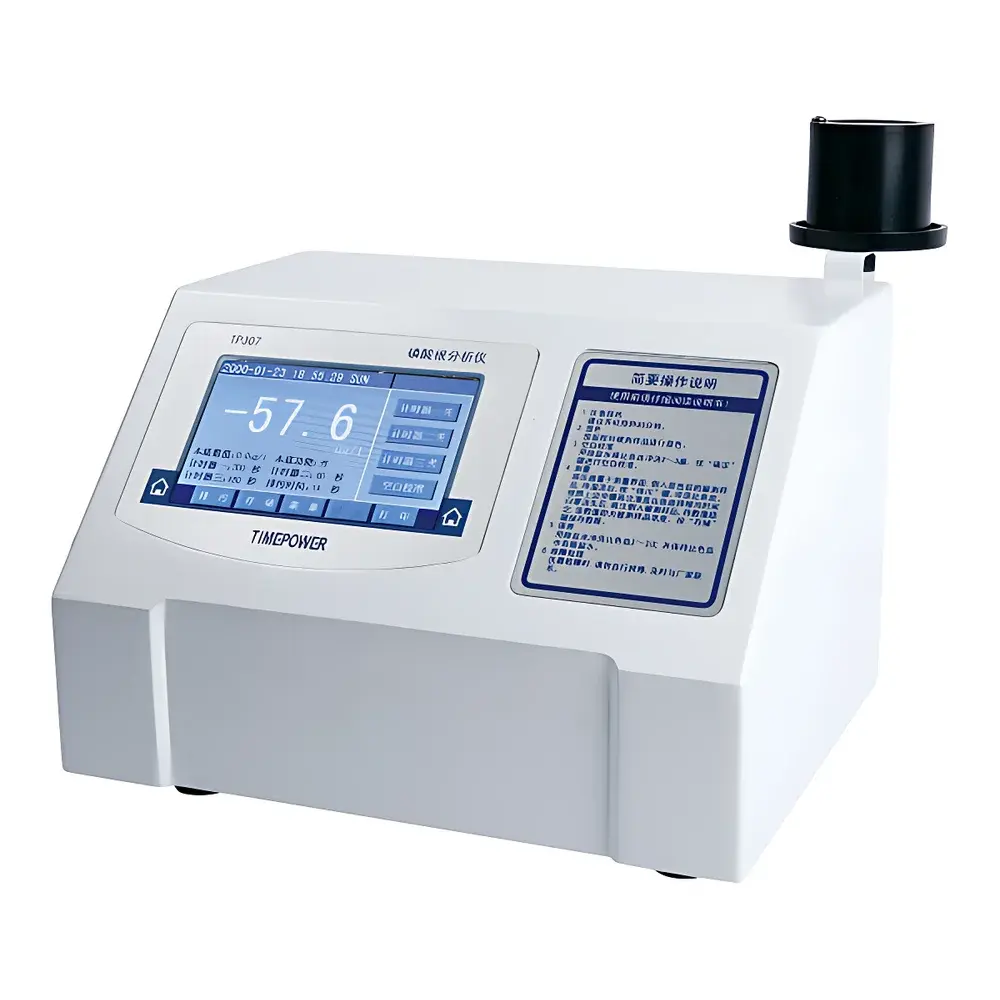
Timepower TP307 Phosphate Analyzer for Laboratory Use
| Brand | Timepower |
|---|---|
| Origin | Beijing, China |
| Manufacturer Type | Direct Manufacturer |
| Regional Classification | Domestic (China) |
| Model | TP307 |
| Pricing | Upon Request |
Overview
The Timepower TP307 Phosphate Analyzer is a benchtop photometric analyzer engineered for precise, routine quantification of orthophosphate (PO₄³⁻) in ultra-pure and process water streams. It operates on the established vanadomolybdophosphoric acid colorimetric method: in acidic medium, orthophosphate reacts with ammonium metavanadate and ammonium molybdate to form a stable yellow-colored heteropoly acid complex—phosphovanadomolybdic acid—whose absorbance at 420 nm is directly proportional to phosphate concentration. This principle adheres strictly to classical spectrophotometric methodology governed by the Lambert–Beer law, ensuring traceable, linear response across defined concentration ranges. Designed specifically for power generation and high-purity industrial applications, the TP307 delivers reliable performance in monitoring boiler feedwater, condensate, desalinated water, and process streams in pharmaceutical, chemical fiber, and fine chemical manufacturing where phosphate control is critical to corrosion inhibition and scale prevention.
Key Features
- Integrated optoelectronic architecture utilizing a precision-imported monochromatic cold light source (peak wavelength 420 nm), delivering long-term photometric stability, low thermal drift, and extended service life (>10,000 hours).
- High-density surface-mount technology (SMT) PCB design with embedded microcontroller unit (MCU), optimized for low power consumption (<30 W), electromagnetic compatibility (EMC), and operational robustness in laboratory and plant-side environments.
- 5.0-inch capacitive touch color LCD interface with intuitive Chinese-language navigation, real-time graphical display of measurement trends, and context-sensitive soft-key operation.
- Automated timing sequence control for reaction incubation and measurement cycles, reducing manual intervention and operator-dependent variability.
- Dual-point calibration support including zero (blank) calibration to compensate for optical path baseline drift and electronic offset, enhancing long-term accuracy and reproducibility.
- Circular data buffer storage supporting up to 256 measurement records with automatic overwrite logic; timestamped entries include concentration value, date/time stamp, and calibration status flag.
Sample Compatibility & Compliance
The TP307 accepts aqueous samples with total suspended solids <5 mg/L and turbidity <1 NTU. It is validated for use with deionized water, steam condensate, demineralized makeup water, and low-ionic-strength process streams typical in thermal power plants and GMP-compliant pharmaceutical water systems. While not certified to ISO/IEC 17025 or ASTM D859, its analytical methodology aligns with established industry references including ASTM D4192 (Standard Test Method for Phosphate in Water by Colorimetric Analysis) and USP (Total Organic Carbon and Inorganic Phosphate in Purified Water). The instrument’s design supports GLP-aligned documentation practices through timestamped data logging and non-volatile memory retention.
Software & Data Management
Data output is accessible via on-device query interface only; no USB, RS-232, or Ethernet connectivity is integrated. All stored records are viewable in chronological order with scroll navigation. Each entry includes measured concentration (mg/L), measurement time, and calibration reference identifier. No proprietary software, cloud synchronization, or FDA 21 CFR Part 11-compliant audit trail functionality is provided. For regulatory environments requiring electronic record integrity, external data capture via manual transcription or third-party serial logging is required.
Applications
- Continuous monitoring of phosphate carryover in turbine condensate return systems to prevent deposition in high-pressure turbines.
- Quality control of phosphate dosing in drum-type boiler water treatment programs (e.g., coordinated phosphate-pH control).
- Verification of phosphate removal efficiency in mixed-bed ion exchange polishing units.
- In-process testing of purified water (PW) and water for injection (WFI) distribution loops during commissioning and periodic requalification.
- Environmental compliance checks for phosphate discharge limits in effluent from chemical synthesis facilities.
FAQ
What is the detection range and selectable scales?
The TP307 offers two factory-configurable measurement ranges: 0–20 mg/L and 0–50 mg/L. Range selection is fixed at time of purchase and cannot be switched in-field.
Does the instrument require daily recalibration?
Blank calibration is recommended before each analytical session or after ambient temperature shifts exceeding ±5°C. Full two-point calibration using certified standard solutions is advised weekly or per internal QA protocol.
Is the reagent kit supplied with the analyzer?
No. Vanadomolybdate reagents must be procured separately as stabilized dry-powder or liquid formulations compliant with ASTM D4192 specifications.
Can the TP307 be used for seawater or wastewater samples?
Not without pretreatment. High chloride, silica, or iron content interferes with the colorimetric reaction. Sample dilution, filtration, and masking agent addition (e.g., tartaric acid for Fe³⁺) are necessary—and method validation required—prior to use.
What maintenance is required for long-term reliability?
Monthly cleaning of the cuvette chamber and optical window with lint-free tissue and isopropanol; annual verification of LED intensity and photodiode responsivity using NIST-traceable neutral density filters is recommended.





