
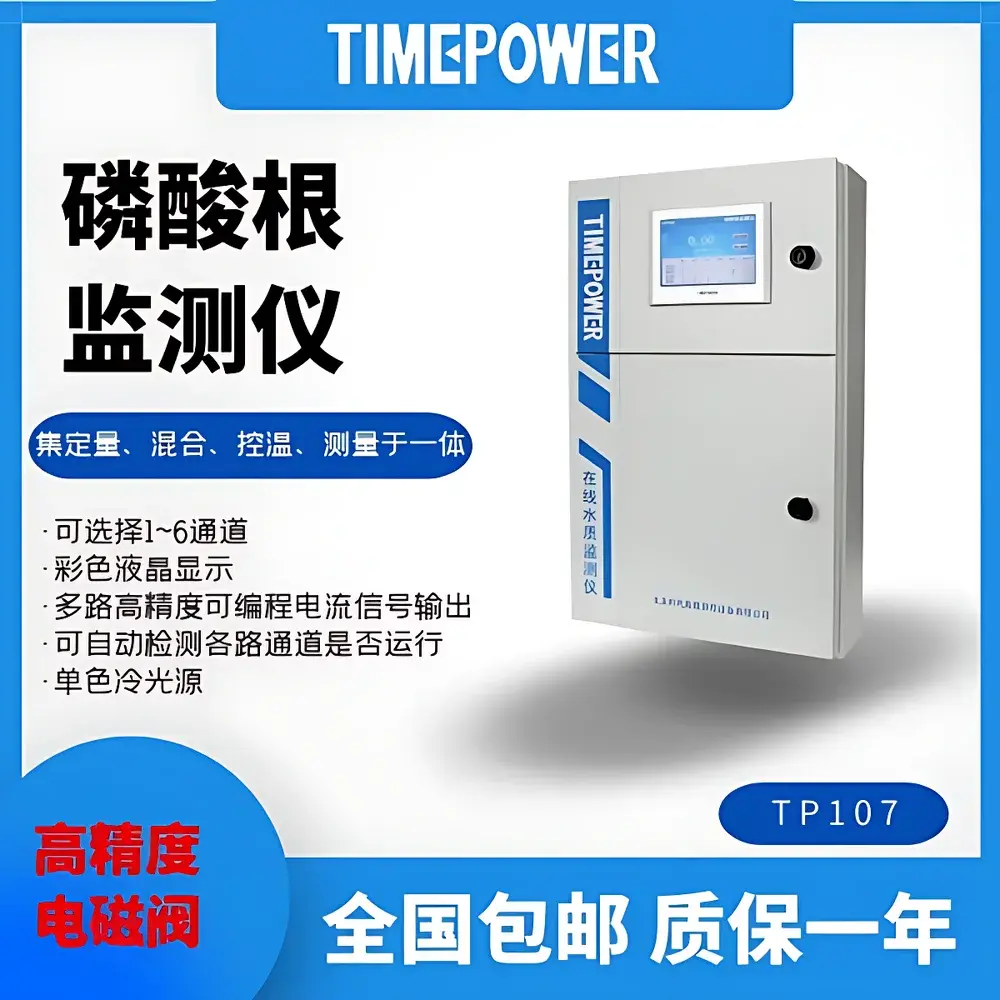
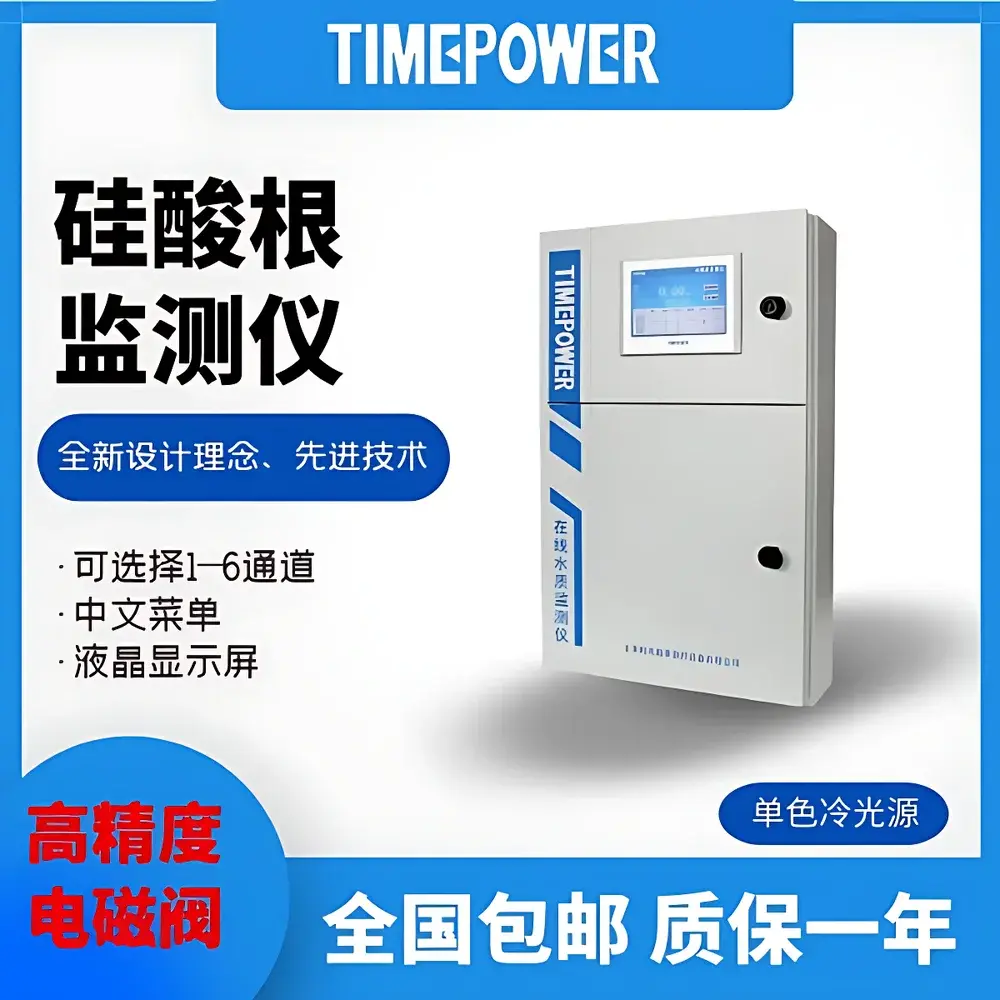
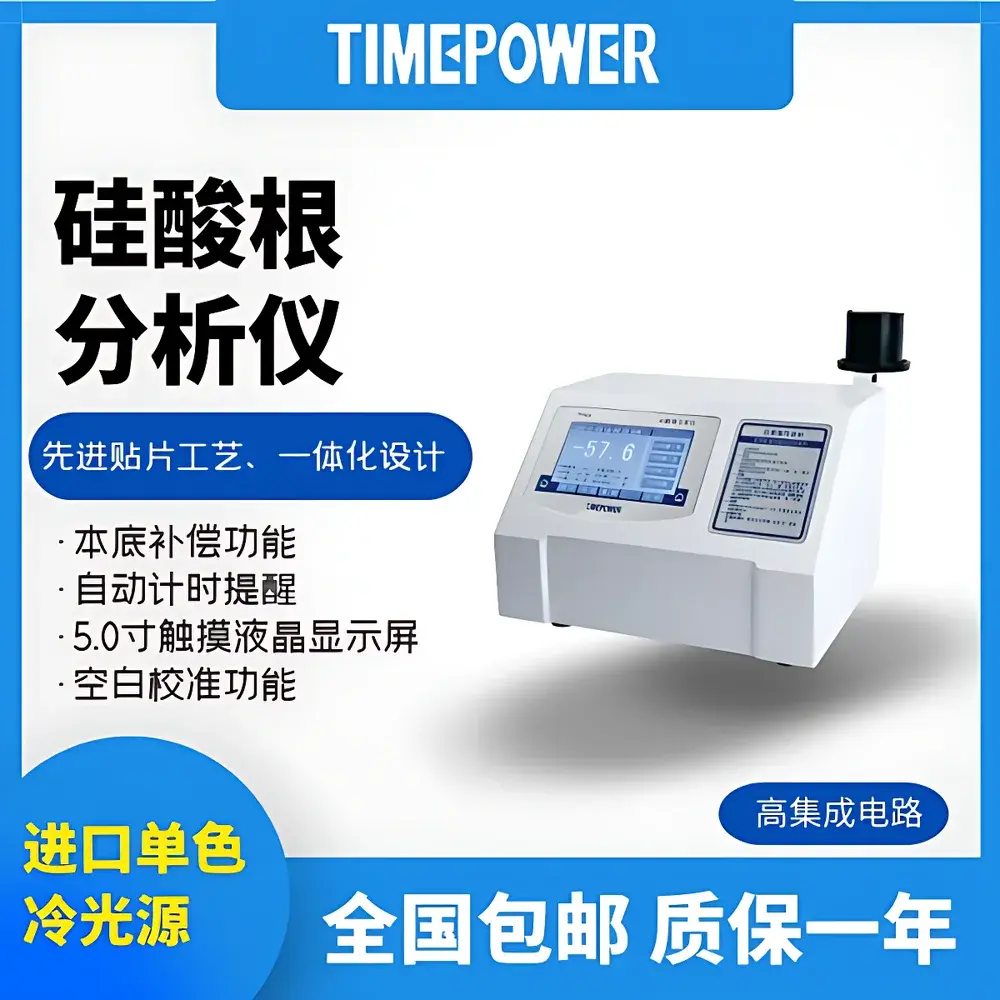
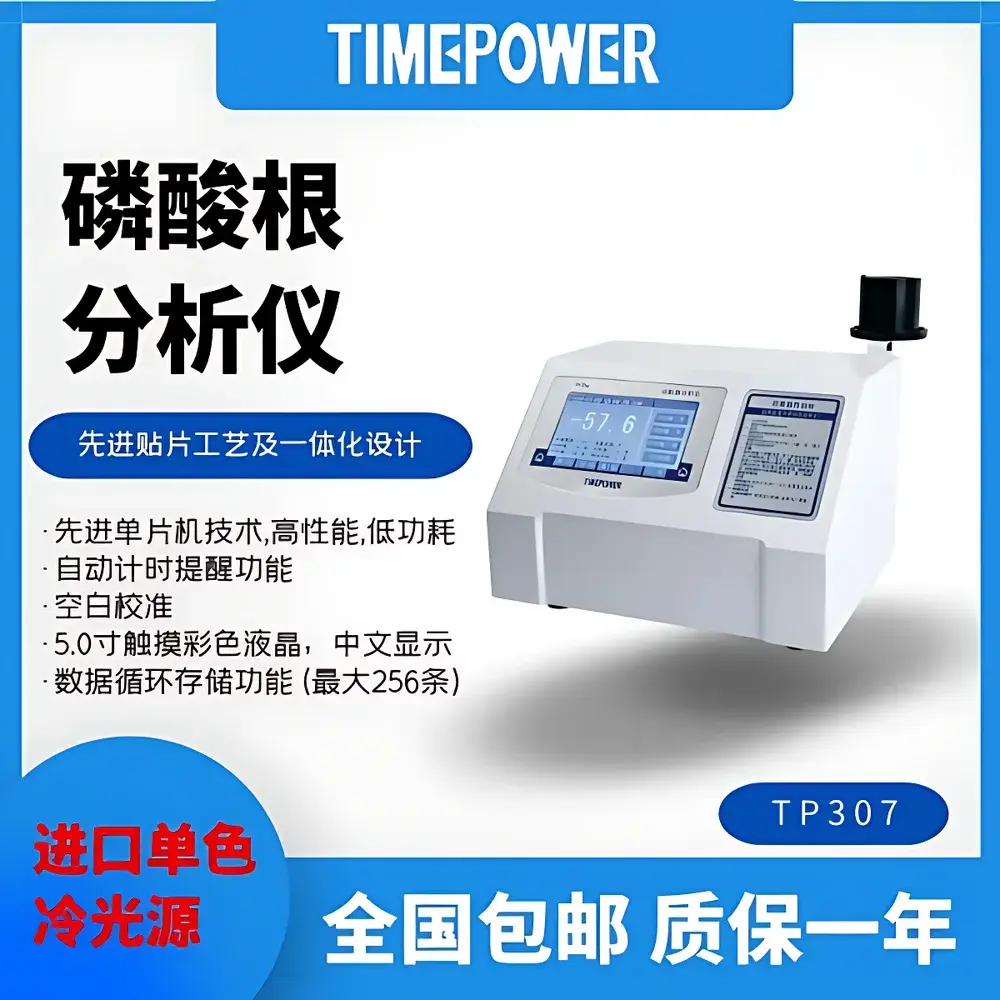
TimePower TP106/TP107 Online Phosphate and Silicate Analyzer
| Brand | TimePower |
|---|---|
| Origin | Beijing, China |
| Manufacturer Type | Manufacturer |
| Product Origin | Domestic |
| Model | TP106 (Phosphate) / TP107 (Silicate) |
| Instrument Type | Online Analyzer |
| Measurement Principle | Molybdenum Blue Photometric Method (for Silicate) |
| Display | 7.0-inch Color TFT Touchscreen |
| Measurement Range (Silicate) | 0.0–200.0 µg/L or 0.0–2000 µg/L (selectable) |
| Accuracy | ±2% F.S. |
| Repeatability | ±1% F.S. |
| Drift | <±1% F.S./24 h |
| Cycle Time | <10 min per channel |
| Sampling Flow Rate | 10–40 L/h |
| Sample Temperature | 5–50 °C |
| Suspended Solids | <5 µm, non-colloidal |
| Ambient Temperature | 5–45 °C |
| Relative Humidity | ≤85% RH (non-condensing) |
| Reagent Consumption | ~3 L/month per reagent (4 reagents total) |
| Digital Output | RS232 or RS485 |
| Analog Output | Isolated 0–20 mA / 4–20 mA / 0–10 mA (configurable) |
| Alarm Outputs | Independent per channel — sample loss, upper/lower limit |
| Power Supply | AC 220 V ±10%, 50 Hz ±10% |
| Power Consumption | ≤100 W |
| Dimensions (W×D×H) | 460 mm × 281 mm × 720 mm |
| Panel Cutout | 670 mm × 410 mm |
| Weight | ~20 kg |
Overview
The TimePower TP106/TP107 Online Phosphate and Silicate Analyzer is a dual-channel, fully automated photometric analyzer engineered for continuous, real-time monitoring of soluble silica (as SiO₂) and orthophosphate (as PO₄³⁻) in high-purity water streams. Designed specifically for critical thermal power plant and semiconductor-grade ultrapure water (UPW) systems, the instrument employs standardized colorimetric methodologies compliant with GB/T 12149–2017 (for silicate) and GB/T 6913–2008 (for phosphate), with analytical performance validated against ISO 15588:2021 and ASTM D859–22 protocols. The silicate module operates via the molybdenum blue method: under controlled acidic conditions (pH 1.1–1.3), soluble silicate reacts with ammonium molybdate to form heteropoly-molybdosilicic acid, which is subsequently reduced by ammonium ferrous sulfate to yield a stable blue chromophore measurable at 650 nm. The phosphate module utilizes the ascorbic acid–molybdate reduction method at pH ~1.5, generating a blue complex quantified at 880 nm. Both channels share a common optical path architecture featuring temperature-stabilized LED light sources, precision interference filters, and dual-beam photodetectors to minimize drift and enhance long-term baseline stability.
Key Features
- Modular dual-channel design supporting independent or synchronized measurement of phosphate and silicate on a single platform
- 7.0-inch high-resolution capacitive touchscreen with intuitive Chinese/English bilingual UI and context-sensitive operation guidance
- Integrated peristaltic pumping system with flow-sensing feedback loop to ensure consistent sample delivery and automatic flow correction
- Reagent auto-dosing with gravimetric calibration capability and low-reagent warning logic to maintain measurement continuity
- Multi-level fault diagnostics including air bubble detection, clog recognition, photometric saturation alert, and reagent depletion prediction
- Rugged industrial enclosure (IP54-rated front panel) with corrosion-resistant internal wetted materials (PTFE, PEEK, quartz cuvettes)
- Zero-drift optical compensation algorithm leveraging reference beam normalization and periodic dark-current correction
Sample Compatibility & Compliance
The TP106/TP107 is validated for use with deionized water, condensate, boiler feedwater, steam drum water, and UPW streams meeting ASTM D5127 Class 1 specifications. It accommodates samples containing ≤5 µm particulates and excludes colloidal silica—consistent with IEC 60404-8-13 requirements for turbine protection monitoring. All wetted components comply with USP Class VI biocompatibility standards. Data integrity meets FDA 21 CFR Part 11 requirements when operated with optional audit-trail-enabled firmware (v3.2+). Calibration verification procedures align with ISO/IEC 17025:2017 clause 7.7 and support GLP/GMP laboratory integration through configurable electronic signatures and user role-based access control.
Software & Data Management
Embedded firmware supports both continuous and programmable interval measurement modes (1–240 minute cycles). Local data storage retains ≥30 days of second-by-second raw absorbance values, calculated concentrations, diagnostic logs, and reagent usage metrics. Communication interfaces include isolated RS485 (Modbus RTU) and RS232 (ASCII protocol) for SCADA integration, plus configurable 4–20 mA analog outputs with HART-compatible signal mapping. Optional TimePower CloudLink gateway enables secure TLS 1.2–encrypted remote monitoring, over-the-air firmware updates, and predictive maintenance alerts based on reagent consumption trends and optical path degradation modeling.
Applications
- Thermal power generation: real-time silicate surveillance in condensate polishing systems to prevent turbine blade deposition (per EPRI TR-102524R2)
- Semiconductor fab UPW loops: sub-ppb-level phosphate detection in rinse water to avoid wafer surface contamination during photolithography
- Pharmaceutical WFI (Water for Injection) distribution networks: compliance verification per USP and EU Annex 1
- Chemical process cooling towers: closed-loop phosphonate corrosion inhibitor dosing control via orthophosphate residual tracking
- Environmental effluent monitoring: regulatory reporting for discharge permits under EPA Method 365.4 and ISO 6878:2004
FAQ
What is the minimum detectable concentration for silicate using the TP107 module?
The lower limit of quantification (LLOQ) is 0.5 µg/L SiO₂ under standard 200.0 µg/L range configuration, verified per ICH Q2(R2) guidelines.
Can the analyzer operate unattended for extended periods?
Yes — with scheduled maintenance every 30 days (reagent replacement, tubing inspection, optical window cleaning), the system achieves >98.5% uptime over 90-day validation cycles.
Is third-party calibration certification available?
TimePower provides NIST-traceable calibration certificates issued by CNAS-accredited laboratories (ISO/IEC 17025), optionally bundled with on-site verification services.
How does the instrument handle sample turbidity or organic interference?
An integrated 0.45 µm pre-filter cartridge and UV-absorbance-based turbidity compensation algorithm mitigate scattering effects; humic acid interference is suppressed via optimized acid digestion time and molybdate stoichiometry.
Does the system support remote firmware upgrades?
Firmware updates are delivered via encrypted USB drive or authenticated HTTPS push through CloudLink gateway — all changes logged with timestamp, operator ID, and hash-verified integrity check.
Related Products







