
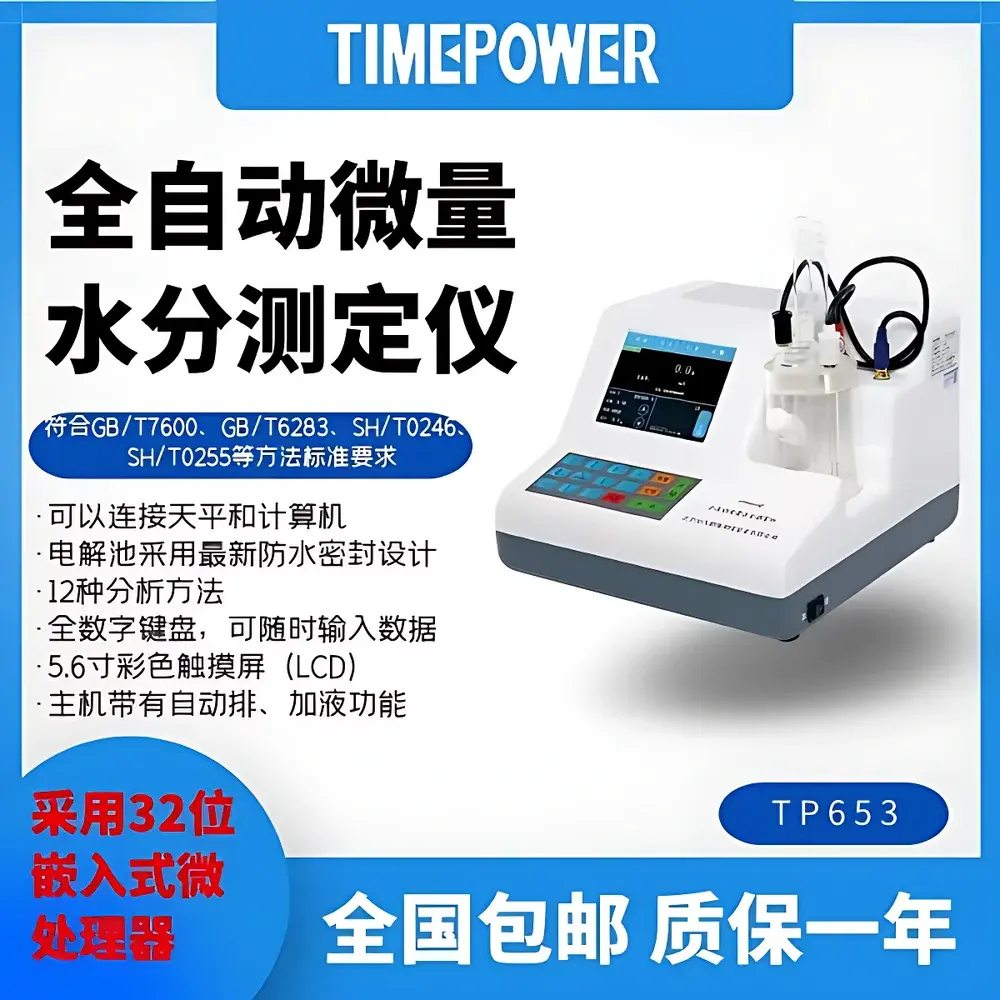
TimePower TP653 Automated Coulometric Karl Fischer Moisture Analyzer
| Brand | TimePower |
|---|---|
| Origin | Beijing, China |
| Manufacturer | TimePower Measurement & Control Co., Ltd. |
| Instrument Type | Coulometric Karl Fischer Moisture Analyzer |
| Measurement Principle | Coulometric titration (Karl Fischer) |
| Resolution | ±0.1 µA |
| Moisture Range | 1 ppm to 100% water content |
| Accuracy | ≤0.3% RSD |
| Minimum Dispensing Increment | 1/2000 of burette volume |
| Titration Control Precision | 0.1 µA |
| Compliance Standards | GB/T 7600, GB/T 6283, SH/T 0246, SH/T 0255 |
| Microprocessor | 32-bit embedded MCU with real-time OS |
| Electrolysis Cell Design | Hermetically sealed, low-drift moisture cell with rapid equilibration |
| User Interface | Dual-mode (capacitive touchscreen + tactile membrane keys) |
| Connectivity | RS-232 for analytical balance integration |
| Method Storage | Up to 12 pre-programmed analysis methods, with 6 user-customizable slots |
| Data Logging | Timestamped measurement records with real-time electrolysis current curve display |
| Auxiliary Functions | Automatic reagent dispensing, waste drainage, background compensation, dual-circuit balanced titration control |
Overview
The TimePower TP653 Automated Coulometric Karl Fischer Moisture Analyzer is an engineered solution for trace-level water quantification in diverse sample matrices—liquids, solids, and gases—using the electrochemical principle of coulometric Karl Fischer titration. Unlike volumetric KF systems, the TP653 generates iodine electrochemically at the anode in a sealed, moisture-sensitive cell, enabling direct stoichiometric determination of water based on Faraday’s law. This eliminates volumetric calibration drift and delivers high reproducibility for samples containing 1 ppm to 100% water. Designed for laboratories requiring GLP-compliant trace moisture data, the instrument meets critical national standards including GB/T 7600 (for insulating oils), GB/T 6283 (general chemical products), SH/T 0246 (light petroleum fractions), and SH/T 0255 (additive-containing lubricants). Its coulometric architecture ensures minimal reagent consumption, extended electrolyte lifetime, and intrinsic suitability for low-moisture applications such as pharmaceutical excipients, lithium battery electrolytes, and high-purity solvents.
Key Features
- 32-bit embedded microcontroller with deterministic real-time operating system for synchronized current control, data acquisition, and method execution
- Coulometric generation of iodine with dual-circuit balanced titration architecture—reducing baseline drift and improving signal-to-noise ratio
- Real-time electrolysis current curve visualization on integrated capacitive touchscreen, enabling immediate assessment of reagent activity and endpoint stability
- Automatic background (blank) current compensation algorithm that dynamically corrects for ambient moisture ingress and electrode polarization effects
- Hermetically sealed, PTFE-gasketed electrolysis cell with optimized electrode geometry—achieving equilibrium in under 90 seconds and extending reagent service life by ≥40% versus conventional designs
- Dual-input operation mode: intuitive touch interface paired with tactile physical keys for glove-compatible use in controlled environments
- Integrated fluid handling module supporting automated reagent addition, solvent purging, and waste evacuation—reducing operator exposure and cross-contamination risk
Sample Compatibility & Compliance
The TP653 accommodates a broad spectrum of industrial and research-grade samples without modification: polar protic liquids (e.g., methanol, ethanol, glycols), non-polar hydrocarbons (transformer oils, jet fuels), viscous materials (polymer melts, greases), hygroscopic solids (APIs, catalysts, desiccants), and compressed gases (via optional gas sampling kit). All analyses adhere to metrological traceability requirements defined in ISO/IEC 17025. The system supports audit-ready documentation per FDA 21 CFR Part 11 when connected to validated LIMS or ELN platforms—enabling electronic signatures, secure user access levels, and immutable audit trails for method parameters, raw current data, and final moisture reports.
Software & Data Management
Instrument firmware includes timestamped event logging with millisecond-resolution current sampling. Each analysis record stores full electrolysis curves, method identifiers, environmental conditions (optional external humidity/temperature input), and statistical summaries (mean, SD, RSD). Data export is supported via CSV, XML, and PDF formats over USB or Ethernet. When interfaced with a certified analytical balance (via RS-232), the TP653 auto-imports sample mass—eliminating manual entry errors. Six user-defined methods can be stored onboard with independent titration thresholds, mixing durations, and post-endpoint stabilization delays. Firmware updates are delivered via signed binary packages to maintain cryptographic integrity.
Applications
- Power industry: Moisture monitoring in transformer oil per IEC 60814 and ASTM D6304—critical for dielectric strength assurance
- Pharmaceutical manufacturing: Quantification of residual water in lyophilized biologics and active pharmaceutical ingredients (APIs) per USP and EP 2.5.12
- Petrochemical QA/QC: Water content verification in jet fuel (ASTM D6304), biodiesel (ASTM D6304), and lubricant additives (SH/T 0255)
- Electronics materials: Ultra-trace moisture detection in lithium hexafluorophosphate (LiPF6) electrolytes where H2O >10 ppm induces SEI layer degradation
- Food & flavor chemistry: Water activity correlation studies in hygroscopic powders (e.g., milk protein isolates, instant coffee) using calibrated KF correlation models
FAQ
What distinguishes coulometric from volumetric Karl Fischer titration in the TP653?
The TP653 exclusively uses coulometric generation of iodine, making it optimal for samples with water content below 1000 ppm. It does not employ a burette or pre-standardized titrant—instead, water is quantified via charge integration (Q = I × t), offering superior precision and lower detection limits than volumetric systems.
Can the TP653 analyze solid samples directly?
Yes—solids are introduced via oven coupling (optional accessory) or dissolution in KF-compatible solvents (e.g., chloroform–methanol mixtures) followed by direct injection. The instrument compensates for solvent blank and supports multi-point calibration for heterogeneous matrices.
Is method validation support available for regulated environments?
TimePower provides IQ/OQ documentation templates aligned with ASTM E2500 and EU GMP Annex 15. Full validation protocols—including specificity, linearity (1–500 ppm), repeatability (n=6), and intermediate precision—can be executed using certified water standards traceable to NIST SRM 2890.
How is data integrity ensured during long-term unattended operation?
The TP653 logs all operational events—including power cycles, method changes, and calibration actions—to internal flash memory with cyclic overwrite protection. Critical parameters (e.g., current offset, cell resistance) are monitored continuously and trigger configurable alerts if deviations exceed preset thresholds.
Does the system comply with cybersecurity requirements for network-connected lab instruments?
Firmware v3.2+ implements TLS 1.2 encryption for remote data transfer, role-based authentication (admin/operator/auditor), and disabled default credentials. Network interfaces are isolated via VLAN tagging recommendations in the installation guide to align with IEC 62443-3-3.






