
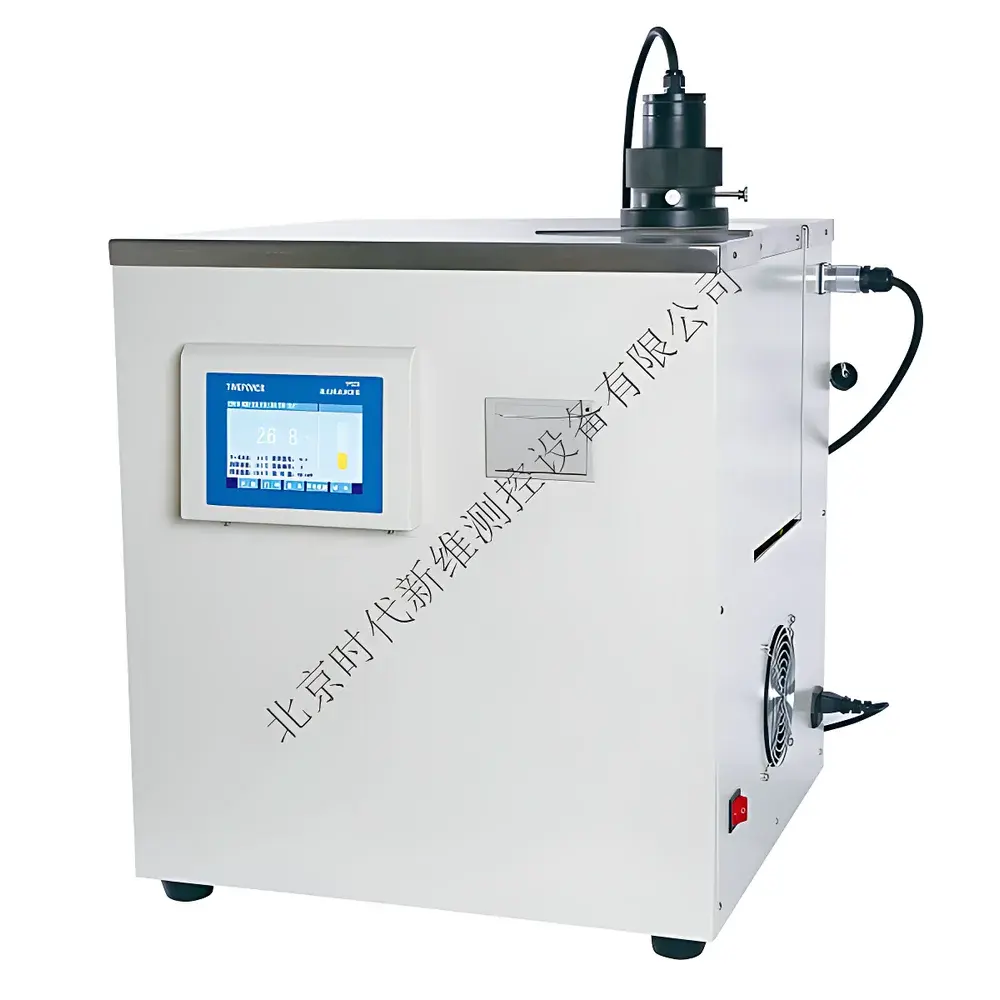
TimePower TP526 Fully Automated Cloud Point and Pour Point Tester for Lubricants and Dark Petroleum Products
| Brand | TimePower |
|---|---|
| Model | TP526 |
| Origin | Beijing, China |
| Manufacturer | TimePower Measurement & Control Co., Ltd. |
| Category | Petroleum Low-Temperature Property Tester |
| Temperature Range | Ambient to –70 °C |
| Accuracy | ±1 °C |
| Resolution | 0.1 °C |
| Display | LCD Touchscreen |
| Cooling System | High-Efficiency Compressor-Based |
| Heating Capability | Up to 50 °C |
| Printer | Thermal, 36-character Chinese/English output |
| Power Supply | AC 220 V ±10%, 50 Hz ±10% |
| Power Consumption | <300 W |
| Dimensions | 460 × 310 × 480 mm |
| Weight | 21.3 kg |
| Compliance | GB/T 510, GB/T 3535, ASTM D2386, ASTM D97 |
Overview
The TimePower TP526 Fully Automated Cloud Point and Pour Point Tester is an engineered solution for precise, standardized determination of low-temperature behavior in lubricants, residual fuels, diesel blends, and dark petroleum products—including those with high viscosity or opaque appearance. It operates on the principle of controlled thermal ramping combined with real-time optical detection of phase transition endpoints—specifically, the cloud point (initial wax crystal formation) and pour point (minimum temperature at which the sample flows under gravity when tilted). Unlike manual or semi-automated systems, the TP526 integrates programmable cooling/heating profiles, automatic sample tilting per ASTM D97 and GB/T 510 protocols, and intelligent endpoint recognition—eliminating operator subjectivity while ensuring strict adherence to international test methodologies.
Key Features
- Fully automated thermal control system with dual-range capability: heating up to +50 °C and cooling down to –70 °C using a robust, maintenance-optimized compressor-based refrigeration unit.
- Integrated tilt mechanism synchronized with temperature profiling to meet exact angular displacement and timing requirements of ASTM D97 and GB/T 510.
- High-resolution (0.1 °C) digital temperature sensing with ±1 °C accuracy across the full operating range, validated per ISO/IEC 17025 traceable calibration practices.
- Intuitive 7-inch capacitive touchscreen interface with multilingual menu support (English/Chinese), enabling intuitive method selection, parameter editing, and real-time curve visualization.
- Onboard thermal printer with 36-character line capacity supports direct output of test reports—including sample ID, date/time stamp, measured values, pass/fail status against specification limits, and operator ID.
- Comprehensive self-diagnostic suite: monitors refrigerant pressure, heater continuity, tilt actuator response, sensor integrity, and thermal stability—displaying actionable error codes and remediation guidance.
- Configurable test modes: “Rapid Screening” (accelerated cooling with adaptive endpoint logic) and “Standard Compliance Mode” (stepwise cooling per ASTM/GB intervals with mandatory hold times).
Sample Compatibility & Compliance
The TP526 accommodates standard ASTM D97 and GB/T 510 test tubes (20 mL nominal volume) and accepts samples regardless of color depth or kinematic viscosity—making it suitable for crude fractions, heavy fuel oils, bitumen emulsions, and highly refined turbine oils. Its optical detection system is insensitive to sample turbidity, enabling reliable cloud point identification even in asphaltene-rich or soot-laden matrices. The instrument conforms to the mechanical, procedural, and reporting requirements of GB/T 510–2010, GB/T 3535–2019, ASTM D2386–18, and ASTM D97–22. All firmware and data handling routines are designed to support GLP-compliant environments, including audit-ready event logs and user-access controls aligned with FDA 21 CFR Part 11 principles (when paired with optional networked data export).
Software & Data Management
The embedded firmware supports method storage for up to 99 user-defined protocols—including custom cooling rates, tilt angles, dwell durations, and pass/fail thresholds. Test results are timestamped and stored locally with full metadata (operator, sample ID, ambient conditions, instrument status flags). Optional USB export enables CSV-formatted data transfer to LIMS or QA databases. No proprietary software installation is required; raw data files are human-readable and compatible with common spreadsheet and statistical analysis tools. Firmware updates are delivered via secure USB key with version-controlled release notes and change logs—ensuring ongoing alignment with evolving regulatory expectations.
Applications
This instrument serves critical quality assurance functions across multiple sectors: power generation facilities use it to verify cold-flow properties of turbine and transformer oils before winter commissioning; petroleum refineries deploy it for in-line monitoring of diesel cloud point during blending optimization; third-party inspection agencies rely on its reproducibility for ASTM-conforming certification reports; and R&D laboratories apply its programmable thermal profiles to study wax crystallization kinetics and additive efficacy. Its broad dynamic range and immunity to sample opacity make it especially valuable for evaluating bio-diesel blends, synthetic ester lubricants, and unconventional crudes where traditional optical methods fail.
FAQ
Does the TP526 comply with ASTM D97 and GB/T 510 without modification?
Yes—the mechanical tilt sequence, cooling rate tolerances, and observation criteria are factory-configured to satisfy both standards’ latest editions.
Can it test samples with viscosities exceeding 1000 cSt at 40 °C?
Yes—unlike capillary-based analyzers, the TP526’s gravity-flow endpoint detection does not depend on fluid mobility prior to solidification.
Is external calibration required annually?
While not mandatory, annual verification using NIST-traceable reference thermometers is recommended for ISO/IEC 17025-accredited labs.
What maintenance does the compressor system require?
No routine oil changes or refrigerant recharging are needed; the sealed unit is rated for >15,000 hours of continuous operation under typical lab conditions.
Can test data be exported to a central LIMS?
Yes—via USB mass-storage mode, generating time-stamped CSV files containing all result fields and instrument metadata.




