
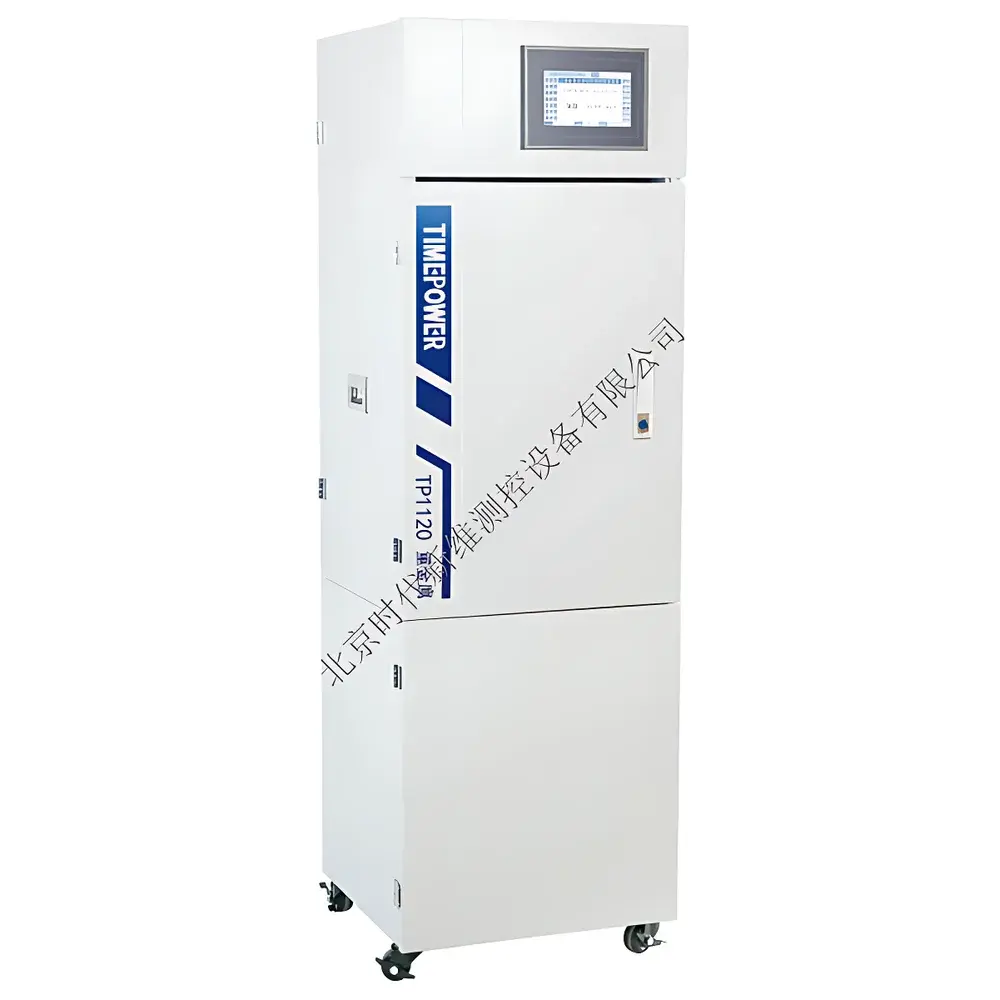
TimePower TP1120 Online Heavy Metals Analyzer for Water Quality Monitoring
| Brand | TimePower |
|---|---|
| Origin | Beijing, China |
| Manufacturer Type | OEM Manufacturer |
| Product Category | Domestic |
| Model | TP1120 |
| Instrument Type | Online Analyzer |
| Detection Principle | Photometric (Colorimetric) Method |
| Detectable Metals | Dual-Parameter / Multi-Parameter (Total Cu, Fe, Ni, Mn, Pb, Cd, As, Zn, Cr, Cr(VI)) |
| Analysis Cycle | 20 min per parameter |
| Accuracy | ≤ ±10% for aqueous samples |
| Resolution | 0.1 mg/L |
Overview
The TimePower TP1120 Online Heavy Metals Analyzer is an industrial-grade, fully automated photometric system engineered for continuous, unattended monitoring of regulated heavy metal species in surface water, industrial process streams, and wastewater effluents. It operates on standardized colorimetric reaction principles—each metal quantified via a dedicated, EPA- and ISO-aligned spectrophotometric method (e.g., 1,10-phenanthroline for total iron; diphenylcarbazide for total and hexavalent chromium; ammonium pyrrolidinedithiocarbamate for total copper). The analyzer integrates high-temperature, pressurized digestion to ensure complete oxidation and solubilization of refractory metal forms—including particulate-bound and organometallic fractions—prior to color development. Designed for compliance-critical environments, the TP1120 meets functional requirements aligned with ISO 15586, ASTM D3559, USP /, and EU Directive 2000/60/EC (Water Framework Directive) for trace metal speciation and reporting.
Key Features
- Modular multi-parameter architecture supporting simultaneous or sequential analysis of up to 10 analytes: Total Copper, Total Iron, Total Nickel, Total Manganese, Total Lead, Total Cadmium, Total Arsenic, Total Zinc, Total Chromium, and Hexavalent Chromium.
- Pressurized high-temperature digestion module (up to 120 °C, 0.3 MPa) enabling rapid, complete matrix digestion without open-vessel volatilization—critical for arsenic and chromium speciation integrity.
- Air-gap negative-pressure aspiration using peristaltic pumping: eliminates direct contact between corrosive reagents and pump tubing, extends maintenance intervals, and ensures long-term volumetric precision.
- Optical subsystem based on imported cold-light LED sources (peak wavelength stability ±1 nm) and interference-filtered photodetectors, delivering photometric repeatability <±0.5% absorbance over 24 h.
- Chemical delivery via precision syringe-driven metering and fluoropolymer (modified PTFE) fluidic lines (ID ≥1.5 mm), minimizing clogging from suspended solids and reducing carryover to <0.8%.
- Embedded 7-inch resistive touchscreen HMI with real-time trend visualization, alarm logging, and guided calibration workflows compliant with GLP documentation practices.
Sample Compatibility & Compliance
The TP1120 accepts raw, filtered (≤100 µm), or pre-sedimented aqueous samples across pH 2–10 and turbidity ≤200 NTU. It is validated for use with municipal influent/effluent, electroplating rinse waters, mining leachates, and cooling tower blowdown. All onboard chemistry protocols conform to internationally recognized standard methods—including ISO 6685 (total iron), ISO 8288 (nickel), ISO 11969 (arsenic), and EPA Method 7196A (hexavalent chromium). Data integrity safeguards include audit-trail-enabled operation logs, electronic signature support, and optional 21 CFR Part 11 compliance packages for regulated pharmaceutical and utility applications.
Software & Data Management
Firmware v3.2 supports dual-mode operation: time-scheduled sampling (interval programmable from 10 to 9999 minutes) and fixed-time (e.g., hourly or at top-of-hour) acquisition. Raw absorbance data, calibration curves, reagent lot tracking, and fault diagnostics are stored locally for ≥12 months. Communication interfaces include isolated RS-232 (ASCII protocol), RS-485 (Modbus RTU), and analog 4–20 mA outputs (NIST-traceable, 12-bit resolution). Optional cloud integration enables remote configuration, predictive maintenance alerts, and secure API-based data ingestion into SCADA, LIMS, or environmental ERP platforms.
Applications
- Real-time compliance monitoring at wastewater treatment plant discharge points under NPDES or IPR permits.
- In-process control of metal recovery circuits in PCB manufacturing and electroplating facilities.
- Early-warning detection of heavy metal breakthrough in groundwater remediation systems (e.g., PRBs or ion-exchange columns).
- Long-term trend analysis for ambient surface water quality networks operated by national environmental agencies.
- Support for ISO 14001-certified EMS programs requiring documented traceability of metal loadings across facility boundaries.
FAQ
What regulatory standards does the TP1120 support for data reporting?
The analyzer’s measurement protocols align with ISO, ASTM, and EPA reference methods; full validation reports and method equivalence documentation are available upon request.
Can the TP1120 differentiate between total chromium and Cr(VI)?
Yes—Cr(VI) is measured directly via diphenylcarbazide complexation at pH 2.0, while total chromium requires prior UV digestion and reduction; both modes are configurable within a single instrument.
Is on-site service and reagent supply supported internationally?
TimePower maintains authorized service partners in EMEA and APAC regions; certified reagent kits—including stabilizers and chelating agents—are shipped globally under UN3082 classification with SDS documentation.
How is calibration traceability maintained?
Each calibration uses NIST-traceable stock standards (certified reference materials, CRMs); calibration events are timestamped, user-signed, and archived with spectral baseline logs.
What maintenance intervals are recommended for routine operation?
Fluidic line inspection every 90 days; optical window cleaning every 30 days; full preventive maintenance—including digestion chamber verification and photometer alignment—every 6 months.







