
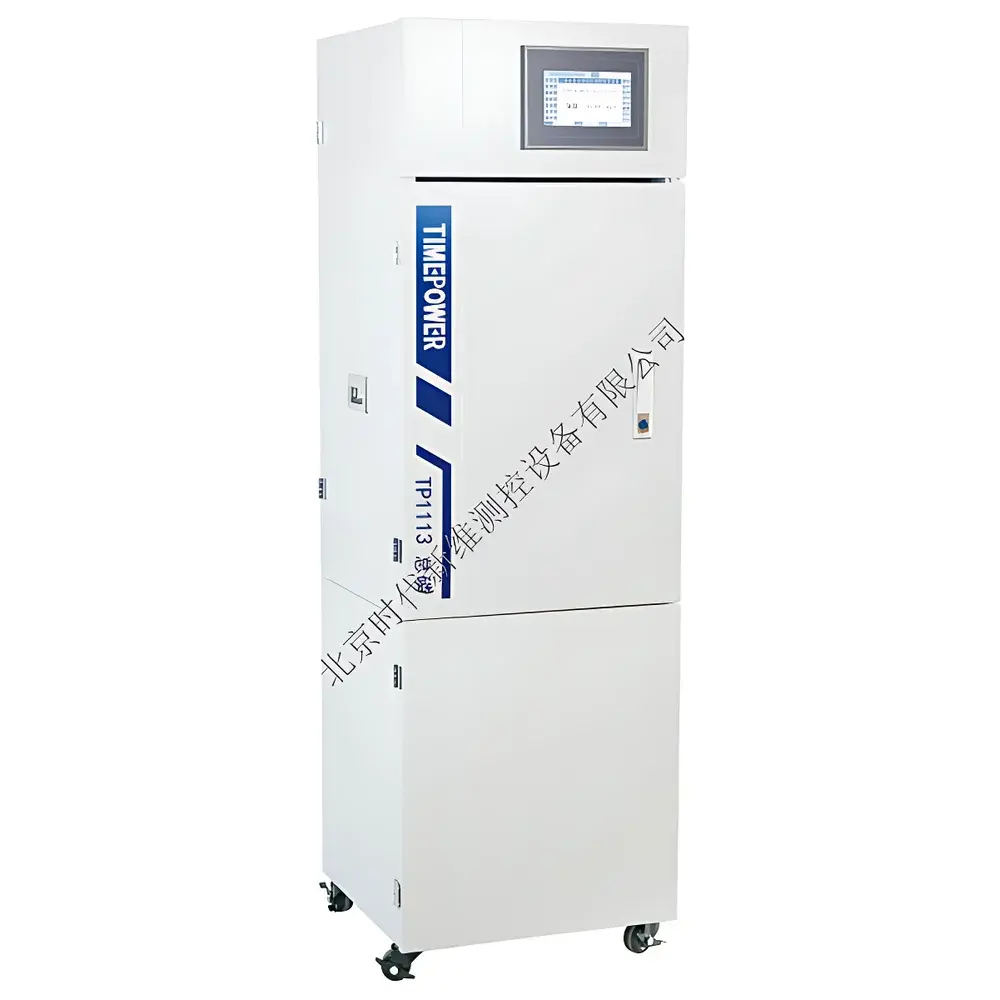
Timepower TP-1113 Online Total Phosphorus Analyzer
| Brand | Timepower |
|---|---|
| Origin | Beijing, China |
| Manufacturer Type | Manufacturer |
| Product Origin | Domestic (China) |
| Model | TP-1113 |
| Measurement Parameter | Total Phosphorus |
| Instrument Type | Online Analyzer |
| Measurement Principle | Molybdate Blue Spectrophotometry (ISO 6878, GB/T 11893-1989) |
| Measurement Range | 0.002–20 mg/L as P |
| Accuracy | ≤ ±5% of reading |
| Detection Limit | 0.01 mg/L |
| Resolution | 0.001 mg/L |
Overview
The Timepower TP-1113 Online Total Phosphorus Analyzer is a fully automated, laboratory-grade water quality monitoring instrument engineered for continuous, unattended determination of total phosphorus (TP) in diverse aqueous matrices. It operates on the internationally standardized molybdate blue spectrophotometric method—fully compliant with ISO 6878:2004 and GB/T 11893–1989—and delivers trace-level quantification across a dynamic range of 0.002 to 20 mg/L phosphorus. Designed for long-term deployment in municipal drinking water treatment plants, wastewater effluent streams, surface water monitoring stations, and industrial discharge points, the TP-1113 integrates high-reproducibility optical detection with robust wet chemistry automation. Its core architecture eliminates reliance on conventional peristaltic pump-driven reagent delivery, instead employing a precision solenoid valve manifold and air-cushioned negative-pressure aspiration system to ensure consistent 1.0 mL reagent dosing while minimizing tubing wear, carryover, and chemical degradation.
Key Features
- Optically stabilized dual-beam photometer with temperature-compensated LED light source and high-transmittance quartz flow cell for enhanced signal-to-noise ratio and long-term baseline stability.
- Integrated high-pressure, high-temperature digestion module (up to 120 °C / 0.2 MPa) enabling complete oxidation of organic and condensed phosphorus species into orthophosphate—critical for accurate total phosphorus recovery in complex wastewater and eutrophic surface waters.
- Air-buffered reagent aspiration system isolates corrosive reagents (e.g., sulfuric acid, potassium persulfate, ammonium molybdate) from peristaltic tubing, significantly extending consumable service life and reducing maintenance frequency.
- Custom-engineered transparent modified PTFE tubing (ID ≥ 1.5 mm) resists clogging from suspended solids and biofilm accumulation—validated for operation with turbid influent samples up to 100 NTU without pre-filtration.
- Modular valve manifold supports flexible reagent sequencing and multi-point calibration protocols; compatible with optional onboard standard addition or spike recovery verification routines.
- IP65-rated enclosure with corrosion-resistant stainless-steel chassis and internal condensation management system for reliable outdoor or process-integrated installation.
Sample Compatibility & Compliance
The TP-1113 accepts raw, filtered, or clarified liquid samples within pH 4–10 and temperature range 5–40 °C. It is validated for use with natural freshwater (rivers, lakes, reservoirs), treated potable water, secondary and tertiary wastewater effluents, agricultural runoff, and industrial process streams containing moderate levels of chloride (< 2000 mg/L), sulfate (< 500 mg/L), and suspended solids (< 150 mg/L). Method performance meets EPA Method 365.4 equivalency requirements for regulatory reporting under NPDES permits. Instrument firmware and data handling workflows support audit-ready operation aligned with GLP principles, including full electronic record retention, user-access controls, and time-stamped event logging. While not FDA 21 CFR Part 11 certified out-of-the-box, the system architecture allows integration with third-party LIMS platforms supporting electronic signature and data integrity compliance.
Software & Data Management
Embedded Linux-based controller runs Timepower’s TPCore v3.2 firmware, offering local touchscreen operation (7″ capacitive display), real-time trend visualization, and configurable alarm thresholds (high/low, rate-of-change, calibration failure). All measurement data—including raw absorbance values, digestion temperature profiles, valve actuation logs, and diagnostic codes—are stored internally for ≥90 days and exportable via Modbus TCP, RS-485 (RTU/ASCII), or optional 4–20 mA analog output. Remote access is enabled through secure SSH and HTTPS interfaces; firmware updates and configuration backups are performed via encrypted SFTP. Data files adhere to CSV and XML schema standards compatible with SCADA systems (e.g., Ignition, Siemens Desigo, Schneider EcoStruxure) and environmental data management platforms such as EnviroData and WaterOneFlow.
Applications
- Real-time compliance monitoring of TP discharge limits at municipal wastewater treatment plant outfalls per EU Urban Wastewater Treatment Directive (91/271/EEC) and China’s “Emission Standard of Pollutants for Municipal Wastewater Treatment Plants” (GB 18918–2002).
- Early-warning detection of phosphorus loading shifts in watershed-scale monitoring networks assessing eutrophication risk in lakes and reservoirs.
- Process optimization in biological nutrient removal (BNR) systems, where rapid TP feedback enables dynamic control of coagulant dosing and anaerobic/anoxic zone residence time.
- Industrial pretreatment verification for food processing, pharmaceutical manufacturing, and pulp/paper facilities subject to local sewer use ordinances.
- Research-grade longitudinal studies requiring high-frequency TP profiling under variable hydraulic and seasonal conditions.
FAQ
What sample pretreatment is required prior to analysis?
No filtration or centrifugation is mandatory; however, samples with >150 mg/L total suspended solids should be pre-screened using a 100 µm mesh to prevent flow cell fouling. Acid preservation is not recommended.
Can the TP-1113 measure both total phosphorus and orthophosphate simultaneously?
No—it is configured exclusively for total phosphorus via high-temperature persulfate digestion. Orthophosphate measurement requires a separate analytical channel or manual bypass mode, not supported in standard configuration.
How often does the system require calibration verification?
Daily single-point verification with certified reference material (CRM) is recommended for regulatory applications; weekly multi-point calibration (3–5 points) ensures traceability to NIST-traceable phosphorus standards.
Is remote diagnostics supported?
Yes—embedded diagnostic engine continuously monitors optical path integrity, digestion efficiency, valve response latency, and reagent depletion status. Alerts are transmitted via SNMP traps or email notifications when predefined thresholds are exceeded.
What is the typical maintenance interval for consumables?
PTFE tubing and digestion reactor seals are rated for ≥6 months of continuous operation at 4-hour sampling intervals; reagent kits (including acid, oxidant, and colorimetric reagents) require replacement every 30–45 days depending on cycle frequency and ambient storage conditions.
Related Products







