
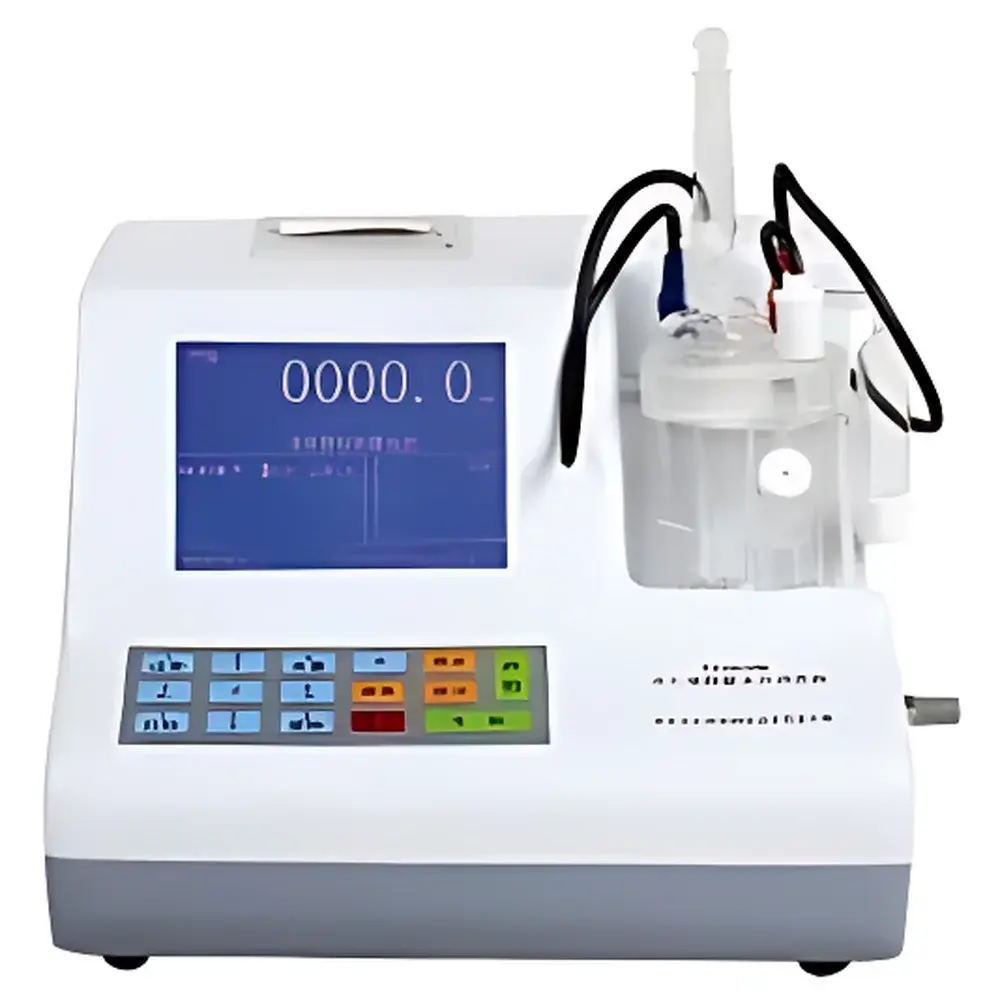
TimePower TP653 Karl Fischer Coulometric Moisture Analyzer
| Brand | TimePower |
|---|---|
| Model | TP653 |
| Type | Coulometric Karl Fischer Titrator |
| Measurement Principle | Coulometric Titration (Karl Fischer) |
| Water Range | 3 µg – 100 mg H₂O |
| Resolution | 0.1 µg |
| Accuracy | ±20% at 3 µg, ±10% at 10 µg, ±1% at 100 µg, ±0.5% above 100 µg (excluding sample handling error) |
| Electrolysis Current | 0–400 mA |
| Display | Backlit Chinese LCD |
| Data Storage | Internal non-volatile memory |
| Printer | Thermal printer (36-character Chinese/ASCII output) |
| Operating Temperature | 10–40 °C |
| Power Supply | AC 220 V ±10%, 50 Hz ±10% |
| Power Consumption | <200 W |
| Dimensions (W×D×H) | 310 × 315 × 215 mm |
| Weight | 3.5 kg |
| Enclosure | Corrosion-resistant engineering plastic |
| Compliance | GB/T 1600, GB 7600, GB/T 683, GB/T 11133, SH/T 0246, SH/T 0255 |
Overview
The TimePower TP653 Karl Fischer Coulometric Moisture Analyzer is a precision laboratory instrument engineered for trace-level water quantification in diverse chemical matrices using the coulometric Karl Fischer titration method. Unlike volumetric KF systems, the TP653 generates iodine electrochemically via controlled current application to the anode compartment of a sealed dual-cell electrolytic cell—enabling direct, stoichiometric determination of water content without reagent standardization or burette calibration. This principle ensures high reproducibility and minimal reagent consumption, making it ideal for low-moisture samples (<100 ppm) where accuracy below 10 µg H₂O is critical. The analyzer is widely deployed in QC laboratories across petroleum refining, pharmaceutical manufacturing, agrochemical R&D, and fine chemical synthesis—where regulatory adherence to pharmacopoeial and industrial standards (e.g., USP <921>, EP 2.5.12, ASTM D6304) demands rigorous moisture control.
Key Features
- 32-bit embedded microprocessor with real-time operating system for deterministic control of titration dynamics and background drift compensation
- Dual-circuit balanced electrolysis architecture minimizing polarization effects and improving endpoint detection sensitivity
- Hermetically sealed, waterproof electrolytic cell design reducing equilibration time and extending reagent service life beyond 500 analyses per fill
- Integrated automated reagent dispensing and waste evacuation system eliminating manual handling and enhancing operator safety
- Real-time electrochemical current vs. time curve visualization on high-contrast monochrome LCD for diagnostic assessment of reagent activity and cell stability
- Six programmable calculation formulas supporting custom moisture reporting formats (e.g., % w/w, ppm, mg/kg) with automatic unit conversion
- Non-volatile internal memory storing up to 1,000 measurement records with timestamp, sample ID, and result metadata for audit-ready data retention
- Thermal printer with bilingual character support (ASCII + GB2312) enabling direct hardcopy output compliant with GLP documentation requirements
Sample Compatibility & Compliance
The TP653 accommodates a broad spectrum of sample types—including volatile organic solvents (e.g., acetone, THF), viscous liquids (lubricating oils, silicone fluids), hygroscopic solids (APIs, excipients, catalysts), and gaseous streams (via optional gas sampling module). Its coulometric mode eliminates volumetric errors associated with syringe injection variability, delivering consistent performance across matrices with varying conductivity and solvation behavior. The instrument meets essential national standard requirements including GB/T 1600 (pesticide formulations), GB 7600 (transformer oil), GB/T 683 (alcohols), GB/T 11133 (hydrocarbon solvents), SH/T 0246 (light distillates), and SH/T 0255 (additive packages). While not pre-certified to ISO/IEC 17025 or FDA 21 CFR Part 11, its architecture supports validation protocols required for GMP environments—including electronic signature implementation, audit trail configuration, and user access level management when integrated into validated LIMS workflows.
Software & Data Management
The TP653 operates autonomously without external PC dependency, yet supports full data export via USB interface in CSV format for post-processing in Excel or statistical analysis platforms. All stored measurements include instrument serial number, operator ID (user-defined), date/time stamp, method identifier, raw coulomb count, calculated water mass, and pass/fail status relative to user-set acceptance criteria. The thermal printer generates tamper-evident reports containing all parameters necessary for regulatory review—including reagent lot numbers (manually entered), cell conditioning status, and drift correction values. For laboratories requiring electronic record integrity, the device’s deterministic firmware allows integration with third-party electronic lab notebook (ELN) systems through RS-232 or Modbus RTU protocols under defined validation protocols.
Applications
- Quantification of residual moisture in lyophilized biopharmaceutical intermediates per ICH Q5C guidelines
- Trace water analysis in lithium battery electrolytes (LiPF₆ solutions) where H₂O < 20 ppm impacts SEI layer formation
- Quality control of polymerization inhibitors (e.g., hydroquinone, MEHQ) in styrene monomer streams
- Moisture verification in aviation turbine fuels (Jet A-1) per ASTM D6304 Class B specifications
- Stability-indicating assay of moisture-sensitive prodrugs during accelerated aging studies
- Batch release testing of silica-based desiccants and molecular sieves used in packaging validation
FAQ
What is the minimum detectable water mass for the TP653?
The instrument achieves a resolution of 0.1 µg H₂O, with reliable quantitation beginning at 3 µg (±20% uncertainty) under optimized environmental and operational conditions.
Can the TP653 analyze solid samples directly?
Yes—solids must be dissolved in KF-compatible solvents (e.g., chloroform/methanol mixtures) prior to injection; optional oven attachments are not supported by this model.
Is the electrolyte cell reusable?
The dual-compartment cell is designed for repeated use over hundreds of analyses when maintained per manufacturer instructions; replacement cells are available as consumables.
Does the TP653 support remote operation or network connectivity?
No native Ethernet or Wi-Fi capability exists; communication is limited to USB mass storage and RS-232 serial interfaces for data transfer only.
How often does the system require recalibration?
Coulometric KF analyzers do not require routine calibration—accuracy is intrinsically tied to Faraday’s constant and electrode surface area; periodic verification with certified water standards (e.g., 1.00 mg/g Disodium Tartrate Dihydrate) is recommended quarterly.






