
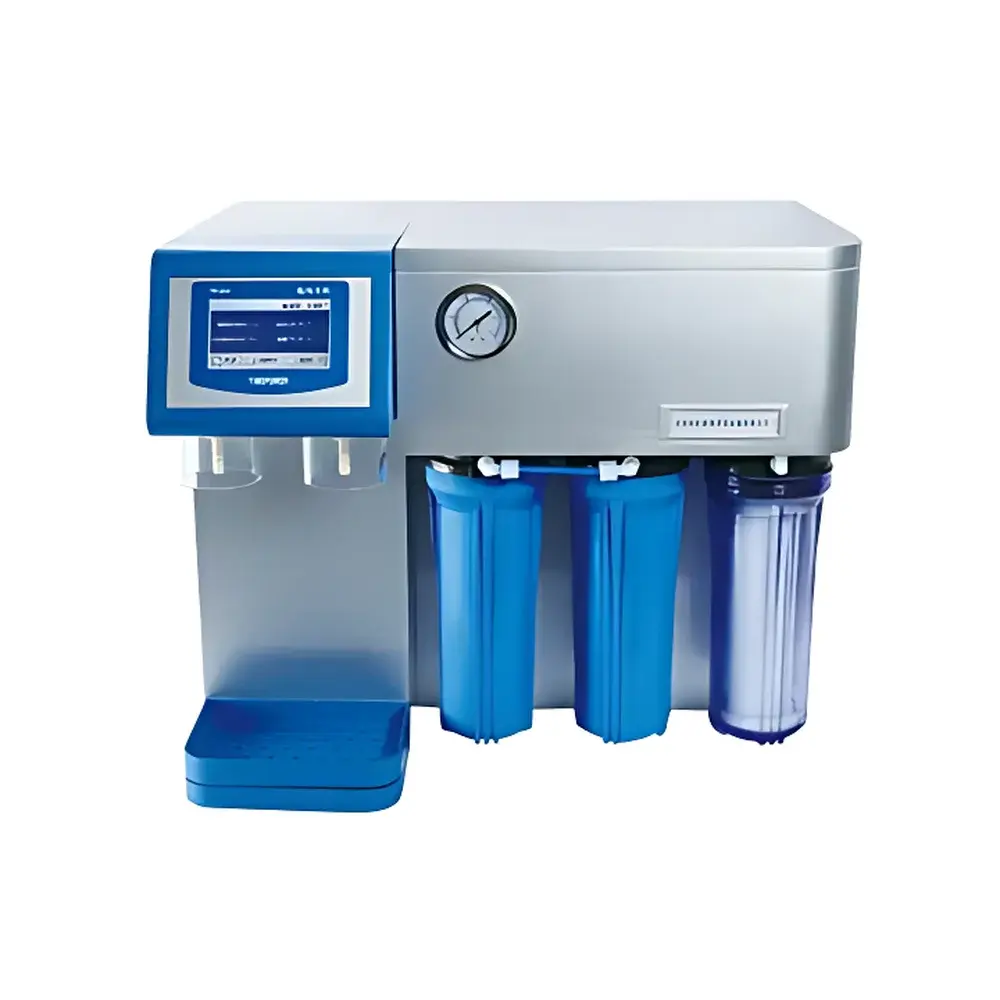
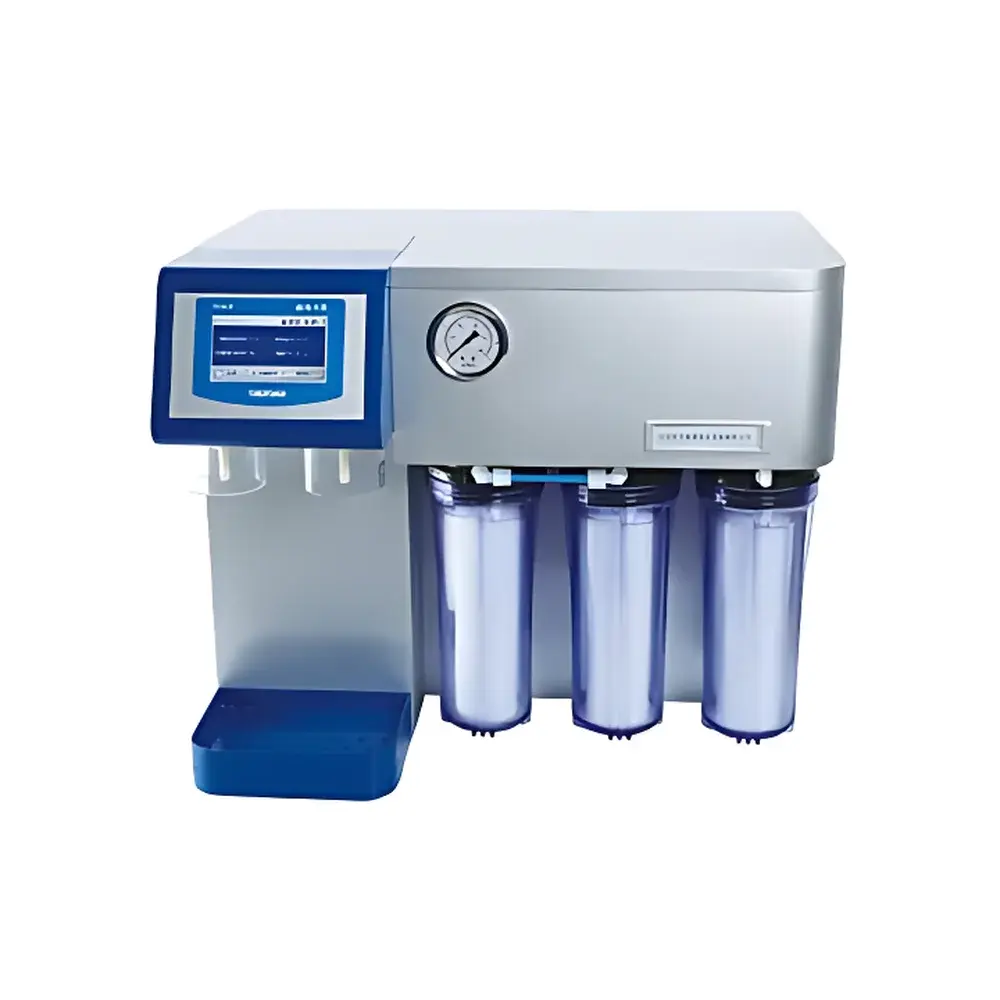
Timepower TP301/TP302 Series Laboratory Ultra-Pure Water System
| Brand | Timepower |
|---|---|
| Origin | Beijing, China |
| Manufacturer Type | Direct Manufacturer |
| Regional Classification | Domestic (China) |
| Model | TP301 / TP302 |
| Pure Water Grade | ASTM Type II / GB6682 Grade III |
| RO Permeate Conductivity | 0–50 µS/cm |
| Ultra-Pure Water Resistivity | 18.25 MΩ·cm @ 25 °C |
| Total Organic Carbon (TOC) | <10 ppb |
| Particles (>0.22 µm) | <1/mL |
| Bacteria | <0.1 CFU/mL |
| Endotoxins | <0.001 EU/mL |
| Silica (as SiO₂) | <10 ppb |
| Heavy Metals (e.g., Fe, Cu, Ni, Cr, Zn, Na, K, Al) | <0.1–20 ppb |
| Cation/Anion Residuals | Cl⁻ <0.01 ppb, NO₂⁻ <0.02 ppb, NO₃⁻ <0.02 ppb, SO₄²⁻ <0.01 ppb |
| Terminal Filtration | 0.22 µm hydrophilic membrane |
| Operating Temperature | 5–40 °C |
| Power Supply | 220 V ±10%, 50 Hz |
| Dimensions (W×D×H) | 600 × 470 × 520 mm |
| Weight | 40 kg |
| Feed Source (TP301) | Municipal tap water |
| Feed Source (TP302) | Pre-treated RO or distilled water |
| Integrated Features | LCD touchscreen interface, automated backwash cycle, programmable ultra-pure water recirculation, real-time resistivity monitoring, quantitative dispensing, DC ultra-pure water delivery pump |
Overview
The Timepower TP301/TP302 Series Laboratory Ultra-Pure Water System is an integrated, multi-stage purification platform engineered for consistent production of Type I ultrapure water (ASTM D1193-20, ISO 3696:1987, and GB/T 6682–2008 Class I) and Type II pure water (GB/T 6682–2008 Class III, ASTM CAP/NCCLS standards). Its core architecture combines reverse osmosis (RO) as the primary desalination barrier, followed by mixed-bed ion exchange resin polishing and terminal 0.22 µm microfiltration. The RO stage achieves >99% rejection of dissolved ions, colloids, bacteria, endotoxins, and organic macromolecules via size exclusion and charge repulsion mechanisms under applied hydraulic pressure. Subsequent deionization removes residual ionic species to yield resistivity values up to 18.25 MΩ·cm at 25 °C — the theoretical maximum for water at equilibrium with atmospheric CO₂. This system is designed for continuous, low-maintenance operation in regulated laboratory environments where water purity directly impacts analytical reproducibility, reagent stability, and instrument longevity.
Key Features
- Real-time, temperature-compensated resistivity monitoring with on-screen display and audible alert thresholds
- Programmable automatic recirculation loop maintains ultra-pure water quality within the distribution loop, minimizing microbial proliferation and TOC accumulation
- Capacitive touchscreen interface with intuitive menu navigation, user-defined dispensing volumes (1 mL–9999 mL), and programmable rinse cycles
- Dedicated ultra-pure water delivery system using a brushless DC pump optimized for low pulsation, minimal particle generation, and silent operation
- Integrated pre-filter, RO membrane, dual-stage ion exchange cartridge (mixed-bed resin), and 0.22 µm final filter — all housed in modular, service-friendly cassettes
- Automated daily RO membrane backwash and periodic system sanitization routines reduce manual intervention and extend consumable life
- Microprocessor-based control logic with event logging, error diagnostics, and maintenance countdown timers
Sample Compatibility & Compliance
The TP301/TP302 delivers water compliant with stringent international standards required for critical applications: ASTM D1193 Type I, ISO 3696 Grade 1, CLSI EP22-A2, and GB/T 6682–2008 Class I. It meets specifications for trace metal analysis (ICP-MS, GF-AAS), molecular biology (PCR, cell culture media preparation), HPLC mobile phase preparation, and calibration standard dilution. All wetted materials — including housing, tubing, and filters — are USP Class VI-certified and leach-resistant. The system supports GLP/GMP-aligned workflows through configurable audit trail logging (optional firmware upgrade), password-protected parameter modification, and timestamped operational records. While not inherently 21 CFR Part 11-compliant out-of-the-box, its data export capability (via USB or RS232) enables integration into validated LIMS or ELN platforms requiring electronic record retention.
Software & Data Management
The embedded IC microcontroller manages all operational sequences, including feed pressure regulation, RO recovery optimization, resin exhaustion prediction, and flow rate calibration. System status, consumable lifetime estimates, and historical resistivity/TOC trends are accessible via the local LCD interface. For centralized monitoring, optional serial communication (RS232) allows connection to lab network servers or SCADA systems. Raw data exports (CSV format) support post-hoc QC review and regulatory submission. Firmware updates are performed locally via USB port, ensuring long-term adaptability to evolving water quality protocols without hardware replacement.
Applications
This system serves as a primary water source for high-sensitivity instrumentation including liquid chromatography–mass spectrometry (LC-MS), inductively coupled plasma optical emission spectroscopy (ICP-OES), and atomic absorption spectroscopy (AAS). It supports sterile technique requirements in pharmaceutical QC labs (USP , EP 2.2.44), nucleic acid amplification workflows, and semiconductor wafer rinsing where particulate contamination must remain below 1 particle/mL at ≥0.22 µm. Routine use extends to buffer preparation for electrophoresis, tissue culture media formulation, and cleaning of precision optics and metrology equipment. The TP302 variant — configured for RO or distilled feed — is particularly suited for facilities with existing central RO infrastructure seeking point-of-use polishing.
FAQ
What feed water quality is required for the TP301 model?
The TP301 accepts municipal tap water meeting typical Chinese urban supply standards (residual chlorine ≤1 ppm, turbidity ≤1 NTU, SDI ≤5). Pre-treatment with activated carbon and sediment filtration is recommended where feed water contains high hardness, iron, or chlorine.
How often must consumables be replaced?
Typical service intervals: pre-filter cartridges every 3–6 months; RO membrane every 18–24 months (dependent on feed TDS and usage); mixed-bed resin every 6–12 months or upon resistivity drop below 15 MΩ·cm. System alerts notify users based on cumulative volume processed.
Can the system be validated per ISO/IEC 17025 or GMP Annex 15?
Yes — the TP301/TP302 supports IQ/OQ/PQ documentation packages. Key parameters (resistivity, TOC, microbial count, particle count) are measurable using standardized test methods; validation templates and calibration certificates for onboard sensors are available upon request.
Is remote monitoring supported?
Standard configuration includes local LCD and USB data export. Ethernet or Wi-Fi modules are available as factory-installed options for SNMP or Modbus TCP integration into building management systems.
Does the system comply with environmental disposal regulations for spent resins?
Spent ion exchange resins are classified as non-hazardous waste under China’s HW13 category when fully exhausted and properly dried. Disposal must follow local municipal hazardous waste guidelines; Timepower provides Material Safety Data Sheets (MSDS) for all consumables.



