
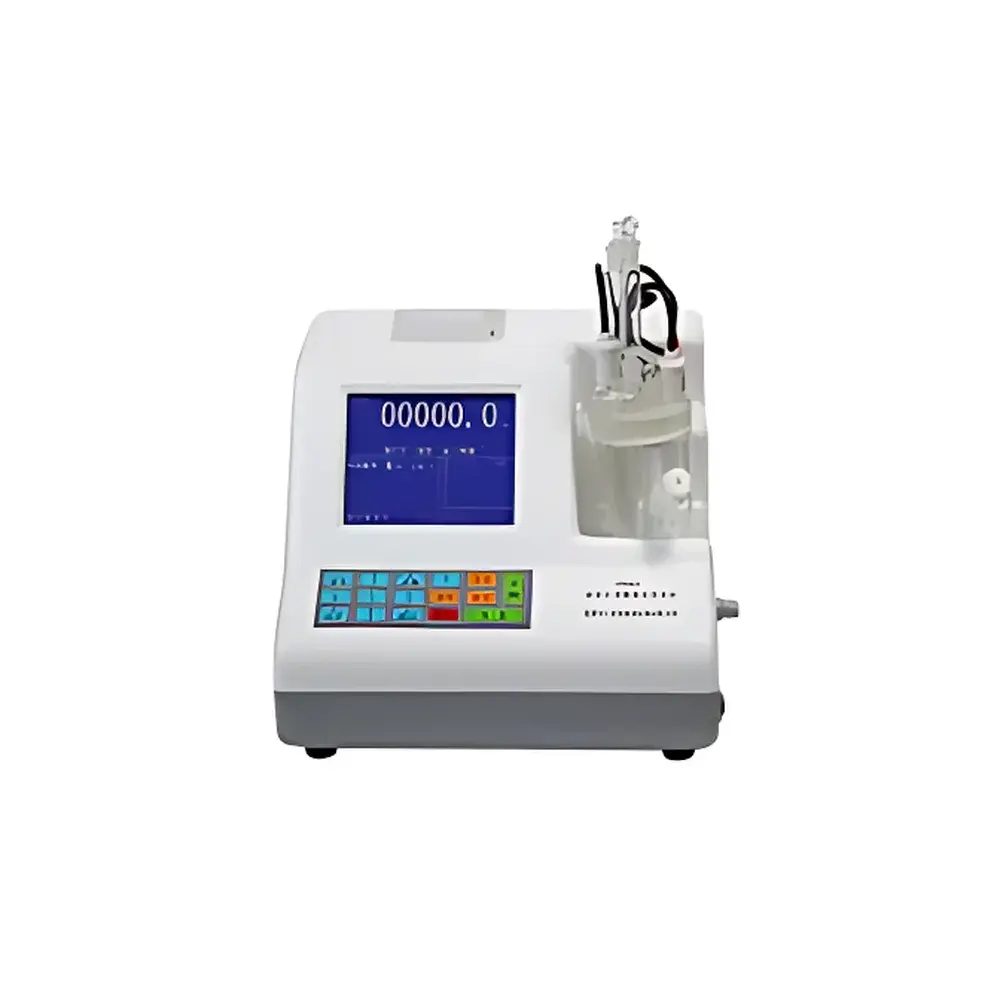
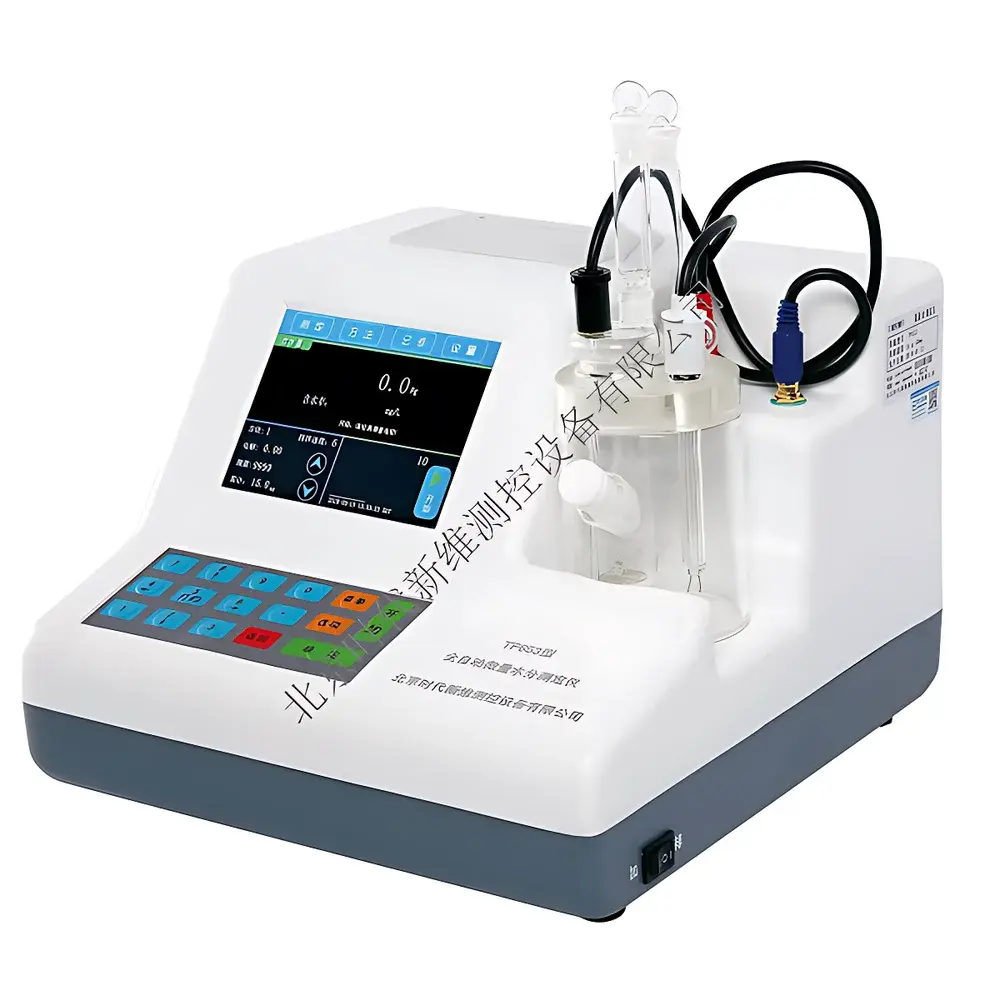
TimePower TP653 Coulometric Karl Fischer Moisture Titrator
| Brand | TimePower |
|---|---|
| Origin | Beijing, China |
| Manufacturer Type | Direct Manufacturer |
| Instrument Type | Coulometric Karl Fischer Moisture Analyzer |
| Titration Method | Fully Automated Coulometric Titration |
| Measurement Resolution | 0.1 µg |
| Water Content Range | 3 µg – 100 mg (H₂O) |
| Accuracy | ±3 µg (for 3–1,000 µg), ±0.3% (for >1 mg, excluding sample weighing error) |
| Minimum Dispensing Increment | 1 µL |
| Electrolysis Current Control | 0–400 mA, auto-regulated |
| Display | 5.6-inch color TFT-LCD touchscreen |
| Interface | RS-232 for balance & PC connectivity |
| Printer | Integrated thermal printer |
| Operating Environment | 20–30 °C, ≤85% RH |
| Power Supply | AC 220 V ±10%, 50 Hz ±10% |
| Max. Power Consumption | ≤40 W |
| Dimensions (W×D×H) | 300 × 290 × 200 mm |
| Weight | 3.7 kg |
Overview
The TimePower TP653 is a fully automated coulometric Karl Fischer (KF) moisture titrator engineered for high-precision quantification of trace water content in liquid, solid, and gaseous samples. It operates on the fundamental electrochemical principle of coulometric KF titration: water reacts stoichiometrically with iodine generated in situ via controlled electrolysis of iodide ions at the anode (I⁻ → ½I₂ + e⁻), while sulfur dioxide and methanol serve as auxiliary reagents in the electrolyte solution. According to Faraday’s law, the total charge passed during electrolysis is directly proportional to the moles of iodine produced—and thus to the moles of water consumed. This enables absolute, reagent-free quantification without volumetric standardization, delivering inherent accuracy and long-term stability. Designed for routine QC laboratories in power generation, petrochemical refining, pharmaceutical manufacturing, agrochemical R&D, and food safety testing, the TP653 complies with core international and national standards including ASTM D6304, ISO 15512, GB/T 7600, GB/T 6283, SH/T 0246, and SH/T 0255.
Key Features
- 32-bit embedded microprocessor with real-time operating system for deterministic control, low-latency response, and stable baseline drift compensation.
- Coulometric electrolysis cell with patented waterproof sealing architecture—reduces equilibration time by >40% and extends electrolyte service life under continuous operation.
- Dynamic real-time electrolysis current monitoring and adaptive current regulation (0–400 mA) ensure optimal iodine generation kinetics across the full 3 µg–100 mg water range.
- Integrated dual-mode user interface: 5.6-inch capacitive touchscreen + tactile physical keypad—designed for glove-compatible operation and >1 million actuation cycles.
- Twelve programmable analysis methods; six user-defined methods stored non-volatily with timestamped execution logs for audit readiness.
- Automated reagent dispensing and waste evacuation system minimizes operator exposure to toxic, flammable KF reagents and eliminates manual syringe handling errors.
- On-screen live electrolysis curve visualization (current vs. time) enables immediate assessment of reagent activity, endpoint detection reliability, and cell contamination status.
- Full RS-232 connectivity for seamless integration with analytical balances (auto-weight import) and LIMS or ELN systems via ASCII protocol.
Sample Compatibility & Compliance
The TP653 accommodates diverse sample matrices without modification: low-viscosity solvents (e.g., acetone, THF, alcohols), viscous oils (transformer oil, lubricants), hygroscopic solids (APIs, excipients, catalysts), and pressurized gases (via gas sampling valve). Its coulometric design inherently avoids reagent consumption variability associated with volumetric KF, making it especially suitable for samples with <100 ppm water content. The instrument supports GLP/GMP workflows through time-stamped method execution records, electronic signature-ready operation logs, and configurable audit trails. While not pre-certified to FDA 21 CFR Part 11, its data integrity architecture—including immutable event logging, password-protected method editing, and exportable CSV/Excel reports—facilitates validation against regulatory requirements for pharmaceutical and medical device manufacturers.
Software & Data Management
Data acquisition, calculation, and reporting are handled internally without dependency on external PCs. All measurements compute water mass (µg), concentration (ppm or %), and relative standard deviation (RSD) automatically using IUPAC-recommended stoichiometric factors. Results are stored with full metadata: date/time stamp, method ID, operator ID (optional), sample ID, weight (if balance-linked), and raw current-time integral. Reports export via USB or thermal printer in ISO 8601-compliant format. Firmware updates are performed via USB flash drive with checksum verification. No cloud connectivity or remote telemetry is implemented—ensuring data sovereignty and network isolation per laboratory IT security policies.
Applications
- Transformer oil moisture monitoring per IEC 60814 and ASTM D1533 for predictive maintenance in substations.
- Residual solvent analysis in pharmaceutical intermediates (ICH Q3C) and final drug products.
- Water content verification in lithium battery electrolytes (LiPF₆ solutions) and cathode/anode materials.
- Quality control of polymer precursors (e.g., polyamide monomers, epoxy resins) where hydrolysis sensitivity dictates strict <50 ppm limits.
- Gas-phase moisture determination in SF₆ insulating gas and compressed air systems per ISO 8573-3.
- Stability-indicating assay for hygroscopic APIs during accelerated aging studies (ICH Q1A).
FAQ
What is the difference between coulometric and volumetric Karl Fischer titration?
Coulometric KF generates iodine electrochemically within the titration cell, enabling sub-microgram detection limits and eliminating need for standardized titrant. Volumetric KF uses pre-prepared iodine-containing titrant; it is better suited for higher water concentrations (>100 ppm) but introduces pipetting and standardization uncertainties.
Can the TP653 analyze solid samples directly?
Yes—using oven coupling (external accessory) or dissolution in water-immiscible solvents (e.g., chloroform, toluene) followed by direct injection. Sample homogeneity and complete water release must be validated per method development guidelines.
How often should the electrolyte be replaced?
Replace when cumulative water consumption approaches 90% of the manufacturer-specified reagent capacity (typically 1–2 g H₂O per 100 mL), or when baseline current drift exceeds 2 µA over 5 minutes in idle state.
Is the instrument compliant with ISO/IEC 17025 requirements?
The TP653 provides traceable measurement capability when used with certified reference materials (e.g., sodium tartrate dihydrate, 15.66% H₂O) and calibrated balances. Full accreditation requires documented uncertainty budgets, inter-laboratory comparisons, and system suitability testing per ISO/IEC 17025:2017 Clause 7.7.
Does the TP653 support multi-user access control?
Yes—administrator and operator accounts with configurable permissions (method edit, calibration, report export) are enforced via PIN-based authentication. Login/logout events are logged with timestamps and user IDs.



