
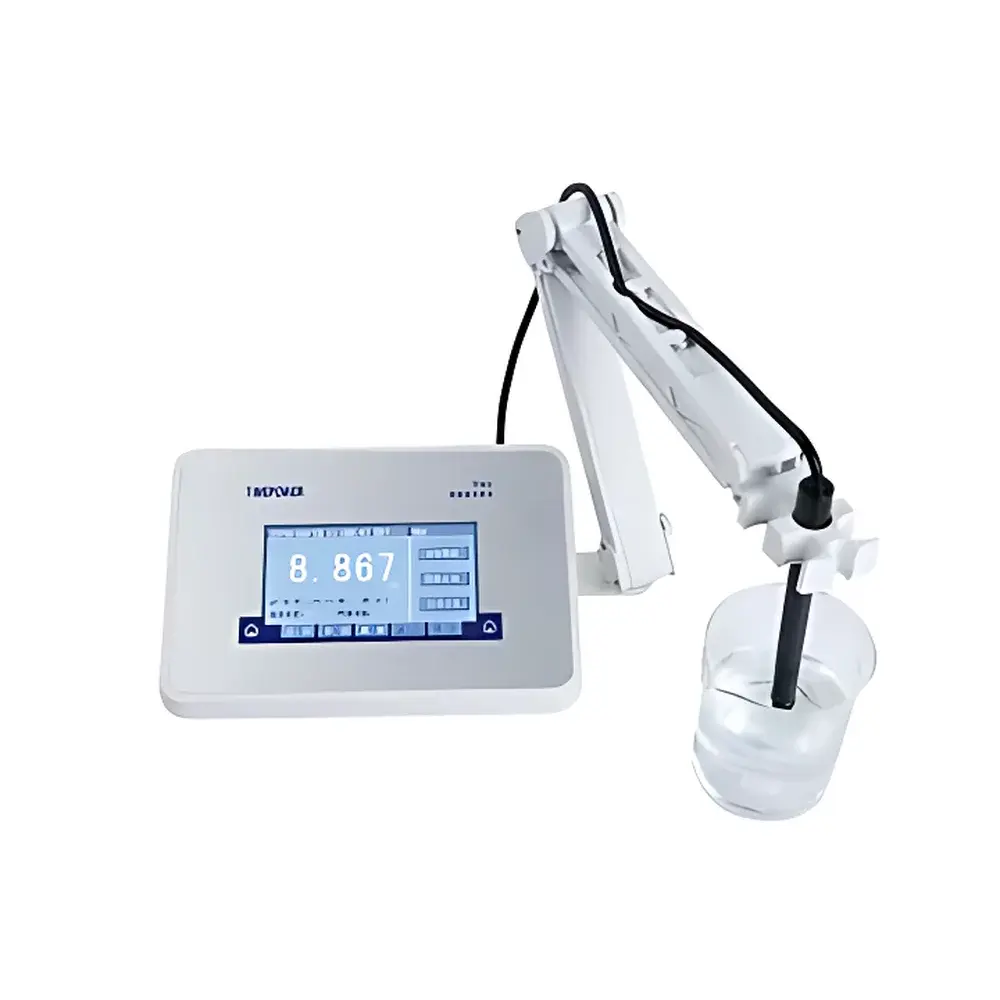
TimePower TP351 Laboratory Dissolved Oxygen Analyzer
| Brand | TimePower |
|---|---|
| Origin | Beijing, China |
| Manufacturer | TimePower Co., Ltd. |
| Type | Benchtop Laboratory DO Meter |
| Measurement Principle | Polarographic Electrochemical Sensor (Clark-type) |
| Range | 0.00–20.00 mg/L |
| Accuracy | ±0.2 mg/L (±1.5% F.S.) |
| Resolution | 0.01 mg/L |
| Repeatability | ≤1% RSD |
| Detection Limit | 2 ppb (O₂) |
| Response Time (T₉₀) | <5 min at 25°C |
| Temperature Compensation Range | 0.1–60.0°C |
| Sample Temp. Range | 5–60°C |
| Display | 128×64 dot-matrix LCD, Chinese interface |
| Power Supply | AC 220 V ±10%, 50 Hz, <5 W |
| Dimensions | 225 × 210 × 260 mm (L×W×H) |
| Weight | 1.5 kg |
Overview
The TimePower TP351 Laboratory Dissolved Oxygen Analyzer is a benchtop electrochemical instrument engineered for precise, reproducible measurement of dissolved oxygen (DO) concentration in aqueous samples across environmental monitoring, wastewater treatment, aquaculture, and academic research laboratories. It employs a polarographic (Clark-type) sensor principle—where molecular oxygen diffuses through a gas-permeable membrane and undergoes reduction at a noble metal cathode under a fixed polarizing voltage—generating a current linearly proportional to O₂ partial pressure. This method ensures high selectivity for dissolved oxygen with minimal interference from common ions or redox-active species. The TP351 integrates a Pt100 temperature sensor for automatic thermal compensation and utilizes 24-bit analog-to-digital conversion to maintain signal integrity across its full 0.00–20.00 mg/L range. Designed for stability in routine QC workflows, it meets fundamental performance expectations aligned with ASTM D888 and ISO 5814 standards for electrochemical DO determination.
Key Features
- Polarographic sensor architecture with YXI-type membrane cap—optimized for rapid response (T₉₀ < 5 min at 25°C) and robust performance in high-oxygen or turbid wastewater matrices
- High-integration circuit design using advanced SMT (surface-mount technology), ensuring long-term operational stability and resistance to electrical noise
- Low-power microcontroller platform enabling consistent measurement fidelity while minimizing thermal drift and energy consumption (<5 W)
- 24-bit A/D converter delivering enhanced resolution (0.01 mg/L) and signal-to-noise ratio for trace-level quantification near detection limits (2 ppb)
- Intuitive Chinese-language menu interface on a 128×64 pixel monochrome LCD—designed for accessibility without requiring specialized training
- Built-in cyclic data storage with auto-overflow management; supports manual timestamped recall of up to 500 measurement records
Sample Compatibility & Compliance
The TP351 is validated for use with freshwater, seawater (with appropriate salinity correction), treated effluent, surface runoff, and process water in municipal and industrial settings. Its operational sample temperature range (5–60°C) and compensated range (0.1–60.0°C) accommodate both ambient and thermally elevated samples. The instrument complies with general requirements for laboratory-grade DO analyzers per ISO/IEC 17025 technical competence criteria and supports adherence to regulatory frameworks including EPA Method 360.1 (for wastewater) and APHA Standard Methods 4500-O G. While not certified for GLP/GMP environments out-of-the-box, its stable calibration retention (±1% F.S./4 h) and traceable measurement chain enable integration into auditable QA/QC protocols when paired with documented electrode maintenance logs and standardization against Winkler titration references.
Software & Data Management
The TP351 operates as a standalone unit with no proprietary PC software dependency. All configuration—including calibration point selection (one- or two-point), temperature unit (°C/°F), and auto-hold activation—is managed directly via front-panel navigation. Measurement data are stored internally with time stamps (real-time clock synchronized during power-on); users may scroll through historical entries or reset memory as needed. For traceability in regulated labs, external documentation of calibration dates, standard concentrations used (e.g., air-saturated water at defined temp/pressure), and electrode replacement history is recommended. Though the device does not support USB or RS-232 output, its low-power design and deterministic behavior facilitate inclusion in automated lab notebooks where manual entry is part of SOP-defined workflows.
Applications
- Environmental monitoring labs performing routine DO profiling of rivers, lakes, and estuaries in compliance with national water quality standards
- Wastewater treatment plants conducting BOD incubation support, aeration basin optimization, and final effluent verification
- Aquaculture facilities maintaining optimal oxygen levels for fish health and feed conversion efficiency
- University teaching laboratories demonstrating fundamental principles of aquatic chemistry, respiration kinetics, and sensor electrochemistry
- Industrial process control for boiler feedwater deaeration validation and cooling tower management
FAQ
What type of electrode does the TP351 use, and is it field-replaceable?
The instrument uses a polarographic Clark-type sensor with a replaceable YXI membrane cap and electrolyte solution. Electrode replacement and membrane servicing are user-performed following manufacturer-provided instructions.
Does the TP351 support automatic barometric pressure compensation?
No—barometric pressure adjustment must be applied manually during calibration using known local atmospheric conditions or reference standards.
Can the TP351 measure dissolved oxygen in saline or brackish water?
Yes, provided salinity correction is applied post-measurement using standard algorithms (e.g., Benson & Krause equation) or verified against calibrated standards of equivalent ionic strength.
Is the instrument suitable for GLP-compliant environments?
It can be deployed within GLP workflows when supported by documented procedures for calibration, maintenance, and data recording—but lacks built-in audit trail or electronic signature capabilities required for full 21 CFR Part 11 compliance.
What is the recommended calibration frequency for routine use?
Daily calibration is advised for high-accuracy applications; weekly calibration is acceptable for screening-level monitoring when instrument stability and electrode condition are verified between sessions.
Related Products







