
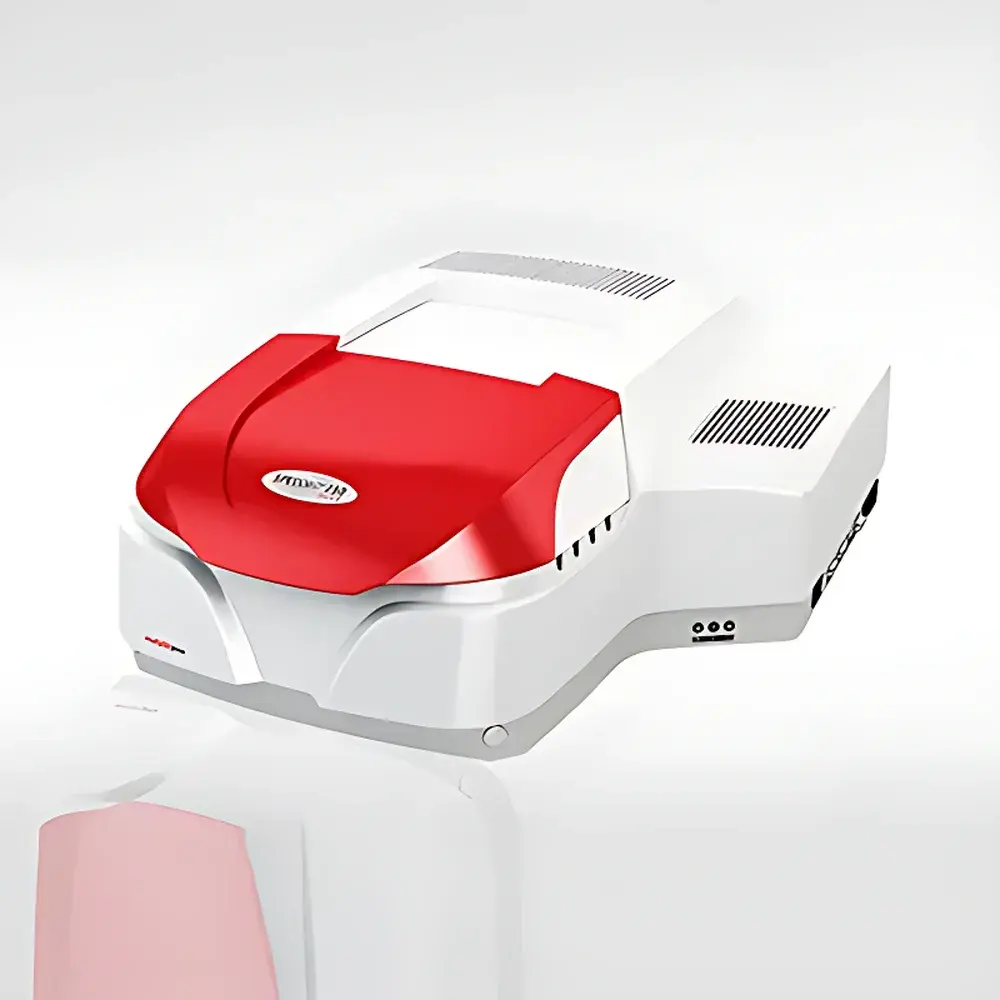
Analytik Jena SPECORD 250 PLUS UV/Vis Spectrophotometer
| Brand | Analytik Jena |
|---|---|
| Origin | Germany |
| Manufacturer | Analytik Jena AG |
| Instrument Type | Double-beam |
| Detector | CCD array |
| Wavelength Range | 190–1100 nm |
| Wavelength Accuracy | < ±0.1 nm (full range) |
| Wavelength Repeatability | ≤ 0.02 nm |
| Spectral Bandwidth | 0.2, 0.5, 1, 2, and 4 nm (motorized selection) |
| Stray Light | < 0.0002% at 340 nm (NaNO₂) |
| Scan Speed | up to 12,000 nm/min |
| Automatic Wavelength Calibration | 内置 Ho-glass reference filter |
| Light Sources | Deuterium lamp (190–350 nm) and tungsten-halogen lamp (350–1100 nm) |
| Software | SCIENCE™ v3.x with GLP-compliant audit trail, method library, and instrument self-check (SCS) |
Overview
The Analytik Jena SPECORD 250 PLUS UV/Vis Spectrophotometer is a high-performance double-beam spectrophotometer engineered for precision absorbance, transmittance, and reflectance measurements across the ultraviolet, visible, and near-infrared spectral regions (190–1100 nm). Based on legacy Carl Zeiss optical architecture—originating from the former Zeiss analytical instrumentation division—the instrument integrates monolithic Zeiss diffraction gratings, high-reflectivity mirrors, and thermally stabilized optical benches to ensure long-term photometric stability and maximum photon throughput. Its double-beam design continuously compensates for source drift and environmental fluctuations, delivering high reproducibility in routine QC, research-grade quantitation, and kinetic monitoring. The system employs a high-resolution CCD linear array detector, enabling simultaneous acquisition of full spectra without mechanical scanning—eliminating wavelength drive errors and enhancing measurement speed and robustness.
Key Features
- Zeiss-engineered optical path: All critical optical components—including holographic gratings, collimating/focusing mirrors, and beam splitters—are manufactured to Zeiss metrological tolerances, ensuring superior stray light suppression (<0.0002% at 340 nm) and exceptional signal-to-noise ratio.
- Motorized, five-step spectral bandwidth selection (0.2, 0.5, 1, 2, and 4 nm): Enables method-specific resolution control compliant with pharmacopeial requirements (e.g., USP <857>, EP 2.2.25, JP 2.04).
- Auto-calibrating wavelength axis: Integrated holmium oxide glass reference filter enables automated, traceable wavelength validation before each measurement sequence—meeting ISO/IEC 17025 and FDA 21 CFR Part 11 data integrity expectations.
- Ultra-high-speed spectral acquisition: Full-spectrum capture in under 0.5 seconds (12,000 nm/min equivalent), supporting real-time kinetics, enzyme assays, and rapid dissolution profiling.
- Intelligent light source management: Software-controlled automatic switching between deuterium and tungsten-halogen lamps ensures optimal spectral coverage while maximizing lamp lifetime and minimizing thermal load.
- Self-diagnostic SCS (System Check System): Performs automated verification of lamp status, detector linearity, shutter function, and grating positioning—generating timestamped diagnostic logs for GLP/GMP audits.
Sample Compatibility & Compliance
The SPECORD 250 PLUS accommodates liquid, solid, and gaseous samples via interchangeable accessories—including temperature-controlled cuvette holders (−10 to 100 °C), integrating spheres (for diffuse reflectance), fiber-optic probes, and dedicated dissolution interface modules. Its large sample compartment supports third-party accessories (e.g., flow cells, electrochemical cells, and gas-handling manifolds) without optical realignment. The instrument complies with IEC 61010-1 (safety), IEC 61326-1 (EMC), and meets essential performance criteria outlined in ASTM E275, ISO 6425, and Ph. Eur. 2.2.25. When operated with SCIENCE™ software v3.x, it supports 21 CFR Part 11–compliant electronic signatures, role-based access control, and immutable audit trails—validated for use in regulated pharmaceutical and clinical laboratories.
Software & Data Management
SCIENCE™ software provides a modular, workflow-driven interface designed for both novice and expert users. It includes over 200 pre-validated application methods covering food & beverage analysis (e.g., colorimetric determination of nitrites, polyphenols), water quality (COD, phosphate, heavy metals), pharmaceutical assay (dissolution testing per USP <711>), and life science applications (protein A280, DNA quantification). All methods enforce parameter constraints (e.g., bandwidth, slit width, integration time) to prevent non-compliant acquisitions. Data export conforms to ASTM E1382 (spectral data interchange format) and can be directly imported into LIMS or statistical packages (e.g., JMP, Minitab). Raw spectral data are stored in vendor-neutral .jdx and .csv formats; processed reports include metadata (operator ID, instrument serial number, calibration timestamps) required for regulatory submissions.
Applications
The SPECORD 250 PLUS serves as a primary analytical tool in quality control laboratories for raw material identification, finished product assay, and stability-indicating methods. Its fast scan capability supports real-time monitoring of chemical reactions—such as hydrolysis kinetics or redox titrations—while its low stray light performance enables accurate measurement of highly absorbing samples (e.g., concentrated dyes, nanoparticle suspensions). In dissolution testing, direct integration with USP Apparatus I–IV enables synchronized sampling, spectral acquisition, and concentration calculation—reducing manual intervention and transcription errors. Researchers utilize its high wavelength accuracy for bandgap determination in nanomaterials and for validating reference standards against NIST-traceable SRMs.
FAQ
Does the SPECORD 250 PLUS support compliance with pharmacopeial monographs?
Yes—it meets all instrumental requirements specified in USP <857>, EP 2.2.25, and JP 2.04, including spectral bandwidth verification, wavelength accuracy, and stray light limits.
Can the instrument be validated for GxP environments?
Yes—SCIENCE™ software includes IQ/OQ/PQ templates, electronic signature workflows, and full audit trail functionality aligned with FDA 21 CFR Part 11 and EU Annex 11.
Is external calibration required for wavelength accuracy?
No—built-in holmium oxide reference enables daily automated wavelength verification; optional NIST-traceable calibration kits are available for periodic full-system validation.
What sample formats are supported beyond standard cuvettes?
Integrating spheres (solid reflectance), fiber-optic probes (in situ monitoring), microvolume adapters (0.5–2 µL), and dissolution interface modules are fully supported and auto-recognized by the software.
How is lamp lifetime optimized during operation?
The software automatically selects the appropriate lamp (D₂ or W-Halogen) based on the selected wavelength range and deactivates idle sources—extending operational life to ≥2,000 hours for D₂ and ≥5,000 hours for halogen.







