
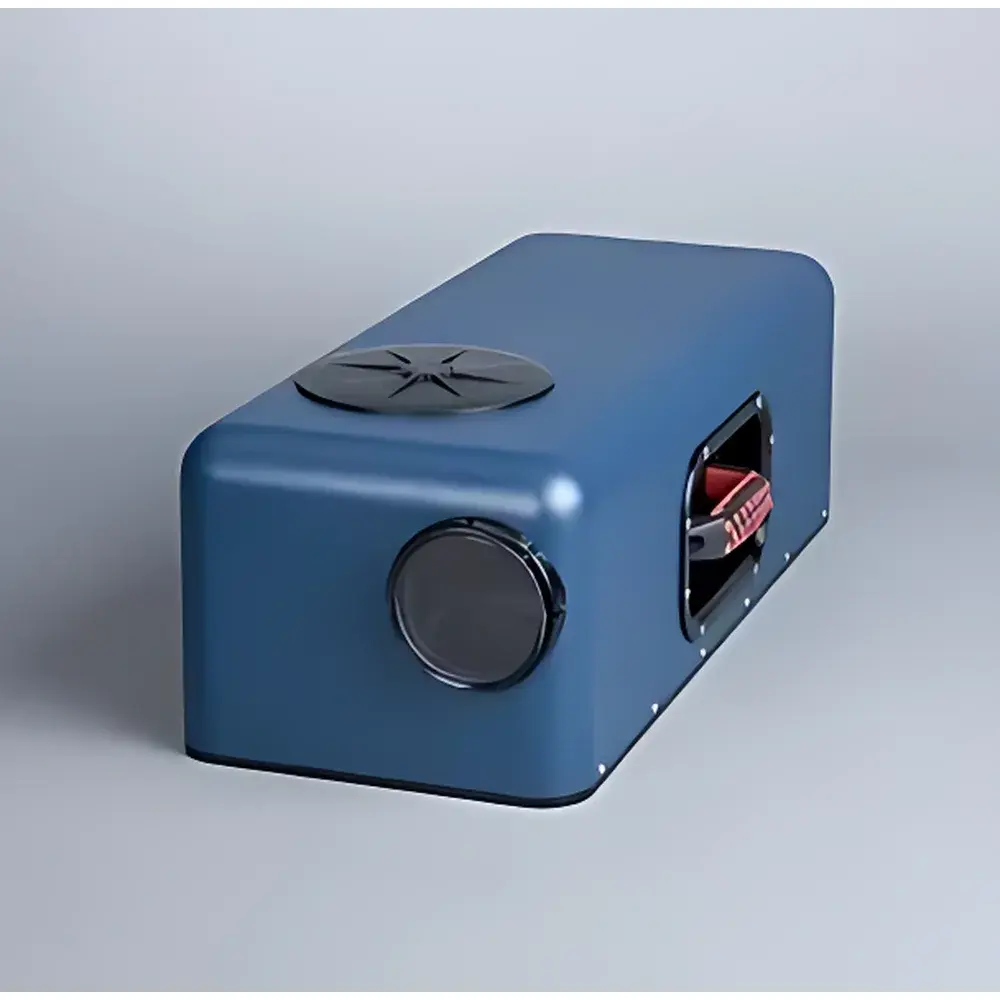
SOC SurfaceOptics SOC720SW Short-Wave Infrared Hyperspectral Imaging Spectroradiometer
| Brand | SOC/SurfaceOptics |
|---|---|
| Origin | USA |
| Manufacturer Type | Authorized Distributor |
| Origin Category | Imported |
| Model | SOC720SW |
| Price | Upon Request |
| Spectral Range | 900–1700 nm |
| Spectral Resolution | 6.25 nm |
| Spectral Channels | 128 |
| Spectral Smile Distortion | <1.5 nm |
| Detector Type | High-Sensitivity InGaAs Linear Array (D* = 1.5 × 10¹³ cm·√Hz/W @ 1550 nm) |
| Spatial Resolution | 640 pixels (across-track) × 640 pixels (nominal along-track) |
| Frame Rate | 30 spatial lines/second |
| Data Cube Acquisition Time | 20 seconds/cube |
| Bit Depth | 14-bit |
| Optical f-number | f/2.4 |
| Total Field of View / Instantaneous Field of View (35 mm lens) | 10° / 0.015625° |
| Interface | Camera Link |
| Built-in Scanning Mechanism | Yes |
| Power Supply | AC / 12 V DC |
| Weight | 30 lbs (13.6 kg) |
| Dimensions | 7" × 14" × 22" (178 × 356 × 559 mm) |
| Data Format | Open BIL (Band Interleaved by Line), IEEE 754 floating-point compatible |
| Software Suite | HyperSpect™ (acquisition), HSAnalysis™ (radiometric calibration & spectral analysis), MIDIS™ (real-time multi-channel processing engine) |
Overview
The SOC SurfaceOptics SOC720SW is a field-deployable, push-broom short-wave infrared (SWIR) hyperspectral imaging spectroradiometer engineered for quantitative remote sensing and laboratory-grade spectral characterization of terrestrial and industrial targets. Operating across the 900–1700 nm spectral window—spanning the critical molecular absorption bands of water, cellulose, lignin, hydrocarbons, and transition-metal oxides—the instrument employs a high-fidelity Offner-type imaging spectrometer coupled with a thermoelectrically stabilized 640-element InGaAs linear detector array. Its optical design minimizes smile and keystone distortion (<1.5 nm spectral smile), ensuring spatial-spectral fidelity required for pixel-level radiometric accuracy. The system implements calibrated reflectance and radiance measurement protocols traceable to NIST-standard reference panels, supporting applications demanding metrological rigor—including ASTM E2792 (Standard Practice for Hyperspectral Imaging of Surfaces) and ISO 18381 (Remote Sensing — Spectral Calibration Procedures). Unlike scanning-based or snapshot systems, the SOC720SW delivers true line-scan hyperspectral cubes with fixed spectral sampling (6.25 nm per channel) and consistent signal-to-noise ratio across all 128 bands.
Key Features
- High-fidelity SWIR imaging spectrometer with <1.5 nm spectral smile distortion and f/2.4 throughput optimized for low-light, high-speed acquisition
- 14-bit digitization with >1.5 × 10¹³ cm·√Hz/W detectivity (D*) at 1550 nm, enabling robust detection of weak spectral signatures in low-reflectance materials
- Integrated push-broom scanning mechanism eliminating external motion dependencies; supports both tripod-mounted stationary surveys and UAV- or vehicle-mounted mobile deployments
- Camera Link interface (base configuration) ensures deterministic, low-latency data streaming up to 30 spatial lines per second with full 640 × 128 spectral cube reconstruction
- Real-time onboard processing via optional MIDIS™ engine: executes simultaneous multi-band correlation, triple-integration spectral averaging, and on-the-fly atmospheric correction preprocessing
- Factory-radiometrically calibrated using NIST-traceable integrating sphere sources and reflectance standards; calibration coefficients embedded in every BIL file header
Sample Compatibility & Compliance
The SOC720SW is designed for non-contact, standoff spectral analysis of heterogeneous surfaces under ambient or controlled illumination. It accommodates reflective, semi-transparent, and scattering samples—including soil aggregates, leaf canopies, polymer films, semiconductor wafers, and painted metal substrates—without requiring sample preparation or vacuum environments. All hardware and firmware comply with FCC Part 15 Class A emissions limits and CE marking requirements for electromagnetic compatibility (EN 61326-1). Software modules adhere to FDA 21 CFR Part 11 guidelines for audit trail generation, electronic signature support, and data integrity preservation during calibration and analysis workflows. Data provenance—including integration time, lamp status, temperature sensor readings, and dark current compensation parameters—is automatically logged in each acquired cube per GLP/GMP-aligned metadata conventions.
Software & Data Management
Acquisition and preprocessing are managed through HyperSpect™, a Windows-native application providing real-time preview, exposure optimization, and automated dark/reference frame capture. HSAnalysis™ provides comprehensive post-acquisition tools: absolute radiometric calibration, spectral unmixing (via constrained least-squares and vertex component analysis), endmember extraction (N-FINDR, PPI), and spectral angle mapper (SAM) classification. All raw and processed data are stored in open BIL format—fully compatible with ENVI, Python (scikit-image, spectral), MATLAB, and GDAL ecosystems—eliminating proprietary lock-in or conversion bottlenecks. MIDIS™ processor firmware supports real-time band math, dynamic range compression, and streaming output to HDF5 or NetCDF-4 containers for HPC pipeline ingestion.
Applications
- Agriculture & Environmental Monitoring: Crop health assessment via NDVI, water stress index (WSI), chlorophyll-a/b ratio mapping, and soil organic carbon estimation
- Industrial Process Control: Real-time polymer identification, plastic sorting (PET/HDPE/LDPE), pharmaceutical tablet coating uniformity, and battery electrode composition verification
- Defense & Security: Covert material discrimination (explosives precursors, camouflage netting), border surveillance under degraded visual conditions, and missile plume spectral signature analysis
- Geosciences: Mineral identification (kaolinite, montmorillonite, goethite), lithological mapping, and hydrocarbon seep detection
- Materials Science: Thin-film thickness profiling, semiconductor defect localization, and corrosion product phase identification on metallic alloys
FAQ
Is the SOC720SW suitable for airborne or UAV-based deployment?
Yes—the system’s compact form factor (13.6 kg), low power draw (12 V DC), and vibration-resistant optical bench make it compatible with medium-class UAVs and light aircraft; optional GPS/IMU synchronization enables georeferenced cube stitching.
Does the system support external triggering or synchronization with other sensors?
Yes—Camera Link interface includes TTL trigger input/output pins for hardware-synchronized operation with LiDAR, thermal cameras, or lighting strobes.
Can I perform absolute reflectance measurements without a laboratory setup?
Yes—field-ready workflow includes integrated reference panel capture routines and bidirectional reflectance distribution function (BRDF) correction templates validated against ISO 18381 test procedures.
What spectral libraries are included with HSAnalysis™?
The software ships with the USGS Digital Spectral Library (Version 7), ECOSTRESS spectral database, and NASA JPL ASTER mineral library—expandable via user-defined ASCII or ENVI-compatible spectral files.
Is MIDIS™ processing mandatory for basic data acquisition?
No—MIDIS™ is an optional acceleration module; core acquisition and calibration functions operate fully in HyperSpect™ and HSAnalysis™ without it.




