
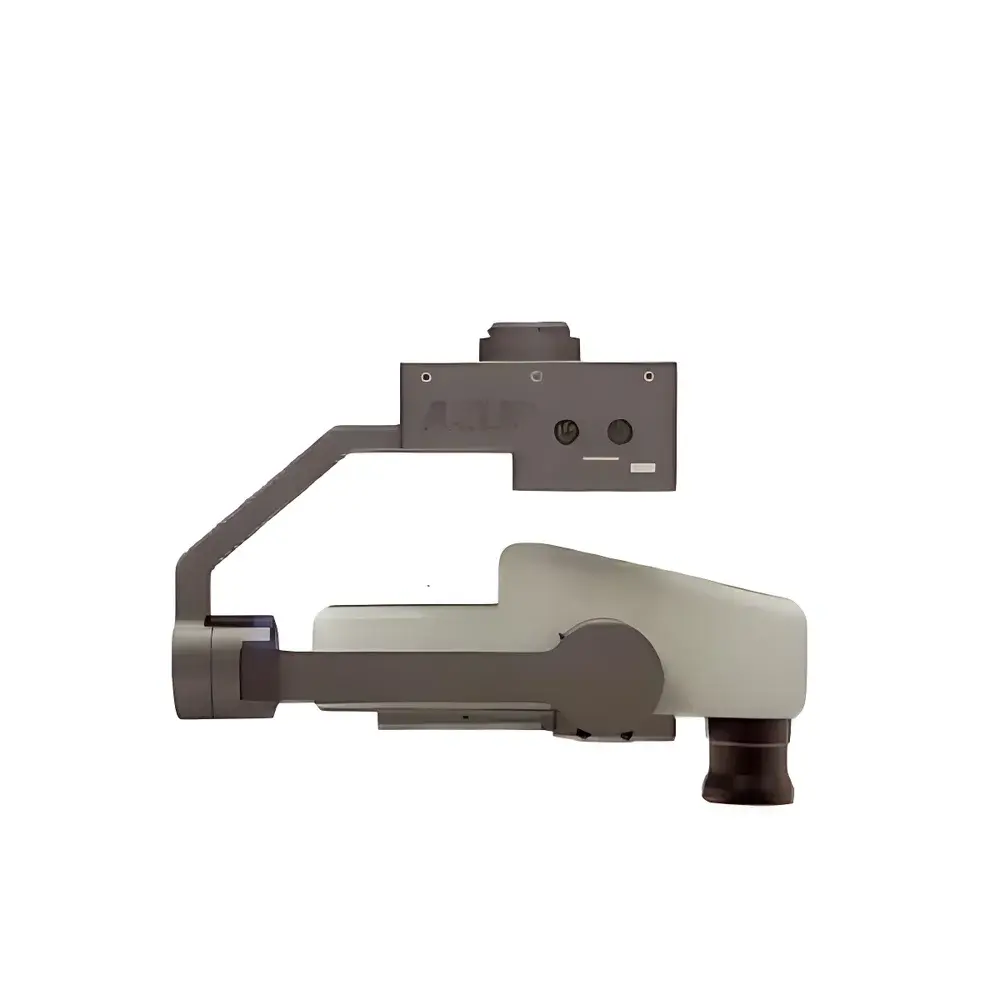
Cubert V185 Hyperspectral Imaging Camera
| Brand | Cubert |
|---|---|
| Origin | Germany |
| Model | V185 |
| Spectral Range | 450–950 nm |
| Spectral Resolution | 8 nm @ 532 nm |
| Imaging Mode | Snapshot (Frame-Based) |
| Weight | ~500 g |
| Platform Compatibility | Ground-based & Airborne (UAV-integrated) |
| Data Acquisition Speed | Full hyperspectral cube in ≤ 1 ms |
Overview
The Cubert V185 is a snapshot-based, frame-sequential hyperspectral imaging camera engineered for high-fidelity spectral-spatial data acquisition in dynamic environments. Unlike push-broom or scanning systems that rely on mechanical motion or platform translation to build spectral cubes, the V185 employs a patented dual-layer image sensor architecture—integrating spatial and spectral information simultaneously across all bands within a single exposure. This solid-state, no-moving-parts optical design operates on the principle of spatial-spectral multiplexing, enabling true simultaneous capture of 125 spectral channels (at 8 nm FWHM resolution centered at 532 nm) across the visible to near-infrared (VNIR) range (450–950 nm). Its sub-millisecond full-cube acquisition time (<1 ms) eliminates motion-induced artifacts, making it uniquely suited for airborne remote sensing applications where platform velocity, vibration, and attitude variability would otherwise compromise data integrity.
Key Features
- Snapshot Hyperspectral Imaging: Captures complete 3D (x, y, λ) data cubes in a single integration period—no line scanning, no temporal interpolation, no geometric misregistration between bands.
- VNIR Spectral Coverage: Continuous spectral response from 450 nm to 950 nm with uniform sampling and calibrated radiometric response traceable to NIST standards.
- High Temporal Fidelity: Effective frame rates up to 1,000 Hz for sequential cube acquisition—enabling real-time monitoring of rapidly evolving surface phenomena (e.g., crop stress onset, chemical plume dispersion).
- UAV-Optimized Form Factor: Compact footprint (120 × 80 × 65 mm) and mass of approximately 500 g facilitate seamless integration onto fixed-wing and multirotor UAVs without significant payload penalty or aerodynamic impact.
- Robust Optical Architecture: All-refractive, achromatized lens system with integrated bandpass filtering; no moving gratings, prisms, or MEMS elements—ensuring long-term calibration stability under thermal and mechanical stress.
- Onboard Metadata Embedding: Each acquired cube includes embedded GPS time stamps, IMU orientation quaternions (when synchronized), exposure settings, and sensor temperature—critical for georeferencing and radiometric correction workflows.
Sample Compatibility & Compliance
The V185 is designed for non-contact, passive reflectance-based measurement of natural and engineered surfaces—including vegetation canopies, soil substrates, mineral outcrops, agricultural fields, and industrial materials. It complies with ISO 17025-aligned calibration protocols for spectral responsivity and radiometric linearity. While not a regulated medical or pharmaceutical device, its data output supports compliance with ASTM E2993 (Standard Practice for Hyperspectral Imaging Data Collection and Analysis) and is routinely deployed in USDA-ARS, ESA FLEX mission validation campaigns, and EU Copernicus Sentinel-2 ground-truthing initiatives. The system’s firmware and metadata structure conform to the HDF5-based Spatio-Temporal Asset Catalog (STAC) extension for interoperability with cloud-native geospatial analytics platforms.
Software & Data Management
The V185 ships with Cubert’s proprietary HyperSpectra Studio software suite—compatible with Windows 10/11 (64-bit) and Linux (Ubuntu LTS). The application supports batch processing of raw .hsi files into calibrated reflectance cubes (.envi format), spectral library matching (using ENVI-compatible ASCII spectral databases), supervised and unsupervised classification (K-means, ISODATA, SVM), and automated derivation of biophysical indices including NDVI, EVI, PRI, and MCARI. All processing steps are logged with full audit trail functionality—including user ID, timestamp, parameter values, and input/output file hashes—to support GLP-compliant documentation requirements. Export options include GeoTIFF with embedded projection metadata, CSV spectral profiles per ROI, and NetCDF-4 for time-series cube stacking.
Applications
- Agricultural Monitoring: Early detection of nitrogen deficiency, water stress, and pathogen infestation via spectral trajectory analysis across growth stages.
- Environmental Surveying: Mapping invasive species distribution, post-fire vegetation recovery, and wetland hydrological zonation using narrowband spectral absorption features.
- Geological Prospecting: Identification of clay mineral assemblages (e.g., kaolinite, smectite) and iron oxide/hydroxide alteration zones through diagnostic VNIR absorption minima.
- Industrial Quality Control: Non-destructive verification of pigment homogeneity in coatings, detection of microplastic contamination in water surfaces, and sorting of recyclable polymer types.
- Defense & Security: Camouflage detection, concealed object identification under foliage (via NIR penetration), and standoff detection of chemical residue signatures.
FAQ
Does the V185 require external illumination for operation?
No—it is optimized for solar-illuminated reflectance measurements but can be used with calibrated active illumination sources (e.g., halogen or LED panels) for controlled lab or indoor applications.
Is radiometric calibration performed in-field or only at the factory?
Factory calibration is provided with each unit (including dark current, flat-field, and spectral response curves); however, optional field-deployable calibration kits (reflectance panels, irradiance sensors) enable periodic recalibration per ASTM E2799 guidelines.
Can the V185 be synchronized with GNSS/IMU units from third-party vendors?
Yes—via TTL trigger input and ASCII NMEA 0183 serial interface; supported protocols include u-blox M8T, NovAtel SPAN, and SBG Systems Ellipse series.
What is the maximum sustainable data throughput during continuous acquisition?
At full resolution (1024 × 1024 spatial pixels × 125 spectral bands × 16-bit depth), sustained write speed is 1.2 GB/s to NVMe SSD—achievable using the optional Cubert CUB-IO-PCIe acquisition card.
Is FDA 21 CFR Part 11 compliance available for the software platform?
HyperSpectra Studio does not currently implement electronic signature or audit trail modules required for Part 11 enforcement; however, its metadata logging framework meets foundational ALCOA+ principles for data integrity in non-regulated research contexts.
Related Products




