
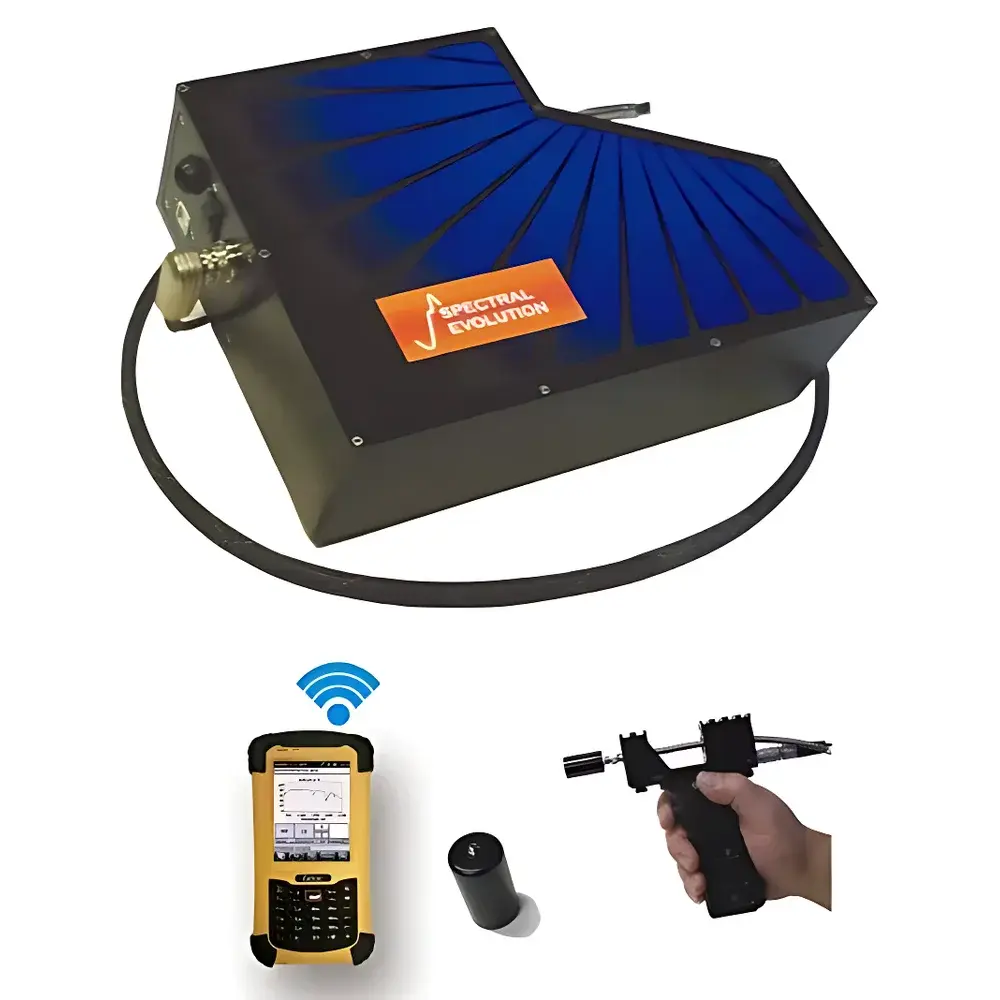
Spectral Evolution SR-1900 Portable Field Spectroradiometer
| Brand | Spectral Evolution |
|---|---|
| Origin | USA |
| Model | SR-1900 |
| Instrument Type | Portable |
| Operating Principle | Grating-based, non-scanning array detector |
| Spectral Range | 350–2500 nm |
| Spectral Sampling Interval | 1.5 nm (350–1000 nm), 3.8 nm @ 1500 nm, 2.5 nm @ 2100 nm |
| Measurement Mode | Diffuse Reflectance |
| Calibration Traceability | NIST-traceable |
| Data Acquisition Software | DARWin SP (Windows) & DARWin CE Mobile (PDA-compatible) |
| Detector Configuration | 512-element enhanced Si array (350–1000 nm) + 256-element thermoelectrically cooled InGaAs array (900–2500 nm) |
| Weight | < 3.3 kg (< 8 lbs) |
| Interface | USB 2.0 and Bluetooth 4.0 |
| A/D Resolution | 16-bit |
| Dimensions | 21.6 × 30.5 × 8.9 cm (8.5″ × 12″ × 3.5″) |
Overview
The Spectral Evolution SR-1900 Portable Field Spectroradiometer is a high-fidelity, NIST-traceably calibrated instrument engineered for quantitative spectral measurement across the ultraviolet, visible, and short-wave infrared (UV-VIS-SWIR) regions — from 350 nm to 2500 nm. It operates on a fixed-grating, full-array detection architecture with no moving optical components, eliminating mechanical drift and calibration instability inherent in scanning monochromator or fiber-coupled dispersive systems. The dual-detector design integrates an enhanced silicon photodiode array (350–1000 nm) and a thermoelectrically cooled indium gallium arsenide (InGaAs) array (900–2500 nm), enabling simultaneous, high-sensitivity acquisition across its entire spectral range. With a full-spectrum acquisition time of ≤100 ms and up to 10 spectra per second, the SR-1900 supports real-time radiometric, reflectance, and irradiance measurements under variable field conditions — critical for time-sensitive remote sensing validation, vegetation phenotyping, and mineral spectral library development.
Key Features
- Fixed holographic grating and linear array detectors ensure long-term wavelength stability and eliminate recalibration requirements due to mechanical wear or thermal misalignment.
- Integrated shutter and drift-lock auto-calibration system compensates for thermal and electronic baseline drift during extended field deployments.
- Automatic dark current subtraction, exposure control, and integration time optimization adapt dynamically to ambient light intensity — from low-light forest understory to high-irradiance desert surfaces.
- Lightweight aluminum chassis (≤3.3 kg) provides mechanical rigidity and passive thermal stabilization, minimizing spectral shift over diurnal temperature cycles.
- Onboard Bluetooth 4.0 and USB 2.0 connectivity enable seamless integration with Windows PCs, ruggedized PDAs, or mobile tablets running DARWin CE Mobile software.
- Field-ready accessories include pistol-grip fiber optic probe, cosine-corrected fore-optics, optional integrating sphere, GPS-enabled PDA with 3-MP imaging, and custom transport cases with or without wheels.
Sample Compatibility & Compliance
The SR-1900 is optimized for non-contact, non-destructive measurement of diffuse reflectance from natural and engineered surfaces — including soils, vegetation canopies, mineral outcrops, painted substrates, photovoltaic materials, and water bodies. Its optical design conforms to ASTM E275, ISO 13406-2, and CIE S 014/E:2006 standards for spectral radiance and reflectance measurement geometry. All factory calibrations are traceable to the National Institute of Standards and Technology (NIST) via calibrated standard lamps and reference panels. The instrument meets IEC 61326-1 (EMC) and MIL-STD-810G (shock/vibration) for field robustness. Data integrity complies with GLP-aligned workflows: DARWin SP software supports audit trails, user-defined metadata tagging, and export formats compatible with ENVI, MATLAB, and Python-based spectral analysis pipelines.
Software & Data Management
DARWin SP (Windows) and DARWin CE Mobile (PDA) provide unified control, acquisition, and preliminary processing. Key capabilities include real-time spectral preview, automatic NDVI, GRVI, SAVI, EVI, PRI, WBI, and other 12+ vegetation indices; spectral matching against the USGS spectral library (v7); CIE color space conversion (XYZ, L*a*b*, chromaticity); solar simulator mode for PV material characterization; and irradiance-weighted energy calculations. Raw data is stored in vendor-neutral ASCII and HDF5 formats. Software supports batch processing, spectral smoothing (Savitzky-Golay), atmospheric correction (via empirical line method), and export to satellite sensor bandpasses (e.g., Landsat OLI, Sentinel-2 MSI, MODIS). All calibration files, measurement logs, and GPS-tagged georeferenced spectra are archived with embedded timestamps and operator IDs — fulfilling FDA 21 CFR Part 11 requirements for electronic records when configured with user authentication and digital signature modules.
Applications
- Earth observation ground truthing for satellite and UAV-based remote sensing missions (e.g., calibration/validation of Sentinel-2, Landsat 9, PRISMA).
- Quantitative plant phenotyping: chlorophyll content estimation, water stress detection, nitrogen status mapping, and senescence monitoring.
- Geological surveying and mineral identification using diagnostic absorption features in the SWIR region (e.g., Al-OH, Mg-OH, CO32−, Fe2+/Fe3+ bands).
- Soil spectroscopy for organic carbon, clay content, iron oxide, and moisture prediction using PLSR and machine learning models.
- Marine and inland water quality assessment: CDOM, chlorophyll-a, and suspended sediment concentration retrieval.
- Industrial applications: LED and solar simulator spectral output verification, thin-film coating characterization, and food quality screening (e.g., sugar content, bruise detection).
FAQ
Is the SR-1900 suitable for laboratory use as well as field deployment?
Yes — its thermal stability, NIST-traceable calibration, and dual-detector architecture support both controlled lab experiments and uncontrolled outdoor environments. The aluminum housing and passive cooling ensure minimal spectral drift over multi-hour sessions.
Can the SR-1900 measure absolute irradiance and radiance?
Yes — it includes factory-calibrated radiometric sensitivity coefficients for direct calculation of spectral irradiance (W/m²/nm) and radiance (W/m²/sr/nm) when used with appropriate cosine correctors or collimating optics.
What spectral resolution does the SR-1900 achieve across its range?
Resolution is defined by full width at half maximum (FWHM): ≤3.5 nm (350–1000 nm), ≤10 nm at 1900 nm, and ≤15 nm at 2500 nm — consistent with industry-standard field spectroradiometers for vegetation and mineral analysis.
Does DARWin software support third-party spectral libraries?
Yes — users may import custom spectral libraries in ASCII or ENVI format and perform spectral angle mapper (SAM), spectral feature fitting (SFF), or Euclidean distance matching alongside the built-in USGS database.
How is data security and traceability ensured in regulated environments?
DARWin SP supports role-based access control, electronic signatures, and immutable audit logs — enabling compliance with 21 CFR Part 11, ISO/IEC 17025, and GxP documentation requirements when deployed with validated IT infrastructure.





