
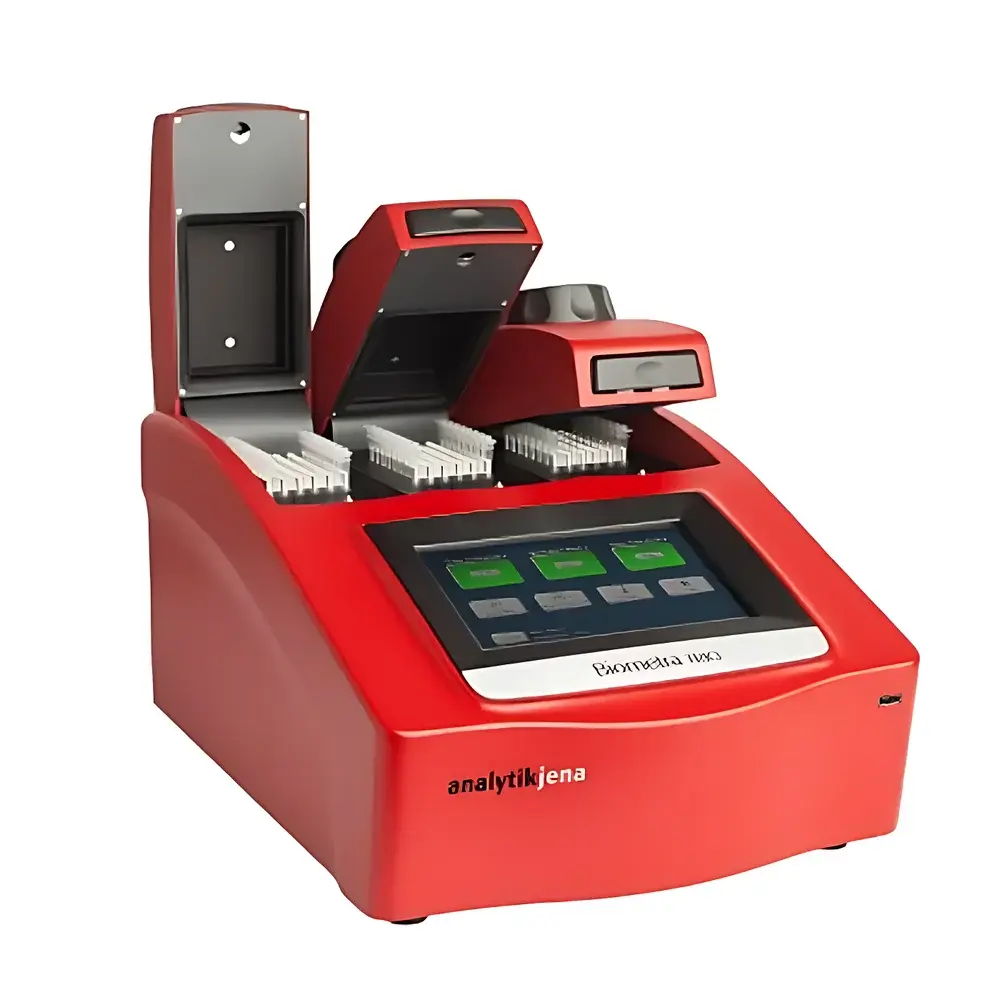
Analytik Jena Biometra TRIO 48 Three-Block PCR Thermal Cycler
| Brand | Analytik Jena |
|---|---|
| Origin | Germany |
| Manufacturer | Analytik Jena AG |
| Product Type | Imported Instrument |
| Model | Biometra TRIO 48 |
| Sample Throughput | 144 wells (3 × 48-well blocks) |
| Heating Rate | 5 °C/s |
| Temperature Accuracy | ±0.1 °C |
| Block Uniformity | ±0.2 °C across block |
| Display | 7-inch full-color capacitive touchscreen |
| Power Recovery | Auto-resume after power interruption |
| Tube Compatibility | Standard 0.2 mL tubes and 8-tube strips |
| Cooling Method | Passive air cooling with bottom intake / rear exhaust airflow |
Overview
The Analytik Jena Biometra TRIO 48 is a high-performance, three-block thermal cycler engineered for laboratories requiring parallel amplification of nucleic acids under independently programmable thermal conditions. Based on Peltier-driven solid-state thermoregulation, the instrument implements precise closed-loop temperature control across three physically separate 48-well aluminum heating blocks—each operating as an autonomous thermal module. This architecture enables simultaneous execution of up to three distinct PCR protocols without cross-contamination risk or thermal interference, delivering an effective maximum throughput of 144 samples per run. Designed in Jena, Germany, the TRIO 48 reflects over 28 years of iterative refinement in thermal cycler engineering, with emphasis on reproducibility, long-term stability, and compliance-ready operation in regulated environments.
Key Features
- Triple independent 48-well blocks with fully decoupled thermal control—no shared heating/cooling circuits ensures true protocol isolation.
- Precision temperature regulation: ±0.1 °C absolute accuracy across the full operational range (4–99 °C), validated per ISO/IEC 17025 traceable calibration procedures.
- Exceptional block uniformity: ≤±0.2 °C deviation between any two wells within a single block, critical for low-abundance target detection and multiplex assay consistency.
- High-speed thermal ramping at 5 °C/s (average), minimizing cycle time without compromising denaturation or annealing fidelity.
- 7-inch capacitive touchscreen interface with multi-language support (English, German, French, Spanish, Chinese), gesture-enabled navigation, and real-time graphical temperature profiling.
- Passive convection cooling system with bottom-intake and rear-exhaust airflow—enables side-by-side placement with adjacent instrumentation without thermal buildup or spatial conflict.
- Automatic power-fail recovery: Upon restoration of mains supply, the instrument resumes the interrupted protocol from the exact step and timepoint, preserving reaction integrity.
Sample Compatibility & Compliance
The Biometra TRIO 48 accepts standard 0.2 mL thin-walled PCR tubes and 8-tube strips without adapters, supporting both capped and skirted configurations. No proprietary consumables are required, ensuring compatibility with globally sourced reagents and master mixes. The system conforms to IEC 61010-1:2010 for laboratory equipment safety and meets electromagnetic compatibility requirements per EN 61326-1:2013. For laboratories operating under GLP or GMP frameworks, the instrument supports optional audit trail logging (via USB export) and complies with foundational data integrity principles aligned with FDA 21 CFR Part 11 when used with validated software configurations. Routine verification protocols—including block homogeneity mapping and ramp rate validation—are supported through built-in diagnostic routines and third-party calibration services.
Software & Data Management
Instrument control and method management are handled via the integrated firmware interface; no external PC is required for routine operation. Protocols are stored internally (up to 1,000 methods) with user-defined naming, versioning, and folder organization. All run logs—including start/end timestamps, actual vs. setpoint temperature traces, and error events—are timestamped and retained for ≥30 days. Data export is supported via USB 2.0 port in CSV format for integration into LIMS or statistical analysis platforms. While the TRIO 48 does not include cloud connectivity or remote monitoring, its deterministic behavior and deterministic file structure facilitate automated parsing in centralized lab informatics systems.
Applications
The TRIO 48 is routinely deployed in academic core facilities, clinical molecular diagnostics labs, and biopharmaceutical QC settings where concurrent optimization of primer sets, gradient-based assay development, or parallel sample processing is required. Typical use cases include: comparative gene expression analysis across treatment groups; validation of CRISPR editing efficiency using multiple sgRNA conditions; pathogen detection panels requiring distinct annealing temperatures per target; and high-volume pre-sequencing library amplification where batch-to-batch consistency must be maintained across independent thermal profiles. Its robustness and minimal maintenance footprint also make it suitable for field-deployable mobile labs and resource-constrained environments requiring high reliability without service dependency.
FAQ
Can the three blocks run different ramp rates simultaneously?
Yes—the TRIO 48 allocates independent Peltier drivers and PID controllers to each block, enabling asynchronous ramp rate, hold time, and temperature setpoint execution.
Is the block surface compatible with optical plates for real-time monitoring?
No—the TRIO 48 is a conventional endpoint thermal cycler and lacks optical excitation/detection modules; it is not designed for qPCR or melt curve analysis.
What maintenance is required beyond routine cleaning?
Annual verification of temperature accuracy and uniformity is recommended; no consumable parts (e.g., lamps, filters, or fluidics) require replacement during normal operation.
Does the instrument support barcode scanning or RFID tube tracking?
No—sample identification remains manual or externally managed via LIMS integration; the device does not feature embedded readers.
How is firmware updated?
Firmware updates are delivered as signed .bin files via USB stick and installed through the service menu; updates preserve all user protocols and calibration history.




