
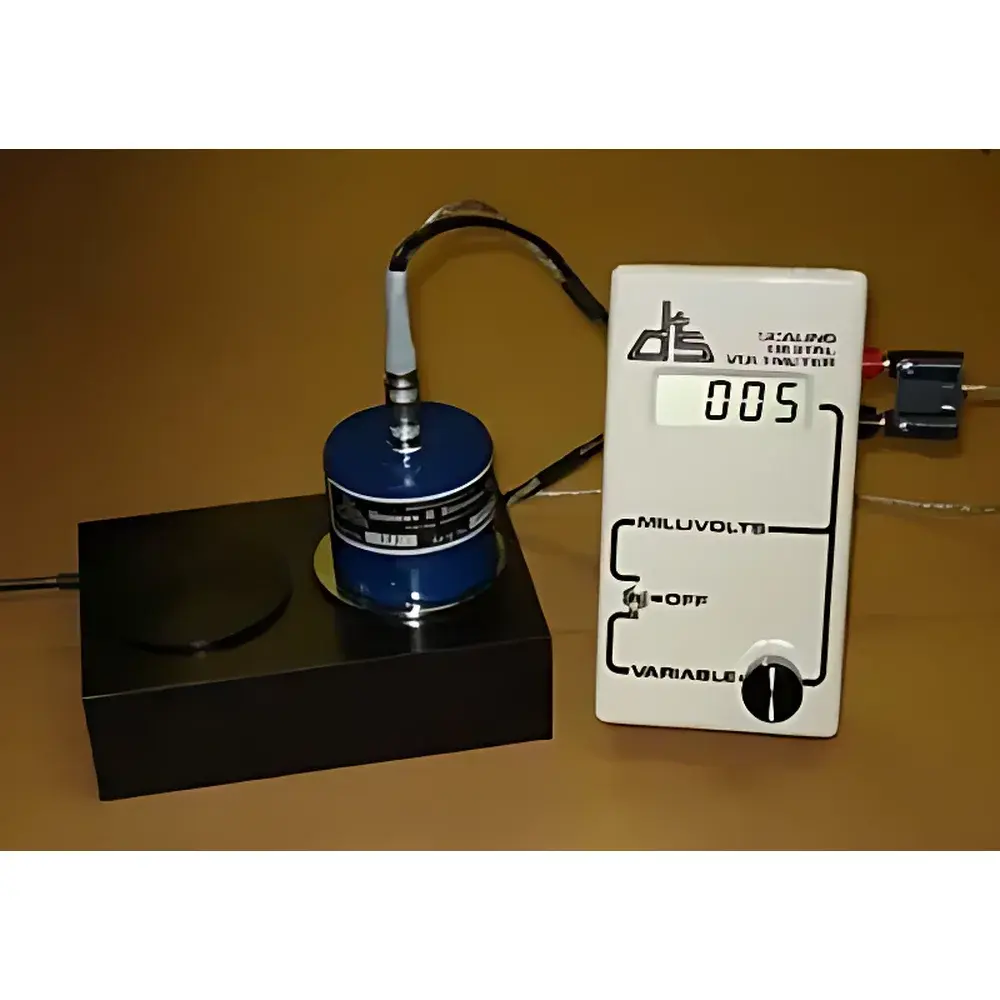
D&S AE1 Total Hemispherical Emissometer
| Brand | D&S |
|---|---|
| Origin | USA |
| Model | AE1/RD1 |
| Measurement Principle | Radiometric comparison against calibrated reference standards |
| Emissivity Range | 0.05–0.95 (total hemispherical, at sample temperature ≤ 54 °C / 130 °F) |
| Repeatability | ±0.01 |
| Response Time | 10 s per reading |
| Minimum Sample Diameter | 5.7 cm (2.25 in) |
| Output Linearity Error | < ±0.01 |
| Standard Bodies Included | Two high-emissivity (ε ≈ 0.95), two low-emissivity (ε ≈ 0.05) reference surfaces |
| Power Supply | 100–240 VAC, 50–60 Hz → 12 VDC adapter |
| Operating Ambient | Stable laboratory environment |
| Compliance | Designed for ASTM C1371, ISO 9277, and ASTM E1933-compliant emissivity validation workflows |
Overview
The D&S AE1 Total Hemispherical Emissometer is a precision radiometric instrument engineered for the direct, contactless measurement of total hemispherical emissivity (ε) of solid materials at moderate temperatures. It operates on the principle of comparative radiometry: the detector—mounted in a thermally stabilized, electrically heated housing—measures infrared radiant exitance from both a calibrated reference standard and the test specimen under identical thermal conditions. Since both surfaces are maintained at the same temperature using an integrated heat sink assembly, the ratio of their emitted radiant fluxes directly yields the sample’s emissivity relative to the known ε-value of the standard. This method eliminates dependence on absolute temperature measurement, blackbody cavity assumptions, or spectral integration, delivering high reproducibility (±0.01) without requiring sample heating, surface coating, or prior knowledge of material composition. The AE1 is optimized for routine quality control, thermal modeling validation, and materials characterization in aerospace, energy efficiency, and building science applications where accurate surface radiative properties govern thermal performance.
Key Features
- High-repeatability comparative measurement with ±0.01 emissivity repeatability across the 0.05–0.95 range
- Electrically heated detector head eliminates need for external furnaces or sample heating—only requires thermal equilibration between sample and reference via passive heat sink
- Direct linear voltage output (mV) proportional to emissivity; no post-processing or curve-fitting required
- Fast acquisition: stable reading obtained within 10 seconds after placement on surface
- Compact, benchtop-compatible design with integrated 12 VDC power supply and universal AC input (100–240 VAC, 50–60 Hz)
- Optional 12 V rechargeable battery pack enables field-deployable operation for up to 12 hours
- Dual-set reference standards included: two high-emissivity (ε ≈ 0.95) and two low-emissivity (ε ≈ 0.05) bodies—enabling in-situ calibration verification and long-term drift monitoring
Sample Compatibility & Compliance
The AE1 accommodates flat, curved, or irregularly shaped samples with minimum diameter of 5.7 cm (2.25 in). With optional adapters—AE-AD1 (1.5 in / 3.8 cm aperture), AE-AD3 (1.0 in / 2.54 cm aperture), or AE-ADP (1⅜ in port for high-curvature or low-conductivity cylindrical surfaces)—the system extends capability to small-diameter rods, tubing, and textured substrates. All measurements require sample and reference surfaces to be held at identical temperature (≤ 54 °C / 130 °F), enforced via thermal mass matching and passive heat sinking. The instrument supports compliance with ASTM C1371 (Standard Test Method for Determination of Emittance of Materials Near Room Temperature Using Portable Emissometers), ISO 9277 (Determination of specific surface area of solids by gas adsorption), and ASTM E1933 (Standard Test Methods for Measuring and Compensating for Emissivity Using Infrared Imaging Systems). Its architecture aligns with GLP documentation requirements through traceable reference standards and operator-controlled zero/balance steps.
Software & Data Management
The AE1 operates as a hardware-calibrated analog system with no embedded firmware or onboard data logging. Emissivity values are read directly from the RD1 micro-digital voltmeter—a dedicated, manually adjustable null-balance meter that converts detector output voltage into emissivity units via pre-established linear scaling. The RD1 features front-panel gain adjustment (standard or 10× option via RD1-10X module) and analog zeroing capability, supporting resolution down to 0.001 emissivity when used with the 10× gain variant. While the system does not interface with computers or generate digital files natively, its analog output (0–20 mV full scale) is compatible with third-party DAQ systems compliant with IEEE 488 or USB-based analog input modules. All calibration records, standard body certificates, and operator logs must be maintained externally per ISO/IEC 17025 or FDA 21 CFR Part 11 requirements when deployed in regulated environments.
Applications
- Validation of thermal barrier coatings (TBCs) and high-temperature alloys in turbine component development
- Characterization of low-emissivity window films, architectural glazing, and reflective insulation systems
- Quality assurance of painted, anodized, or oxidized metal surfaces in automotive and aerospace manufacturing
- Thermal modeling input for building envelope simulation (e.g., EnergyPlus, TRNSYS) requiring validated surface radiative properties
- Research into nanocoatings, metamaterials, and selective absorbers/emitters for solar thermal and radiative cooling applications
- Calibration transfer between laboratory-grade and portable emissometers in metrology labs
FAQ
How does the AE1 achieve emissivity measurement without measuring temperature?
The AE1 uses comparative radiometry: it measures the ratio of infrared radiant exitance between a reference standard and the sample, both held at identical temperature via thermal equilibration. Since emissivity ε = Msample/Mblackbody and M ∝ ε·σ·T⁴, equalizing T cancels the temperature term—making the voltage output directly proportional to ε.
What is the role of the heat sink (absorber)?
The heat sink ensures thermal equilibrium between the reference standard and the test sample during measurement. It provides sufficient thermal mass to minimize transient gradients and stabilize surface temperature without active cooling or heating.
Can the AE1 measure curved or cylindrical surfaces?
Yes—using optional adapters AE-ADP (for high-curvature cylinders >2 in radius) or custom probes (AE1-Custom), the system supports non-planar geometries while maintaining optical field-of-view alignment and thermal contact integrity.
Is the RD1 voltmeter required for operation?
Yes. The RD1 is not optional—it is the designated readout instrument designed to interpret the AE1’s analog output with calibrated gain and offset. Its manual null-balance function establishes the 0.00 and 1.00 emissivity endpoints using reference standards.
Are calibration certificates provided with the reference standards?
Each set of high- and low-emissivity standards is supplied with a factory-issued certificate of nominal emissivity values traceable to NIST SRMs. Users are advised to perform periodic verification using secondary standards in accordance with ISO/IEC 17025 internal calibration procedures.




