
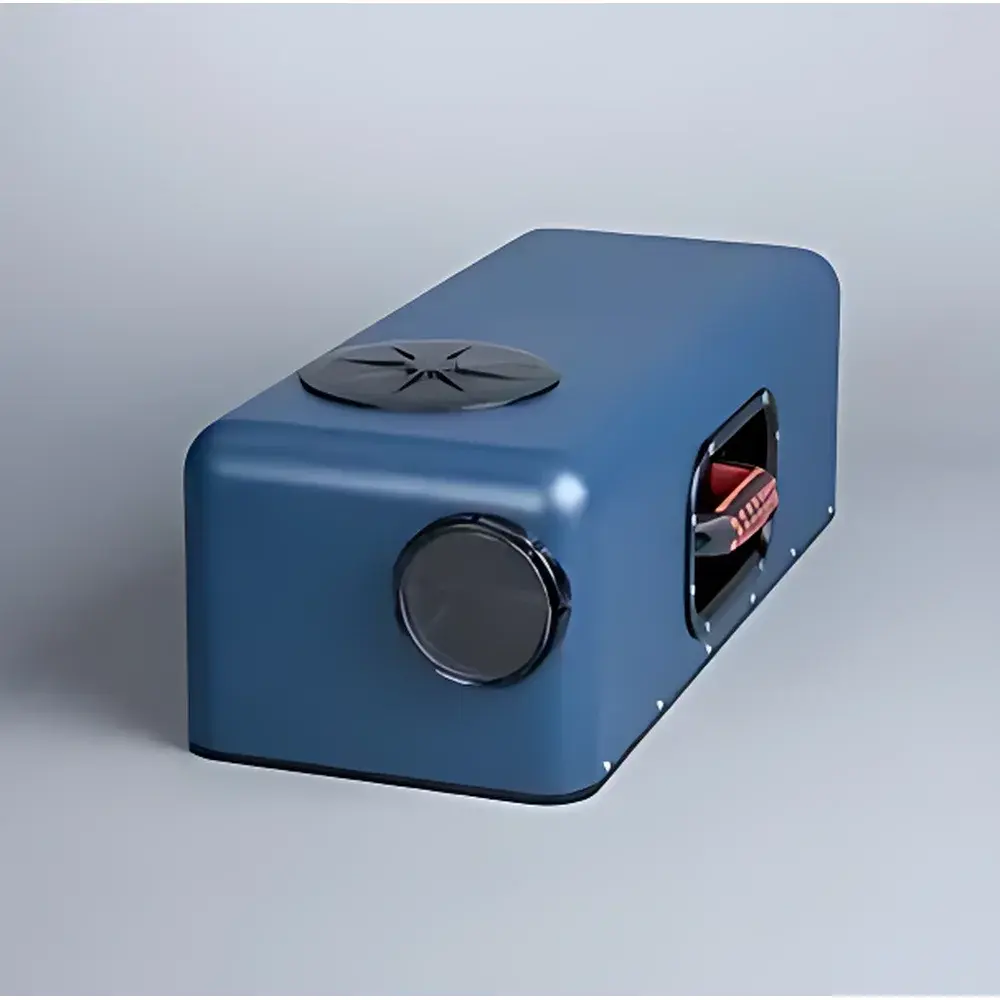
SurfaceOptics SOC 730VS Visible-Near Infrared Hyperspectral Imaging Spectrometer
| Brand | SurfaceOptics |
|---|---|
| Origin | USA |
| Model | SOC 730VS |
| Operating Principle | Push-broom |
| Imaging Modality | 3D hyperspectral datacube acquisition |
| Deployment | Ground-based and airborne compatible |
| Spectral Range | 400–1000 nm |
| Spectral Resolution | 2 nm |
| Spatial Resolution (IFOV) | 0.17 mrad |
| Field of View (TFOV) | 10° |
| Detector Array | 1024 × 1024 pixels |
| Frame Rate | 15 fps |
| Bit Depth | 12-bit |
| Optical f-number | f/2.4 |
| Smile Distortion | <1.5 µm |
| Interface | Camera Link |
| Power Supply | AC / 12 V DC |
| Tripod Mount | 3/8″–16 |
Overview
The SurfaceOptics SOC 730VS is a commercially available, push-broom visible–near-infrared (VNIR) hyperspectral imaging spectrometer engineered for high-fidelity spectral-spatial data acquisition across the 400–1000 nm range. It captures full hyperspectral datacubes—comprising spatial (x, y) and spectral (λ) dimensions—in real time via a high-stability, integrated scanning architecture. Unlike snapshot or tunable-filter systems, the SOC 730VS employs a line-scan principle: as the instrument moves relative to the scene (via platform motion or controlled translation), each detector line acquires one spatial row at all wavelengths simultaneously, building a three-dimensional data structure (x × y × λ) with consistent radiometric calibration and geometric fidelity. Its f/2.4 optics, low smile distortion (<1.5 µm), and 12-bit digitization ensure high signal-to-noise ratio and spectral fidelity—critical for quantitative reflectance analysis, material identification, and spectral unmixing in field-deployable and laboratory environments.
Key Features
- Push-broom acquisition architecture enabling synchronized spatial and spectral sampling without mechanical filter wheels or tunable elements
- High-resolution 1024 × 1024 pixel CMOS detector array optimized for VNIR quantum efficiency and low dark current
- Fixed spectral resolution of 2 nm across the full 400–1000 nm band—achieved via precision diffraction grating and aberration-corrected fore-optics
- 0.17 mrad instantaneous field of view (IFOV) and 10° total field of view (TFOV), supporting scalable ground sampling distance (GSD) from handheld to airborne platforms
- Camera Link interface (Base or Medium configuration) ensuring deterministic, low-latency data streaming at 15 fps sustained frame rate
- Integrated polarization-sensitive optical path compatible with external polarimetric calibration sources for Stokes parameter derivation
- Modular power architecture supporting dual-mode operation: AC mains or regulated 12 V DC for UAV or vehicle integration
Sample Compatibility & Compliance
The SOC 730VS is designed for non-contact, passive reflectance measurement of solid, liquid, and semi-solid samples under ambient or controlled illumination. Its spectral coverage encompasses key diagnostic absorption features—including chlorophyll-a (680 nm), water vapor bands (~940 nm), and iron oxide transitions (500–700 nm)—making it suitable for agricultural phenotyping, mineral mapping, and industrial surface inspection. The system complies with ISO 17025 traceability requirements when used with NIST-traceable reflectance standards (e.g., Spectralon®). Data output follows open binary formats (e.g., BIP/BIL/BSQ), fully compatible with ENVI, Python (hyperspy, scikit-image), MATLAB, and commercial GIS platforms. For regulated environments, raw data logs support audit-ready metadata embedding (time stamp, GPS/IMU sync tags, exposure settings), aligning with GLP documentation workflows and FDA 21 CFR Part 11 electronic record integrity guidelines when paired with validated MIDIS™ processing firmware.
Software & Data Management
SurfaceOptics provides the SOC HS Analysis Suite—a modular application for radiometric calibration, spectral smile correction, geometric rectification, and endmember extraction. Calibration routines include dark current subtraction, flat-field normalization, and wavelength registration using mercury-argon lamp spectra. When coupled with the optional MIDIS™ real-time processor, the SOC 730VS supports on-board spectral library matching (e.g., USGS, JPL, ECOSTRESS), multi-channel correlation tracking, and triple-integration spectral averaging—reducing latency for inline quality control. All processed and raw datasets are stored in vendor-neutral formats with embedded ENVI .hdr headers, enabling seamless ingestion into third-party analytical pipelines. SDKs for C++, Python, and LabVIEW allow custom algorithm integration and automated report generation compliant with ISO/IEC 17020 reporting structures.
Applications
- Precision Agriculture: Detection of nitrogen stress, water deficit, and early disease onset via vegetation indices (NDVI, PRI, CIred-edge) derived from contiguous narrowband reflectance
- Remote Sensing & Earth Observation: Land cover classification, soil organic carbon estimation, and coastal water turbidity mapping using supervised and unsupervised spectral clustering
- Industrial QA/QC: Real-time coating thickness verification, contaminant detection on pharmaceutical tablets, and polymer blend homogeneity assessment
- Biomedical Research: Label-free tissue differentiation in ex vivo histopathology and fluorescence-free angiography using intrinsic chromophore contrast
- Defense & Security: Camouflage detection, material-specific target recognition, and battlefield situational awareness through spectral anomaly detection algorithms
- Materials Science: Mapping of oxidation states in battery cathodes, grain boundary analysis in thin-film photovoltaics, and corrosion product identification on aerospace alloys
FAQ
What spectral calibration standards are recommended for field use?
NIST-traceable Spectralon® reflectance panels (99%, 50%, 10%) and calibrated tungsten-halogen lamps are recommended for radiometric and wavelength calibration. SurfaceOptics provides SOPs for outdoor solar irradiance-based calibration using clear-sky reference spectra.
Is the SOC 730VS compatible with UAV integration?
Yes—the compact form factor (≤2.1 kg), 12 V DC input, and IMU synchronization interface support integration with Class I/II UAVs. Vibration isolation mounts and GPS-locked timestamping are required for georeferenced mosaicking.
Can the system operate in low-light conditions?
With its f/2.4 aperture and high-quantum-efficiency sensor, the SOC 730VS achieves usable SNR down to ~10,000 lux (sunlit canopy) or ~500 lux under supplemental halogen illumination. Integration time is adjustable from 1 ms to 500 ms per line.
Does the system support hyperspectral data compression?
Raw data is acquired uncompressed; however, the MIDIS™ processor offers lossless Huffman encoding and optional PCA-based near-lossless compression (≥12:1) while preserving spectral shape fidelity for downstream classification.
What maintenance is required for long-term calibration stability?
Annual recalibration against factory baseline is recommended. Detector dark current drift is monitored via internal shutter sequences; optical alignment verification is advised after shock events exceeding 10 g.





