
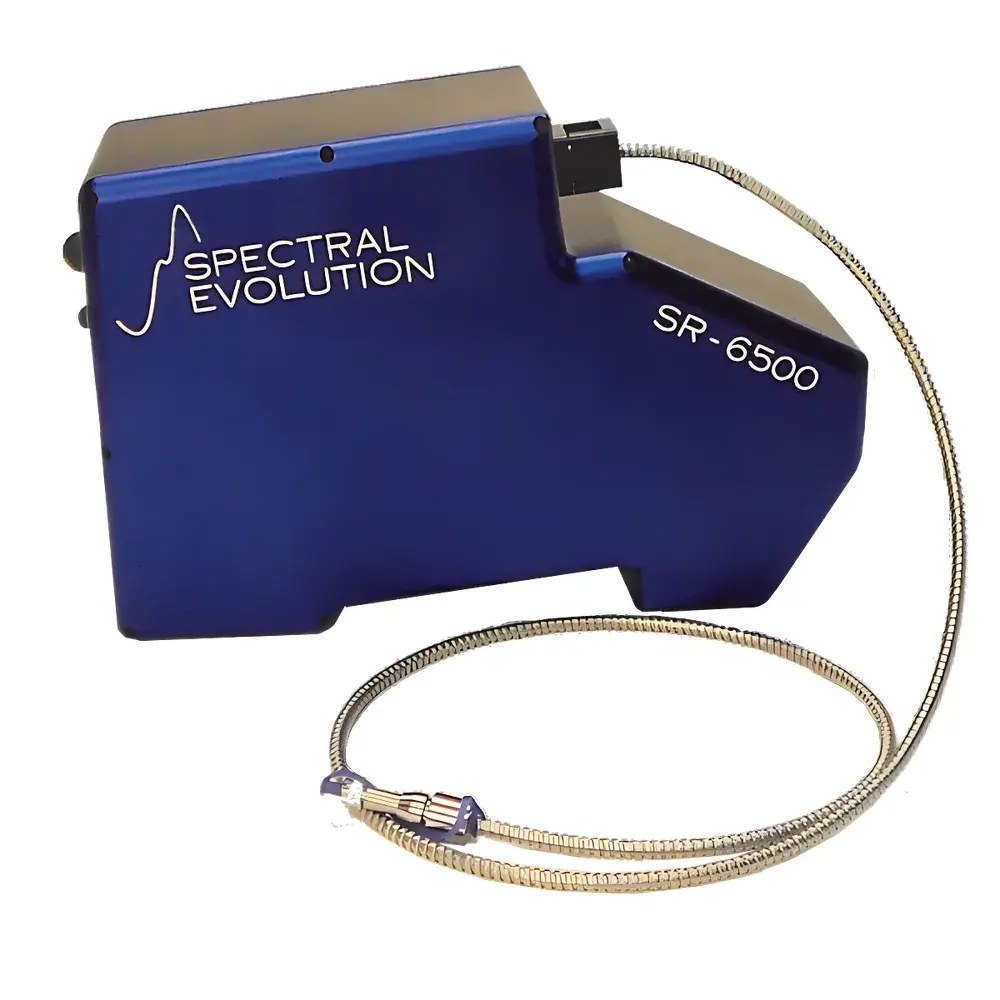
Spectral Evolution SR-6500/A Field Spectroradiometer
| Brand | Spectral Evolution |
|---|---|
| Model | SR-6500/A |
| Origin | USA |
| Spectral Range | 350–2500 nm |
| Spectral Resolution | 1.5 nm @ 700 nm |
| Detector Configuration | TE-cooled 1024-element Si (VIS-NIR), dual 512-element TE-cooled InGaAs (SWIR1 & SWIR2) |
| Total Spectral Channels | 2151 |
| NEΔL (1.5 m fiber) | 0.8×10⁻⁹ W/cm²/nm/sr @ 400 nm |
| Operating Mode | Ground-based, filter-based spectral acquisition with interferometric optical path design |
| Thermal Stability | Bidirectional temperature control, spectral drift < 0.1% over 8 h |
| Weight | 5 kg |
| Dimensions | 31.5 × 22.9 × 38.7 cm |
| Power | 33 W, 220 VAC or 7.4 VDC battery |
| Data Interface | USB and Bluetooth |
| GPS Integration | Built-in PDA GPS with geotagged spectral storage (≥100,000 spectra) |
| Software Platform | Windows-native acquisition suite with USGS spectral library, vegetation index engine (NDVI, GRVI, SR, etc.), CIE colorimetry, solar simulation, and optional EZ-ID mineral identification module |
Overview
The Spectral Evolution SR-6500/A Field Spectroradiometer is a high-performance, ground-based spectroradiometric measurement system engineered for rigorous field spectroscopy applications requiring exceptional spectral fidelity across the full solar-reflective range. It operates on a hybrid optical architecture combining precision filter-based spectral selection with an interferometric optical path—enabling stable, high-fidelity radiometric measurements without moving parts. Its tri-detector configuration integrates three thermoelectrically (TE) cooled linear array detectors: a 1024-pixel silicon CCD for the visible to near-infrared (350–1000 nm), and two optimized 512-pixel InGaAs arrays—one standard and one extended-range—for shortwave infrared coverage (1000–2500 nm). This architecture delivers 2151 discrete, calibrated spectral channels with resolution specifications of 1.5 nm at 700 nm, 3.0 nm at 1500 nm, and 3.8 nm at 2100 nm—meeting or exceeding the resolving power required for validation of next-generation airborne hyperspectral sensors such as AVIRIS-NG and PRISM.
Key Features
- Tri-band TE-cooled detector architecture ensures low-noise, high-dynamic-range performance across 350–2500 nm without mechanical scanning or grating movement
- Bidirectional thermal stabilization system maintains optical alignment and detector responsivity, limiting spectral drift to < 0.1% over 8-hour continuous operation
- Integrated PDA controller with touchscreen interface, built-in GPS, voice annotation, and 10-megapixel imaging for fully georeferenced, metadata-rich spectral capture
- One-touch automated acquisition: simultaneous auto-exposure, auto-dark current subtraction, shutter synchronization, and onboard spectral storage
- Modular optical interface supporting interchangeable fore-optics (1°–8° FOV lenses), fiber optic probes, contact reflectance heads, leaf clip-on probes, and integrating spheres
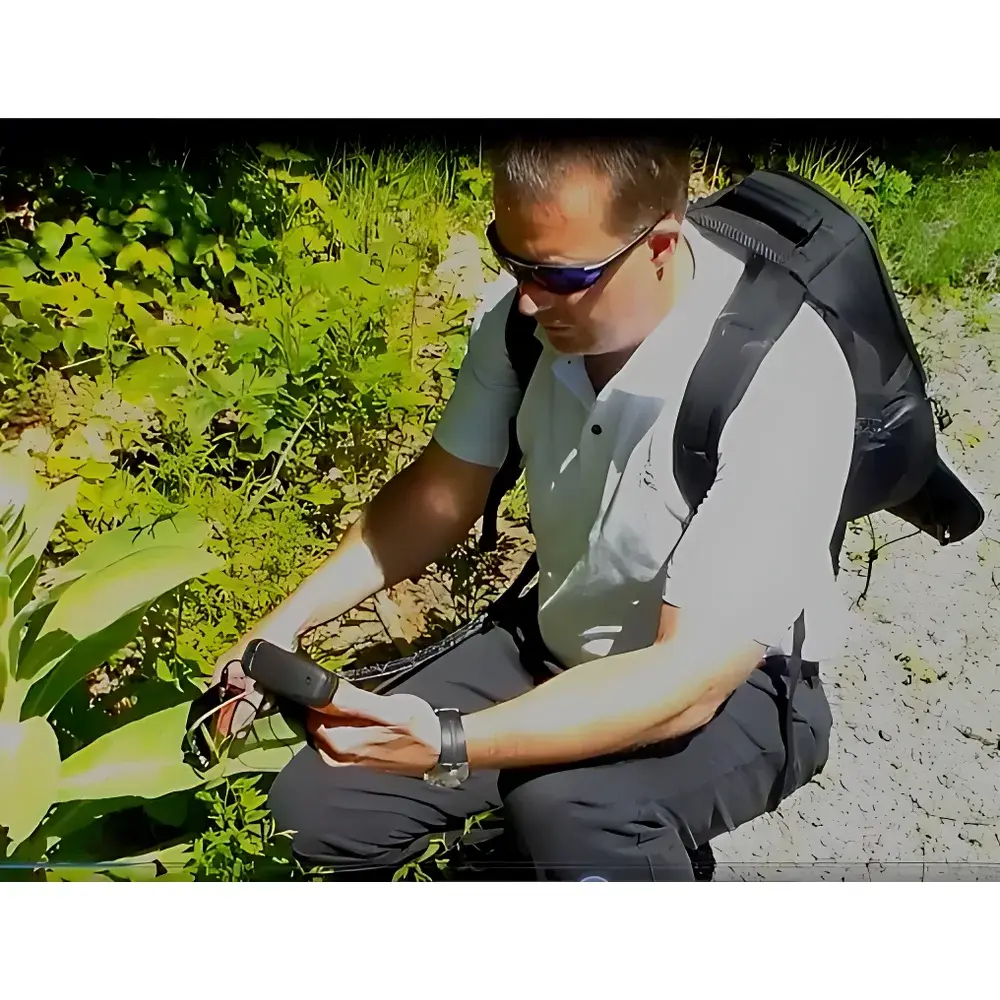
- Robust mechanical design: aluminum alloy housing, IP54-rated environmental protection, and 5 kg operational weight optimized for backpack or tripod deployment
Sample Compatibility & Compliance
The SR-6500/A is designed for non-contact, in situ measurement of surface-leaving radiance, reflectance, transmittance, and irradiance under natural or controlled illumination. It supports standardized protocols for vegetation biophysical parameter retrieval (e.g., LAI, chlorophyll content), mineralogical identification via spectral absorption feature analysis, ocean color calibration, and industrial material characterization. The instrument complies with ASTM E275, ISO 9001 traceable calibration practices, and supports GLP-compliant data workflows through audit-trail-enabled software logging. All factory calibrations are NIST-traceable and include spectral responsivity, radiometric linearity, and stray light characterization reports. The system meets FDA 21 CFR Part 11 requirements when used with validated software configurations and electronic signature modules.
Software & Data Management
Data acquisition and post-processing are performed using Spectral Evolution’s proprietary Windows-based SpectraWiz® software suite, deployable on laptops, tablets, or the integrated PDA. The platform provides real-time spectral preview, automatic dark/reference correction, and batch processing of geotagged datasets. Integrated libraries include the USGS Digital Spectral Library (Version 7), enabling spectral matching against >2,400 mineral, vegetation, and man-made material reference spectra. Vegetation indices—including NDVI, GRVI, SR, NDWI, and EVI—are computed automatically from raw reflectance data. SpectraWiz also supports cross-sensor validation by resampling output to match MODIS, SPOT, Sentinel-2, and AVHRR bandpasses. Optional EZ-ID mineral identification software adds automated absorption feature detection, continuum removal, and spectral angle mapper (SAM) classification. All data exports comply with ENVI, HDF5, and ASCII formats; metadata conforms to ISO 19115 geospatial standards.
Applications
- Radiometric calibration and validation of airborne and satellite hyperspectral imagers (e.g., AVIRIS-NG, HySpex, PRISMA)
- Field-based mineral mapping and lithological discrimination in exploration geology
- Quantitative assessment of plant physiological status, stress response, and species classification via narrowband reflectance features
- Oceanographic and limnological studies including phytoplankton pigment analysis and CDOM quantification
- Industrial QA/QC of coatings, pigments, plastics, and solar cell materials under ambient or simulated solar illumination
- CIE color space analysis (XYZ, L*a*b*, ΔE) for agricultural product grading, textile evaluation, and display calibration
FAQ
What spectral calibration standards are included with the SR-6500/A?
The instrument ships with NIST-traceable radiometric calibration certificates for each detector segment, including spectral responsivity curves, linearity verification, and stray-light correction matrices. A removable, portable 1000 W quartz-halogen lamp with cosine-corrected diffuser is provided for field-based radiometric validation.
Can the SR-6500/A operate autonomously in remote locations?
Yes—the integrated PDA enables fully standalone operation with up to 100,000 spectra stored internally, GPS-tagged and time-stamped. External 7.4 VDC lithium battery packs support ≥6 hours of continuous measurement without AC power.
Is the software compatible with third-party analysis platforms like Python or MATLAB?
All exported data files include header metadata and adhere to standard spectral format conventions. SpectraWiz supports direct ASCII/HDF5 export, enabling seamless ingestion into Python (SciPy, NumPy, scikit-learn), MATLAB, R, or ENVI for custom modeling, machine learning, or time-series analysis.
How does the bidirectional thermal control improve measurement stability?
Unlike single-direction cooling systems, the SR-6500/A’s dual-mode thermal regulation actively heats or cools detector assemblies to maintain constant junction temperature—minimizing thermal expansion-induced wavelength shift and responsivity drift, especially critical during diurnal field campaigns.
Does the system support radiance-to-reflectance conversion in real time?
Yes—when paired with a calibrated reference panel (e.g., Spectralon® 99% diffuse reflector), the software performs instantaneous radiance-to-reflectance conversion using concurrent dark, reference, and target measurements, all synchronized within a single acquisition sequence.






