
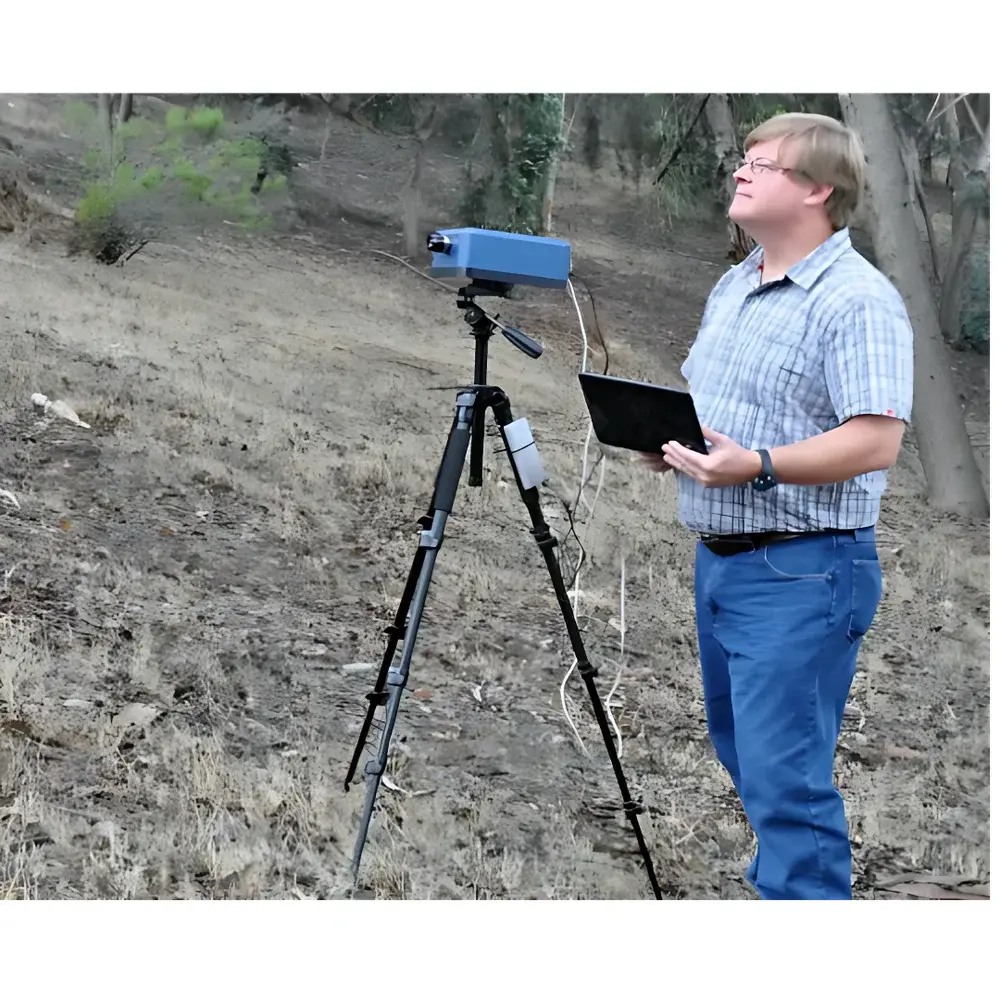
SOC SurfaceOptics SOC 710VP Pushbroom Hyperspectral Imaging Spectrometer
| Brand | SOC/SurfaceOptics |
|---|---|
| Origin | USA |
| Manufacturer Type | Authorized Distributor |
| Import Status | Imported |
| Model | SOC 710VP |
| Operating Principle | Pushbroom Scanning |
| Deployment Mode | Ground-based |
| Spectral Range | 400–1000 nm |
| Spectral Resolution | Up to 1.3 nm (user-configurable) |
Overview
The SOC SurfaceOptics SOC 710VP is a high-integration, ground-based pushbroom hyperspectral imaging spectrometer engineered for quantitative spectral imaging across visible and near-infrared (VNIR) wavelengths. Utilizing a dual-CCD optical architecture with integrated linear translation scanning, the instrument acquires spatially registered spectral data cubes (x, y, λ) without geometric distortion—eliminating reliance on external motion platforms that introduce misregistration, keystone, or smile artifacts. Its core measurement principle is based on spatial-spectral separation via prism-grating optics coupled with synchronized line-by-line CCD readout, enabling high-fidelity radiometric and spectral fidelity in field-deployable configurations. Designed for rigorous scientific use, the SOC 710VP operates under ambient lighting or controlled illumination and delivers calibrated reflectance data traceable to NIST-traceable standards when used with appropriate calibration targets.
Key Features
- Integrated pushbroom scanning mechanism: Eliminates mechanical misalignment and image distortion inherent in externally mounted scan systems; ensures pixel-level spatial-spectral co-registration.
- Dual-CCD detection architecture: One CCD captures real-time preview imagery for region-of-interest selection; the second performs synchronized spectral acquisition—enabling true “what-you-see-is-what-you-get” operation.
- High spectral flexibility: Configurable spectral resolution down to 1.3 nm across 400–1000 nm, with user-adjustable binning, exposure time, and scan velocity to optimize signal-to-noise ratio per application.
- Field-ready portability: Total system mass of 2.95 kg; compatible with standard photographic tripods, motorized translation stages, UAV-mount adapters (via optional interface), and inverted/epi-illumination microscope couplers.
- Fully automated acquisition workflow: Built-in dark current correction, auto-exposure optimization, programmable measurement sequences, and scheduled unattended operation with timestamped metadata logging.
- USB 3.0 interface with deterministic latency: Enables real-time frame streaming and synchronization with external triggers (e.g., GPS PPS, shutter signals, environmental sensors).
Sample Compatibility & Compliance
The SOC 710VP supports non-contact, non-destructive spectral imaging of heterogeneous surfaces at macro- to micro-scale resolutions—from whole-plant canopies (field plots, orchards) to leaf cross-sections and seed embryos under microscopy. It complies with ISO 17025-relevant measurement uncertainty frameworks when operated with certified reflectance standards (e.g., Spectralon® panels). Data acquisition protocols align with ASTM E2780 (Standard Practice for Hyperspectral Imaging of Plant Canopies) and support GLP-compliant metadata embedding (instrument ID, calibration date, illumination geometry, integration time). While not FDA-cleared as a medical device, its radiometric stability and spectral repeatability meet requirements for preclinical botanical research under ICH-GCP-aligned study designs.
Software & Data Management
The proprietary SOC Hyperspectral Studio software provides end-to-end data handling: radiometric calibration (dark, white, and reference panel correction), spectral angle mapper (SAM) classification, reflectance normalization, band math, ROI-based spectral extraction, and 3D spectral surface visualization. All processed datasets export in ENVI-compatible BIL/BIP formats (.hdr/.dat), TIFF stacks, and CSV/XLSX tables for downstream statistical modeling (e.g., PLSR, PCA, SVM). The software enforces audit-trail functionality—including operator ID, parameter change history, and raw file checksums—to satisfy 21 CFR Part 11 readiness when deployed in regulated environments. Third-party interoperability includes direct import into MATLAB, Python (scikit-image, hylite), and commercial platforms such as ERDAS Imagine and QGIS with hyperspectral plugins.
Applications
- Environmental remote sensing: Detection of invasive species, soil organic carbon estimation, and wetland vegetation mapping using spectral indices (NDVI, PRI, MCARI).
- Precision agriculture: In-field phenotyping of crop stress (water, nitrogen, disease), yield prediction modeling, and variety discrimination via spectral fingerprinting.
- Plant science research: Chlorophyll content quantification, stomatal conductance inference, and photosynthetic pigment dynamics tracking across diurnal cycles.
- Postharvest quality assessment: Non-invasive evaluation of fruit firmness, sugar content (Brix), bruise detection, and seed viability screening.
- Microspectroscopy: Coupled with upright/inverted microscopes, enables cellular-level spectral profiling of plant tissues, pollen grains, and fungal hyphae without sectioning.
- Forensic botany & taxonomy: Species-level identification of herbarium specimens and fragmented plant material using library-matching algorithms.
FAQ
What spectral calibration standards are recommended for field use?
NIST-traceable Spectralon® diffuse reflectance panels (99%, 50%, 12%) are recommended; annual recalibration against a factory-characterized lamp source is advised for long-term radiometric consistency.
Can the SOC 710VP operate under variable natural illumination?
Yes—when paired with a cosine-corrected irradiance sensor and synchronized capture timing, it supports solar-induced fluorescence (SIF) and reflectance measurements under dynamic daylight conditions.
Is microscope coupling mechanically standardized?
It uses C-mount and RMS-thread adapters compatible with major OEM microscopes (Olympus, Zeiss, Leica); no custom optomechanical redesign is required.
Does the system support real-time onboard processing?
No—data acquisition is streaming-only; spectral analysis occurs post-capture in SOC Hyperspectral Studio or external computing environments.
What is the typical spatial sampling resolution at 1 m working distance?
With the standard f/2.8 lens, instantaneous field of view (IFOV) is ~0.5 mm/pixel; resolution scales linearly with distance and lens focal length.





