
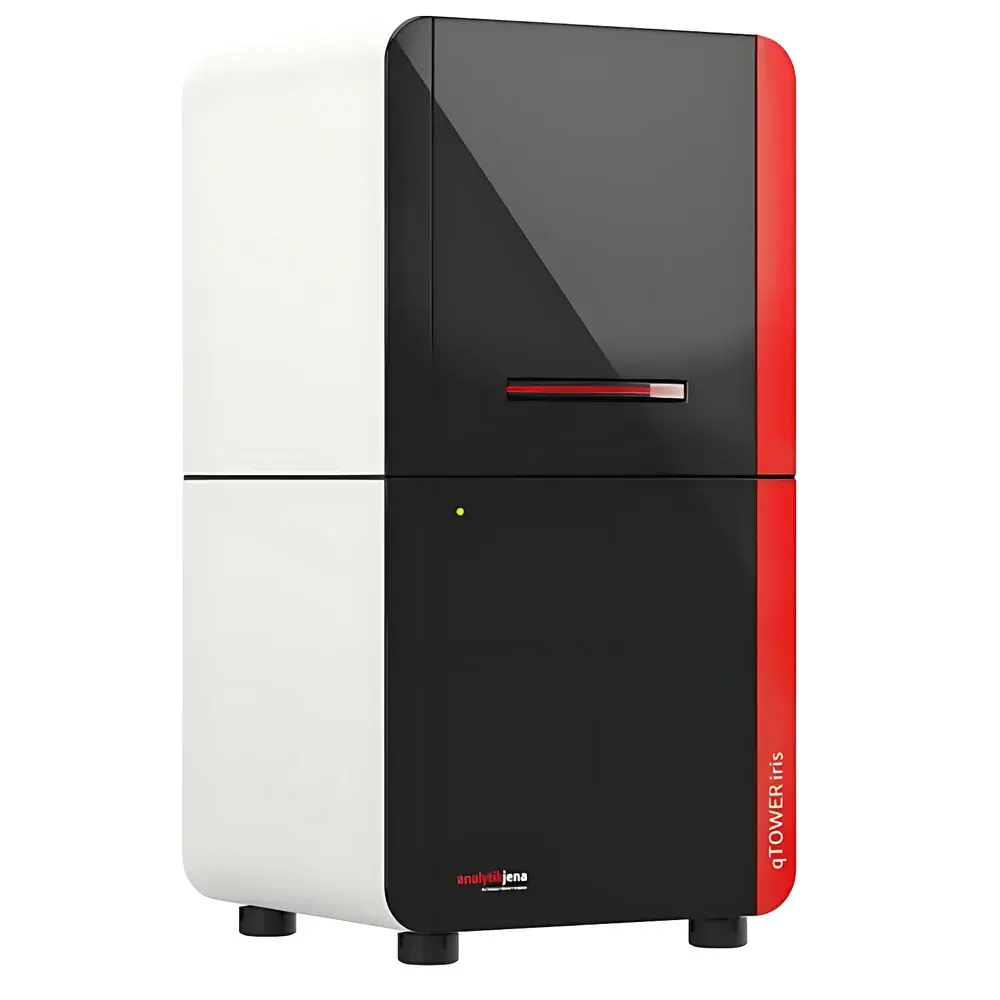
Analytik Jena qTOWERiris Full-Spectrum Real-Time Fluorescence Quantitative PCR System
| Brand | Analytik Jena |
|---|---|
| Origin | Germany |
| Manufacturer Type | Original Equipment Manufacturer (OEM) |
| Product Category | Imported Instrument |
| Model | qTOWERiris |
| Instrument Type | Real-Time Fluorescence Quantitative PCR System |
| Sample Capacity | 96-well format |
| Heating Rate | 8 °C/s |
| Temperature Accuracy | ±0.1 °C |
| Well-to-Well Temperature Uniformity | ±0.15 °C |
Overview
The Analytik Jena qTOWERiris is a purpose-built, full-spectrum real-time fluorescence quantitative PCR system engineered for high-precision nucleic acid quantification, multiplex assay development, and advanced thermal shift applications in molecular biology, clinical diagnostics, and biopharmaceutical research. Unlike retrofitted conventional PCR instruments, the qTOWERiris features an integrated optical and thermal architecture optimized from first principles for quantitative performance. Its measurement principle relies on synchronous detection of fluorescence emission across six independently configurable optical channels—spanning 340–750 nm—enabling simultaneous monitoring of DNA amplification, melting transitions, and protein thermal stability via intrinsic or extrinsic fluorophores. The system employs a solid-state LED excitation array (7 high-intensity, spectrally discrete LEDs), a high-gain photomultiplier tube (PMT) detector, and an 8-channel fiber-optic scanning head that acquires data from eight wells concurrently without ROX normalization—though optional ROX referencing remains supported for legacy assay compatibility.
Key Features
- Full-spectrum optical architecture with user-selectable 1–6 channel configurations; field-upgradable channel count without hardware replacement
- Modular filter sets supporting UVA (340–380 nm) and protein-specific detection (e.g., CPM, ANS, SYPRO Orange), enabling direct thermal shift assays (TSA/CEST)
- Seven long-life, non-thermal LEDs delivering stable excitation intensity across UV–NIR range; zero heat load on reaction chamber, eliminating thermal crosstalk
- PMT-based detection with ultra-low dark current and high quantum efficiency, achieving single-copy DNA detection sensitivity and reliable discrimination of ≤1.5-fold concentration differences
- Dynamic linear detection range spanning 10 orders of magnitude (10⁰–10¹⁰ copies)
- Patented 12-column linear temperature gradient function (0.1–20.0 °C range per run) for empirical optimization of annealing conditions
- Gold-plated pure silver thermal block with Peltier-based control, ensuring rapid heat transfer, corrosion resistance, and long-term calibration stability
- Intelligent pressure-regulated heated lid (up to 110 °C; max contact force 30 kg/plate) for uniform evaporation suppression across all well types (96-well plates, 8-tube strips, individual tubes)
- Acoustic noise level ≤60 dB(A) during operation—designed for shared laboratory environments requiring low ambient disturbance
Sample Compatibility & Compliance
The qTOWERiris accepts standard 96-well PCR plates (full-skirted, semi-skirted, or non-skirted), 8-tube strips, and individual 0.2 mL tubes, supporting reaction volumes from 5–100 µL. Its thermal design complies with ISO 13485 manufacturing standards and supports GLP/GMP-aligned workflows through audit-trail-enabled software logging. While not FDA-cleared as an IVD device, the system meets essential requirements for method validation under CLIA, CAP, and ISO/IEC 17025 frameworks. All thermal and optical calibrations are traceable to national metrology institutes (PTB, NIST). The instrument satisfies key MIQE (Minimum Information for Publication of Quantitative Real-Time PCR Experiments) reporting criteria, including mandatory metadata capture for primer efficiency, baseline settings, and melt curve acquisition parameters.
Software & Data Management
The qPCRsoft software suite is provided free of charge, with unlimited installation rights and lifetime version upgrades. It delivers comprehensive analysis modules—including absolute quantification, dual-standard-curve relative quantification, efficiency-corrected ΔΔCt, high-resolution melt (HRM) profiling, SNP/allelic discrimination, endpoint fluorescence analysis, and PCR efficiency calculation. Data export supports CSV, Excel, and XML formats compliant with LIMS integration. Audit trails record user actions, parameter changes, and instrument events with timestamps and operator IDs—fully compatible with FDA 21 CFR Part 11 requirements when deployed with validated electronic signature protocols. Multi-instrument control allows one workstation to manage up to 16 independent qTOWERiris units simultaneously, each running distinct protocols with synchronized data aggregation.
Applications
The qTOWERiris serves core applications in gene expression profiling, pathogen load quantification (viral/bacterial/fungal), GMO detection, copy number variation (CNV) analysis, miRNA quantification, and CRISPR editing efficiency assessment. Its extended spectral capability uniquely enables label-free and dye-based protein thermal shift assays—supporting biophysical characterization of antibody–antigen interactions, small-molecule binding kinetics, and formulation stability screening. The system is routinely deployed in academic core facilities, QC labs for mRNA vaccine production, and regulatory submission support studies where reproducibility, traceability, and multi-parametric assay flexibility are critical.
FAQ
Can the optical channel configuration be changed after purchase?
Yes—the qTOWERiris supports field-upgradable channel expansion from 1 to 6 channels via software license activation and optional filter set installation.
Is ROX reference dye required for normalization?
No—its 8-channel fiber-optic scanning architecture eliminates well-to-well optical variability, making ROX optional; however, ROX channel support is retained for method transfer compatibility.
What is the maximum recommended reaction volume?
The optimal volume range is 5–100 µL; volumes above 75 µL require validation for thermal uniformity and evaporation control.
Does the software comply with 21 CFR Part 11?
Yes—when configured with electronic signatures, role-based access control, and audit trail archiving, it fulfills predicate rules for regulated environments.
Is maintenance required for the LED light source?
No—the solid-state LED array is rated for >50,000 hours of operation and requires no alignment, cooling, or replacement throughout the instrument’s service life.



