
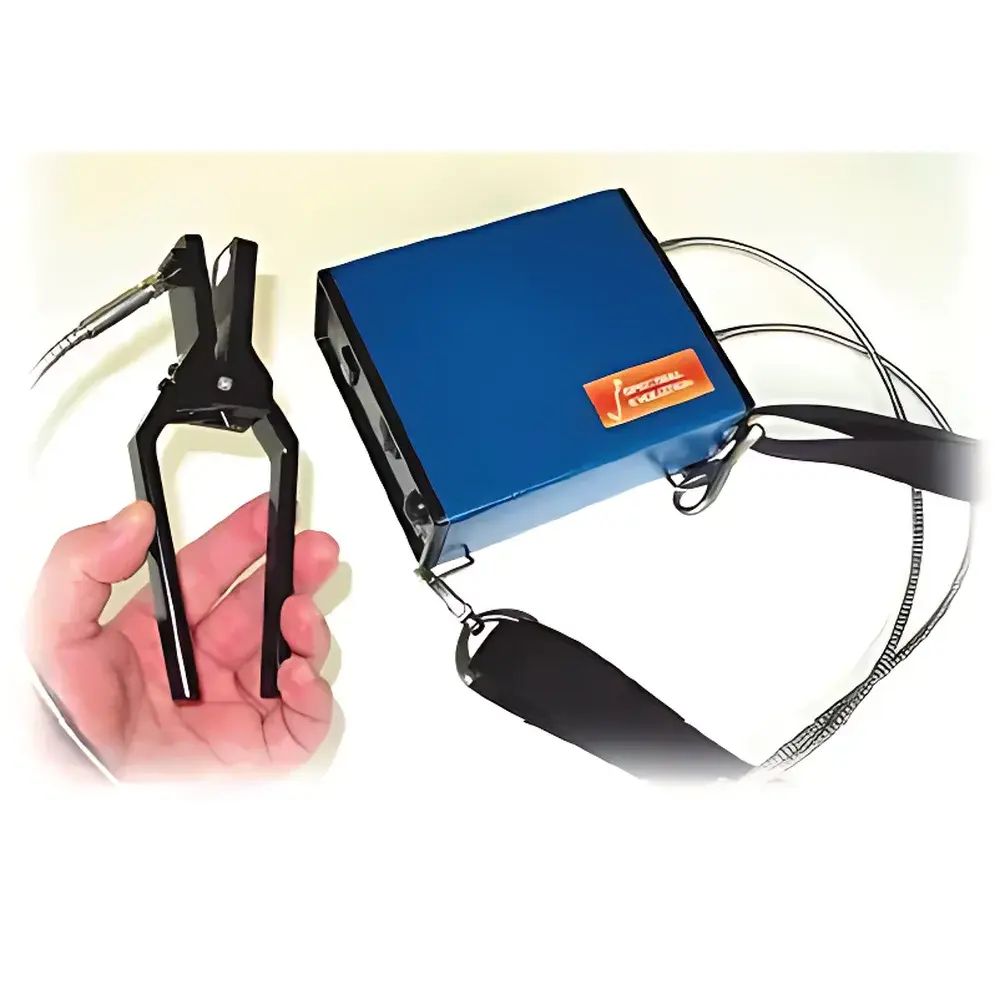
SEI PSP-1100 Portable Plant Spectroradiometer
| Brand | SEI |
|---|---|
| Origin | USA |
| Manufacturer Type | Authorized Distributor |
| Origin Category | Imported |
| Model | PSP-1100 |
| Instrument Type | Portable |
| Operating Principle | Fixed-grating array detector (non-scanning) |
| Wavelength Range | 320–1100 nm |
| Integration Time | 8–2000 ms |
| Sampling Interval | 1.5 nm |
| Measurement Mode | Diffuse Reflectance |
| Chemometrics Software | DARWin SP |
| Optical Resolution | 3.2 nm (FWHM) |
| Stray Light | <0.05% @ 700 nm |
| Detector | 512-element silicon photodiode array (25 µm × 2.5 mm pixel size) |
| A/D Conversion | 16-bit |
| Wavelength Accuracy | ±0.5 nm |
| Wavelength Repeatability | ±0.1 nm |
| NEΔL (400 nm, 1 s) | 8.0×10⁻¹⁰ W/cm²/nm/sr |
| NEΔL (700 nm, 1 s) | 7.0×10⁻¹⁰ W/cm²/nm/sr |
| NEΔL (900 nm, 1 s) | 1.5×10⁻⁹ W/cm²/nm/sr |
| Max Radiance @700 nm | 1.5×10⁻⁴ W/cm²/nm/sr |
| Input Port | 25° fiber optic coupling |
| Slit Width | 50 µm |
| Power Supply | Internal 2800 mAh rechargeable Li-ion battery (operating time >4 h) |
| Dimensions | 17.8 × 8.3 × 14.6 cm |
| Weight | <1.8 kg |
| Communication Interfaces | USB 2.0, Bluetooth 4.0 |
| Compliance | CE, FCC Part 15, RoHS |
Overview
The SEI PSP-1100 Portable Plant Spectroradiometer is a field-deployable, non-scanning spectroradiometric instrument engineered for high-fidelity spectral reflectance measurements of vegetation and terrestrial surfaces. Based on a fixed-grating optical architecture with a 512-element silicon photodiode array detector, the PSP-1100 eliminates mechanical scanning components—enhancing long-term calibration stability, measurement reproducibility, and operational robustness in variable environmental conditions. Its 320–1100 nm spectral coverage spans the full photosynthetically active radiation (PAR) region (400–700 nm), near-infrared (NIR) band critical for vegetation indices (e.g., NDVI, PRI), and the UV-A edge—enabling quantitative analysis of chlorophyll content, leaf water status, pigment composition, and structural properties. The system integrates an internal broadband tungsten-halogen source and calibrated reference optics optimized for leaf-level contact measurements via optional leaf clip attachments. Designed explicitly for plant phenotyping, precision agriculture, ecological monitoring, and remote sensing ground-truthing, the PSP-1100 delivers laboratory-grade radiometric accuracy in a rugged, handheld platform compliant with ASTM E275, ISO 9001 manufacturing protocols, and GLP-aligned data integrity requirements.
Key Features
- Fixed-grating, non-scanning optical design ensures superior wavelength repeatability (±0.1 nm) and long-term radiometric stability without moving parts
- Integrated 2800 mAh rechargeable Li-ion battery supports >4 hours of continuous field operation—no external power required for standard surveys
- Automatic exposure control, auto-shutter actuation, and real-time distance correction—all executed with single-button initiation
- Full-reflection optical path minimizes stray light (<0.05% at 700 nm) and maximizes throughput efficiency across the UV-VIS-NIR range
- Bluetooth 4.0 and USB 2.0 interfaces enable cable-free data acquisition and remote instrument control from tablets or ruggedized PDAs
- Compact form factor (17.8 × 8.3 × 14.6 cm) and sub-1.8 kg mass permit one-handed operation during extended field campaigns
- 25° fiber-optic input port supports rapid interchangeability between leaf clips, cosine correctors, and integrating spheres for diverse sample geometries
Sample Compatibility & Compliance
The PSP-1100 is validated for direct-contact and standoff reflectance measurements of intact leaves, canopies, soil surfaces, and calibration standards (e.g., Spectralon® 99% reflectance panels). Its 4° fore-optic field-of-view enables standardized leaf-level sampling per ASABE S578.1 and ISO 11727 protocols. When paired with the optional leaf clip accessory, the system maintains consistent illumination geometry and minimizes shadowing artifacts during in situ chlorophyll or anthocyanin quantification. All firmware and data acquisition routines comply with FDA 21 CFR Part 11 requirements for electronic records and signatures when used with DARWin SP’s audit-trail-enabled configuration. Hardware meets CE marking directives (EMC Directive 2014/30/EU, Low Voltage Directive 2014/35/EU), FCC Part 15 Class B emission limits, and RoHS 2011/65/EU material restrictions.
Software & Data Management
DARWin SP (Spectral Evolution’s proprietary software) provides end-to-end spectral workflow management—from real-time preview and auto-exposure optimization to post-acquisition normalization, derivative analysis, and index calculation. The software supports simultaneous overlay and statistical comparison of multiple spectra, batch processing of time-series datasets, and export of ASCII-compatible .txt files compatible with MATLAB, R, Python (NumPy/Pandas), ENVI, and ERDAS IMAGINE. DARWin SP includes built-in calibration validation tools, dark-current subtraction routines, and spectral smoothing filters (Savitzky-Golay, moving average) with adjustable window parameters. For mobile deployment, DARWin CE—a Windows Mobile–compatible version—is available for integration with GETAC PS336 rugged PDAs, enabling synchronized GPS tagging, georeferenced image capture, altitude logging, and voice annotation—each metadata stream time-stamped and embedded directly into the spectral header.
Applications
- Non-destructive leaf-level phenotyping: chlorophyll-a/b ratio estimation, carotenoid index derivation, and water-band depth analysis at 970 nm
- Canopy reflectance profiling for validation of satellite-derived vegetation indices (e.g., EVI, SAVI, MSAVI2)
- Soil-vegetation-atmosphere transfer (SVAT) model parameterization using directional-hemispherical reflectance factors (DHRF)
- Controlled-environment stress response monitoring (drought, nutrient deficiency, pathogen infection) via time-series spectral trajectory analysis
- Calibration and validation of hyperspectral imaging systems and UAV-mounted multispectral sensors
- Field spectroscopy training and undergraduate/graduate teaching in biophysical remote sensing and plant physiology
FAQ
What spectral calibration standards are supported by the PSP-1100?
The instrument ships with NIST-traceable factory calibration using certified reflectance standards (e.g., Spectralon® 99% and 20% panels). Field recalibration is supported via user-provided reference panels with known bidirectional reflectance distribution function (BRDF) characteristics.
Can the PSP-1100 operate under direct sunlight without saturation?
Yes—the automatic exposure algorithm dynamically adjusts integration time (8–2000 ms) and employs hardware-based shutter control to prevent detector saturation across ambient irradiance levels from dawn to midday clear-sky conditions.
Is DARWin SP compliant with 21 CFR Part 11 for regulated environments?
When configured with user authentication, electronic signature enforcement, and audit-trail logging enabled, DARWin SP meets predicate rule requirements for electronic records and signatures in GxP workflows.
What accessories are recommended for long-duration field deployments?
We recommend the ruggedized travel case with integrated shock absorption, spare 2800 mAh batteries with dual-bay charger, weatherproof fiber-optic cable (stainless-steel armored), and a portable tripod with leveling base for repeatable nadir-viewing geometry.
Does the PSP-1100 support external triggering or synchronization with other sensors?
Yes—via TTL-compatible trigger input (BNC), the unit accepts external sync pulses for coordinated acquisition with LiDAR, thermal cameras, or environmental loggers in multi-sensor field arrays.




