
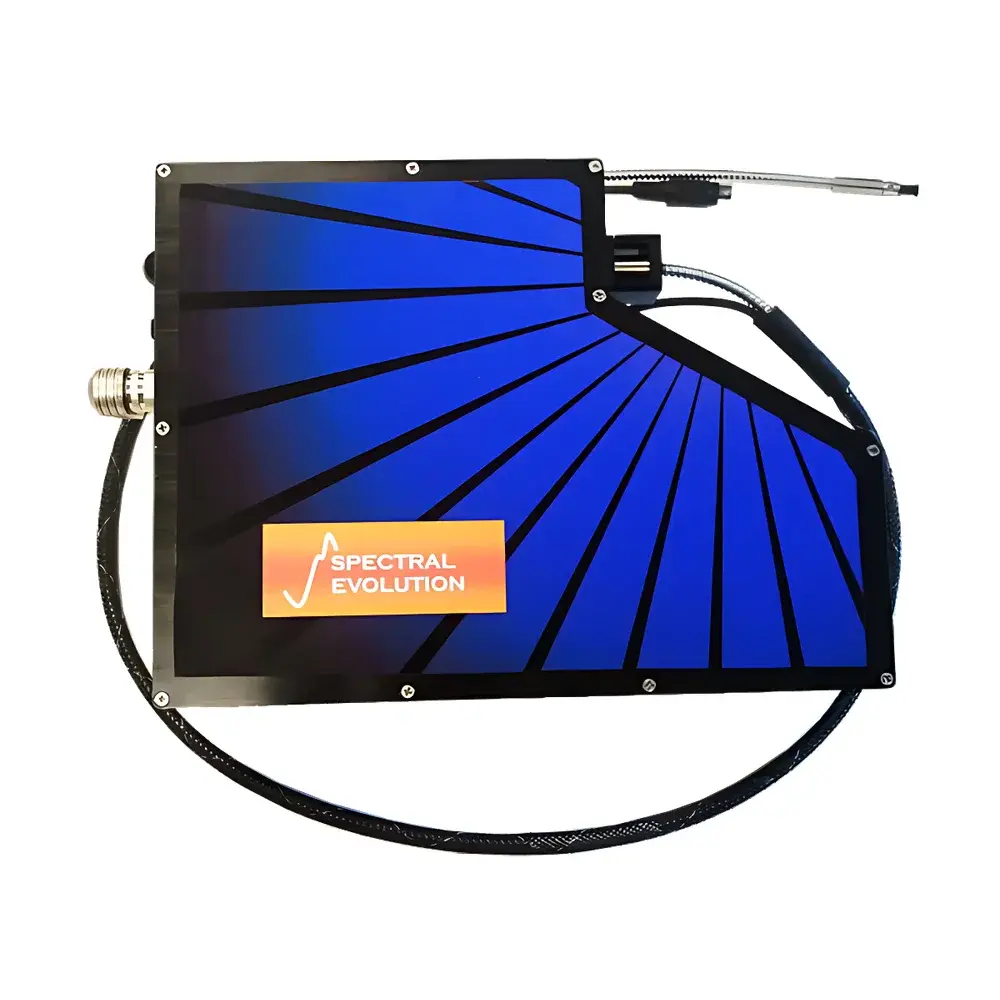
Spectral Evolution SR-3500 Portable Field Spectroradiometer
| Brand | Spectral Evolution |
|---|---|
| Origin | USA |
| Model | SR-3500 |
| Spectral Range | 350–2500 nm |
| Spectral Resolution | 3 nm (350–1000 nm), 8 nm @ 1500 nm, 6 nm @ 2100 nm |
| Optical Design | Fixed holographic grating with linear array detectors |
| Detector Configuration | UV-enhanced Si (512-pixel) + dual TE-cooled InGaAs (2 × 256-pixel) |
| FOV Options | 1°–10° lenses, cosine corrector, fiber optic probes, integrating sphere |
| Noise Equivalent Radiance (1.2 m fiber) | 0.8×10⁻⁹ W/cm²/nm/sr @ 400 nm, 1.2×10⁻⁹ W/cm²/nm/sr @ 1500 nm |
| Wavelength Accuracy | ±0.5 nm |
| Wavelength Repeatability | ±0.1 nm |
| Integration Time | 7.5–1000 ms (auto or user-defined) |
| Data Acquisition Rate | Up to 10 Hz |
| Communication | USB 2.0 + Bluetooth 4.2 |
| Weight | 3.4 kg |
| Dimensions | 21.6 × 27.9 × 8.9 cm |
| Calibration | NIST-traceable, factory-calibrated radiometric and spectral response |
Overview
The Spectral Evolution SR-3500 Portable Field Spectroradiometer is a high-performance, full-range spectroradiometric instrument engineered for precise in-situ and airborne measurement of spectral radiance, reflectance, transmittance, and irradiance across the ultraviolet, visible, and shortwave infrared (UV-VIS-SWIR) spectrum (350–2500 nm). Unlike scanning or filter-wheel-based systems, the SR-3500 employs a fixed holographic grating optical design coupled with three synchronized linear array detectors — a UV-enhanced silicon (Si) array for 350–1000 nm and two thermoelectrically (TE) cooled indium gallium arsenide (InGaAs) arrays covering 1000–1700 nm and 1700–2500 nm, respectively. This architecture eliminates moving optical components, ensuring long-term spectral stability, high radiometric reproducibility, and immunity to calibration drift induced by mechanical wear or thermal misalignment. With a full-spectrum acquisition time of ≤100 ms and sustained data capture at up to 10 spectra per second, the SR-3500 supports dynamic field measurements including real-time vegetation index derivation, solar spectral monitoring, and rapid UAV-based hyperspectral surveying. Its NIST-traceable factory calibration provides documented uncertainty budgets for both spectral wavelength assignment and absolute radiometric responsivity — essential for compliance with ASTM E275, ISO 17025, and remote sensing validation protocols.
Key Features
- Triple-detector architecture: UV-enhanced 512-pixel Si + dual TE-cooled 256-pixel InGaAs arrays for seamless 350–2500 nm coverage
- No moving optics: Fixed grating design ensures mechanical robustness, thermal stability, and long-term calibration integrity
- Integrated hardware controls: Automatic dark current subtraction, auto-exposure, auto-integration time, and motorized shutter enable hands-free operation
- Wireless & mobile-ready: Bluetooth 4.2 and USB 2.0 interfaces; compatible with Windows CE-based PDAs featuring built-in GPS, 3 MP camera, and ≥100,000-spectrum storage
- Rugged field deployment: Anodized aluminum chassis (3.4 kg), IP54-rated enclosure options, and optional shock-resistant transport cases
- Modular optical interface: Interchangeable fore-optics including narrow FOV lenses (1°–10°), cosine correctors, bare fibers, contact probes, and integrating spheres
- Real-time spectral processing: On-device calculation of NDVI, EVI, SAVI, PRI, WBI, GRVI, and other 12+ vegetation indices aligned with Landsat, Sentinel-2, MODIS, and AVHRR bandpasses
Sample Compatibility & Compliance
The SR-3500 is designed for non-destructive, contact and non-contact spectral characterization of diverse natural and engineered surfaces — including leaves, soils, minerals, coatings, photovoltaic materials, food products, pharmaceutical tablets, and water bodies. Its calibrated spectral response enables quantitative comparison against reference standards such as USGS spectral libraries (preloaded in DARWin SP software) and ASTM G173-03 extraterrestrial and AM1.5G solar irradiance references. The instrument meets requirements for GLP-compliant environmental monitoring and supports audit-ready data provenance through embedded timestamps, GPS geotags, detector temperature logs, and shutter state metadata. While not FDA 21 CFR Part 11-certified out-of-the-box, its DARWin SP software architecture permits integration into validated laboratory information management systems (LIMS) via configurable audit trails and electronic signature modules upon customer-specific qualification.
Software & Data Management
DARWin SP (v6.x+) serves as the primary acquisition and analysis platform — available for Windows desktop and Windows CE PDA environments. It provides real-time spectral visualization, automated dark/light correction, spectral library matching (including mineral identification via spectral angle mapper), and export in ENVI, ASCII, CSV, and NASA’s NetCDF-4 formats. The software includes built-in tools for atmospheric correction (using MODTRAN-derived coefficients), BRDF modeling support, and cross-platform spectral resampling to match satellite sensor bandpasses. LabVIEW drivers are available under NDA for OEM integration and automated test systems. All raw and processed spectra retain embedded EXIF-like metadata: GPS coordinates, UTC timestamp, integration time, detector temperature, optical configuration ID, and calibration file version — enabling traceable reprocessing and inter-instrument comparability per ISO/IEC 17025 Clause 7.7.
Applications
- Remote Sensing Validation: Ground-truthing of multispectral/hyperspectral satellite and UAV imagery (e.g., Sentinel-2, WorldView-3, PRISMA)
- Plant Phenotyping: High-throughput leaf-level chlorophyll estimation, water stress detection (NDWI, WBI), and nitrogen status mapping
- Geological Surveying: In-field mineral identification using spectral absorption feature analysis (e.g., OH-, Fe³⁺, Al-OH bands) and USGS library matching
- Environmental Monitoring: Coastal and inland water quality assessment (CDOM, chlorophyll-a, suspended sediments) via reflectance inversion models
- Solar Energy: PV module spectral responsivity testing, soiling loss quantification, and spectral mismatch factor calculation per IEC 61853
- Food & Pharma: Non-invasive quality control of grain moisture, fruit sugar content, tablet coating uniformity, and API concentration
FAQ
Is the SR-3500 suitable for UAV-mounted operation?
Yes — its low mass (3.4 kg), integrated IMU-compatible mounting interface, programmable trigger logic, and battery-powered autonomy make it ideal for integration with fixed-wing and multirotor UAV platforms. Optional UAV synchronization modules support GPS-locked geo-tagging and gimbal-stabilized pointing.
What spectral calibration standards are provided with the instrument?
Each SR-3500 ships with NIST-traceable radiometric and spectral calibration certificates, including wavelength accuracy (±0.5 nm), radiometric uncertainty (<5% @ 400–1000 nm, <8% @ 1000–2500 nm), and stray light characterization (≤0.1%).
Can the SR-3500 measure absolute irradiance without a cosine receptor?
No — absolute irradiance measurements require a calibrated cosine-corrected diffuser. The standard SR-3500 configuration measures radiance; irradiance capability is enabled only when paired with an optional NIST-calibrated cosine receptor accessory.
Does DARWin SP support batch processing of large spectral datasets?
Yes — the Batch Processing Module allows automated application of dark correction, smoothing, index calculation, and spectral resampling across thousands of files, with customizable output templates and error logging.
How often is recalibration recommended?
Spectral Evolution recommends annual radiometric recalibration and biennial spectral recalibration under typical field use; more frequent verification is advised after mechanical shock, extreme thermal cycling, or exposure to condensation or particulate contamination.
Related Products




