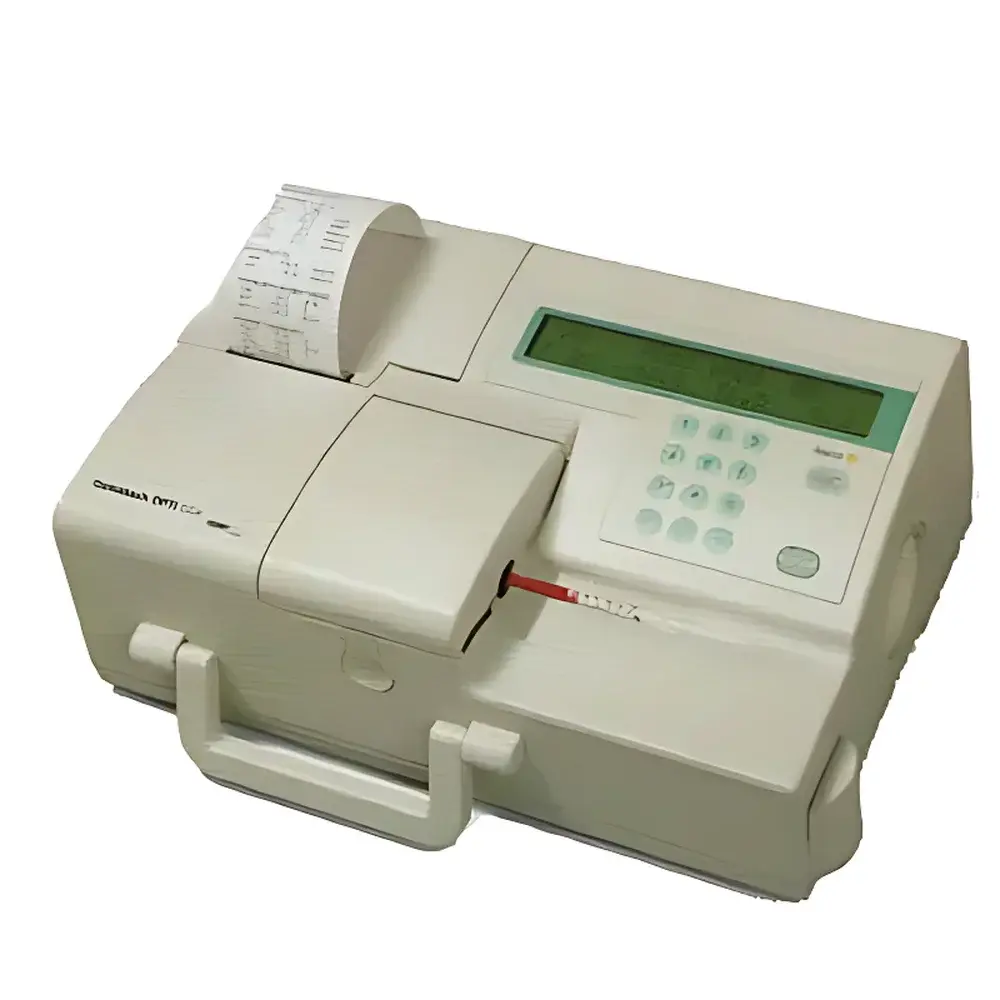
OPTI CCA Blood Gas Analyzer
| Brand | OPTI |
|---|---|
| Origin | USA |
| Model | OPTI CCA |
| Measurement Principles | Fluorescence-based optical sensing (pO₂, pCO₂), Reflectance photometry (pH, tHb, SO₂), Ion-selective field-effect transistor (ISFET) for electrolytes (Na⁺, K⁺, Ca²⁺, Cl⁻), Enzymatic electrochemical detection (Glu) |
| Sample Volume | 95 µL whole blood (arterial, venous, capillary) |
| Test Time | ≤85 seconds |
| Calibration | Factory-calibrated disposable cartridges, no user calibration required |
| Data Storage | Internal memory for ≥10,000 patient results with timestamps, operator IDs, and QC records |
| Connectivity | USB, RS-232, optional HL7 v2.x over Ethernet |
| Regulatory Compliance | FDA 510(k) cleared, CE-IVD, ISO 13485 certified, CLIA-waived for certain test panels |
| Power | Rechargeable Li-ion battery (≥8 hours continuous operation), auto-switching AC/DC |
Overview
The OPTI CCA Blood Gas Analyzer is a compact, cartridge-based, dry-chemistry point-of-care (POC) system engineered for rapid, simultaneous quantification of critical blood gas, electrolyte, oxygenation, and metabolic parameters from a single 95 µL whole blood sample. Unlike traditional wet-chemistry or electrode-based analyzers, the OPTI CCA employs a fully integrated optical and solid-state sensor architecture: fluorescence lifetime detection for pO₂ and pCO₂, reflectance photometry for pH and total hemoglobin (tHb), spectrophotometric oxyhemoglobin saturation (SO₂) calculation, ISFET technology for Na⁺, K⁺, Ca²⁺, and Cl⁻, and enzymatic amperometric detection for glucose (Glu). This multi-modal transduction eliminates liquid reagents, reference electrodes, and fluidic tubing—resulting in zero routine maintenance, no warm-up time, and intrinsic resistance to environmental interference such as altitude or ambient humidity. Designed for deployment across high-acuity clinical environments—including emergency departments, intensive care units (ICU/CCU), operating rooms, and mobile medical units—the OPTI CCA delivers laboratory-grade accuracy without dependency on centralized core labs.
Key Features
- True dry-system architecture: No liquid reagents, no electrolyte refills, no electrode replacement, and no daily calibration procedures.
- Integrated sample aspiration: Capillary-driven microfluidic loading ensures precise volumetric delivery and minimizes operator-induced variability.
- Intelligent disposable test cartridges: Each cartridge contains pre-dried, lyophilized reagents and embedded optical sensors; lot-specific calibration data is encoded in an RFID chip.
- Onboard thermal regulation: Maintains optimal reaction temperature (37 °C ± 0.2 °C) independent of ambient conditions, ensuring reproducibility across diverse clinical settings.
- Embedded barcode scanner: Supports bidirectional LIS/HIS integration via scanned patient ID, specimen ID, and operator credentials—enabling full traceability per CLIA and ISO 15189 requirements.
- Real-time quality assurance: Dual-level QC—electronic (cartridge-integrated reference signals) and liquid (user-run controls)—with automated flagging of out-of-range results and trending reports compliant with Westgard rules.
- Regulatory-ready data management: Audit trail with timestamped operator logins, result modifications, QC events, and cartridge lot tracking—fully aligned with FDA 21 CFR Part 11 and EU IVDR Annex II documentation standards.
Sample Compatibility & Compliance
The OPTI CCA accepts heparinized (lithium or sodium) whole blood specimens collected via arterial, venous, or capillary puncture. Capillary samples require no centrifugation and remain stable for analysis up to 15 minutes post-collection. Cartridges are stored at room temperature (15–30 °C); no refrigeration or equilibration is required prior to use—reducing pre-analytical delays in time-sensitive resuscitation scenarios. The system meets IEC 61010-1 safety standards and carries CE marking under In Vitro Diagnostic Regulation (IVDR) 2017/746. It is FDA 510(k)-cleared for quantitative measurement of pH, pO₂, pCO₂, tHb, SO₂, Na⁺, K⁺, Ca²⁺, Cl⁻, and Glu in human whole blood, with performance validated per CLSI EP9-A3 and ISO 15197:2013 protocols. All test methods are traceable to NIST SRMs and certified reference materials.
Software & Data Management
The OPTI CCA runs proprietary firmware with embedded database architecture supporting ≥10,000 patient records, each including date/time stamps, operator ID, cartridge lot number, QC status, and raw sensor output values. Data export is supported via USB mass storage (CSV/Excel), RS-232 serial transmission, or optional Ethernet interface with configurable HL7 v2.x message mapping (ORU^R01, ACK). Built-in statistical tools compute mean, SD, CV%, and Levey-Jennings charts for QC monitoring. System logs retain all user actions—including login/logout, result review, deletion, and configuration changes—for GLP/GMP-compliant audit readiness. Firmware updates are delivered via encrypted USB key with digital signature verification.
Applications
The OPTI CCA supports acute clinical decision-making in sepsis triage (lactate-free acid-base assessment), ventilator weaning (real-time pO₂/pCO₂ trends), cardiac surgery perfusion monitoring, diabetic ketoacidosis evaluation (electrolyte + glucose + acid-base balance), and neonatal respiratory distress assessment. Its portability and battery autonomy make it suitable for aeromedical evacuation, disaster response, and field hospital deployment where infrastructure reliability is limited. The absence of consumable fluids and electrodes significantly reduces total cost of ownership (TCO) compared to conventional benchtop analyzers—particularly in low-volume or intermittent-use settings.
FAQ
Does the OPTI CCA require daily calibration or routine maintenance?
No. Each test cartridge is factory-calibrated and contains embedded reference standards; no user calibration, electrode conditioning, or fluidic system cleaning is required.
Can the instrument interface with our hospital’s LIS or EMR system?
Yes—via RS-232, USB, or optional Ethernet with configurable HL7 v2.x messaging (ORU^R01). Integration support documentation and mapping templates are provided.
What is the shelf life and storage requirement for test cartridges?
Cartridges have a 12-month shelf life when stored at 15–30 °C; refrigeration is neither required nor recommended.
Is the OPTI CCA compliant with FDA 21 CFR Part 11 and EU IVDR?
Yes—audit trails, electronic signatures, and secure data handling meet both regulatory frameworks for electronic records and signatures.
How does the system ensure operator safety during sample handling?
The closed-cartridge design prevents direct contact between blood and instrument surfaces; aerosol generation is eliminated, and biohazard exposure risk is reduced to ALARA levels per OSHA Bloodborne Pathogens Standard 1910.1030.