
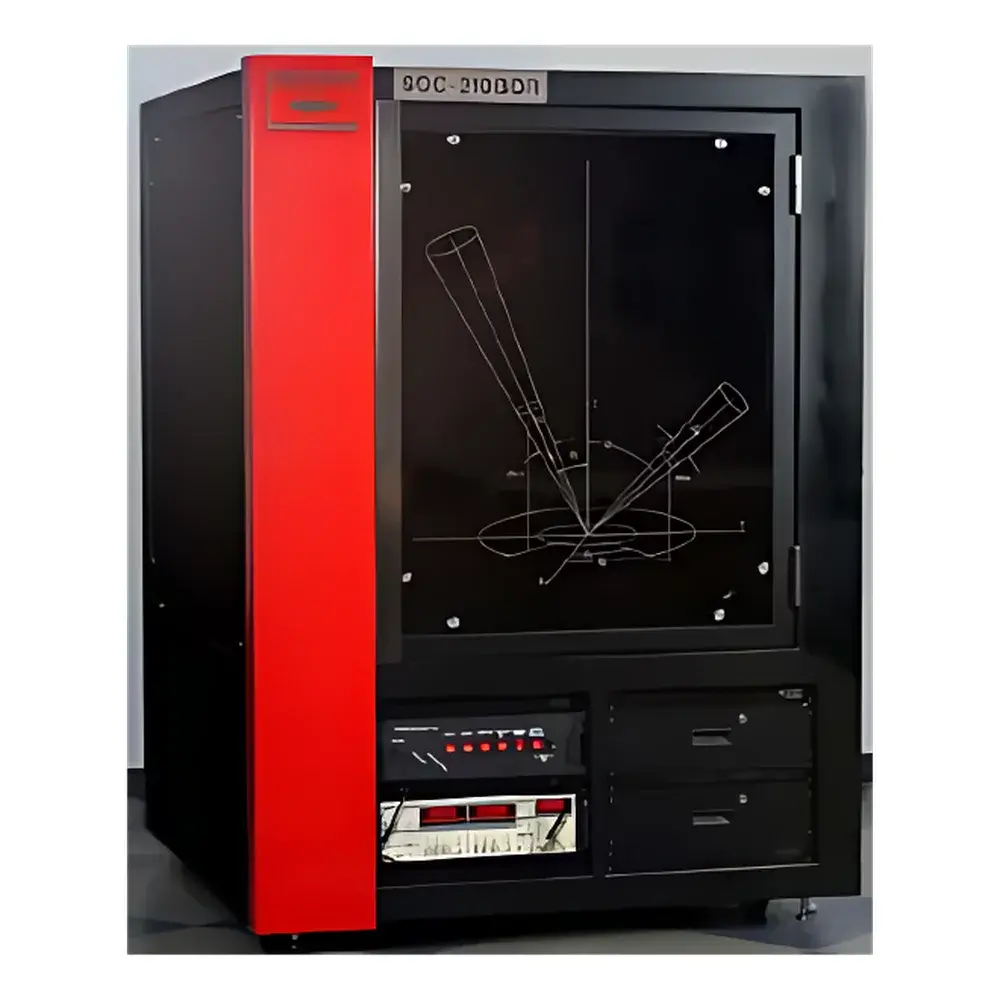
SOC SurfaceOptics BRDF Measurement System SOC-210 BDR
| Brand | SOC/SurfaceOptics |
|---|---|
| Origin | USA |
| Manufacturer Type | Authorized Distributor |
| Import Status | Imported |
| Model | SOC-210 BDR |
| Price | USD 985,000 (FOB USA) |
| Spectral Range | 0.35–14 µm (detector-dependent) |
| Measurement Background Noise | <1×10⁻³ sr⁻¹ |
| Angular Reproducibility | <5% of background noise |
| Measurement Axes | Fully automated θᵢ, φᵢ, θᵣ, φᵣ (incident and reflected polar/azimuthal angles) |
| Filter Wheel | Motorized 12-position bandpass filter wheel |
| Detector Options | Stirling-cooled MCT (mid-IR) and InSb (SWIR/MWIR) |
| Sample Mounting | Horizontal stage compatible with powders, liquids, flat solids, and rough surfaces |
| Data Acquisition | Fully automated reference-sample interleaving, real-time normalization, and radiometric calibration traceable to NIST standards |
Overview
The SOC SurfaceOptics BRDF Measurement System SOC-210 BDR is a research-grade, fully automated bidirectional reflectance distribution function (BRDF) characterization platform engineered for quantitative optical surface metrology across the ultraviolet–visible–shortwave–midwave–longwave infrared spectrum (0.35–14 µm). Based on the fundamental radiometric principle of directional hemispherical reflectance sampling, the SOC-210 BDR implements a dual-goniometric architecture with independent, high-precision motorized control of incident (θᵢ, φᵢ) and reflected (θᵣ, φᵣ) spherical angle coordinates. This enables rigorous acquisition of BRDF data — defined as the ratio of reflected radiance to incident irradiance per unit solid angle — under rigorously controlled illumination and viewing geometries. The system is designed for compliance with ASTM E259, ISO 13655, and CIE 117 standards for spectral reflectance measurement, and supports traceable calibration protocols aligned with NIST-traceable reference standards (e.g., Spectralon®, Infragold®). Its modular detector configuration — supporting both Stirling-cooled InSb (1–5.5 µm) and MCT (2–14 µm) detectors — ensures low-noise, high-dynamic-range radiometric performance without liquid nitrogen dependency.
Key Features
- Fully automated four-axis goniometry (θᵢ, φᵢ, θᵣ, φᵣ) with angular resolution ≤0.05° and repeatability <0.02°, enabling dense BRDF sampling grids (e.g., 5° × 5° or finer)
- Integrated 12-position motorized bandpass filter wheel for rapid multispectral BRDF acquisition without manual intervention or detector reconfiguration
- Horizontal sample stage with vacuum chuck and adjustable leveling, validated for stable measurement of loose powders, volatile liquids, thin films, and optically rough substrates
- Real-time background subtraction and reference-sample interleaving algorithm to mitigate drift and thermal artifacts during extended acquisitions
- Onboard electro-optical control unit with embedded Linux OS, providing deterministic timing, hardware synchronization, and local data buffering prior to Ethernet transfer
- Factory-calibrated radiometric scale with uncertainty <±2.5% (k=2) across full spectral range, supported by annual recalibration services compliant with ISO/IEC 17025
Sample Compatibility & Compliance
The SOC-210 BDR accommodates diverse sample forms without modification: flat polished optics (up to Ø150 mm), spray-coated panels, anodized metals, particulate beds (e.g., planetary regolith simulants), and static liquid surfaces (e.g., hydrocarbon films, aqueous suspensions). Sample mounting follows ASTM E2750 guidelines for non-contact reflectance geometry. All measurements are conducted under Class 1000 cleanroom-compatible environmental enclosures (optional), with temperature stabilization (±0.5°C) and humidity control (<30% RH) available. System documentation includes full 21 CFR Part 11-compliant audit trails, electronic signatures, and raw-data integrity logs — satisfying GLP/GMP requirements for defense and aerospace material qualification per MIL-STD-810 and ECSS-Q-ST-70-02C.
Software & Data Management
The proprietary BRDF Studio™ software (v5.3+) provides instrument control, real-time visualization of BRDF hemispheres, and batch processing via Python API (PySOC). Data export conforms to ASTM E2982 binary format and HDF5, with metadata fields compliant with ISO 16363 for digital preservation. Calibration files include spectral responsivity, goniometer alignment matrices, and stray-light correction maps. Software modules support BRDF-to-BTDF conversion, Kubelka-Munk inversion for scattering coefficients, and integration with optical design tools (e.g., LightTools®, FRED™) via ASCII export of BSDF lookup tables.
Applications
- Aerospace: Characterization of thermal control coatings (e.g., Z-93, S13G), ablative heat shields, and solar array reflectors under simulated space illumination
- Defense: Signature prediction of camouflage materials, low-observable surfaces, and IR countermeasure decoys across threat-band wavelengths (3–5 µm, 8–12 µm)
- Planetary Science: Validation of photometric models (e.g., Hapke, Minnaert) using analog regolith samples measured under vacuum-compatible configurations
- Automotive & Industrial Coatings: Quantitative gloss, haze, and sparkle analysis beyond ISO 2813 — including angular-dependent color shift (gonioapparent behavior)
- Optical Manufacturing: Metrology of diffractive optical elements (DOEs), microlens arrays, and structured surfaces where scatter modeling requires full BRDF input
FAQ
What spectral calibration standards are included with the SOC-210 BDR?
NIST-traceable reflectance standards (Spectralon® 99% and Infragold® 95%) calibrated at three wavelengths per decade from 0.35–14 µm, plus optional blackbody source for absolute radiance validation.
Can the system measure BRDF under vacuum or inert atmosphere?
Yes — optional environmental chamber (10⁻⁴ mbar base pressure, LN₂-cooled cold finger) integrates with the horizontal stage and maintains optical path integrity through CaF₂ viewport windows.
Is remote operation supported for unattended overnight measurements?
Fully supported via encrypted SSH/VNC; all detector cooling, filter sequencing, goniometer motion, and data logging operate autonomously with watchdog-triggered error recovery and email alerts.
How is BRDF data validated for inter-laboratory comparison?
Each system ships with a certified intercomparison dataset measured against the NPL BRDF Reference Facility (UK), documented in the ISO/IEC 17025 test report included with delivery.
Does the software support custom measurement sequences for non-standard geometries?
Yes — the BRDF Studio™ sequence editor allows user-defined angular sampling schemes (e.g., conical scans, meridional sweeps) with programmable dwell times, averaging counts, and adaptive step sizing based on signal-to-noise thresholds.



