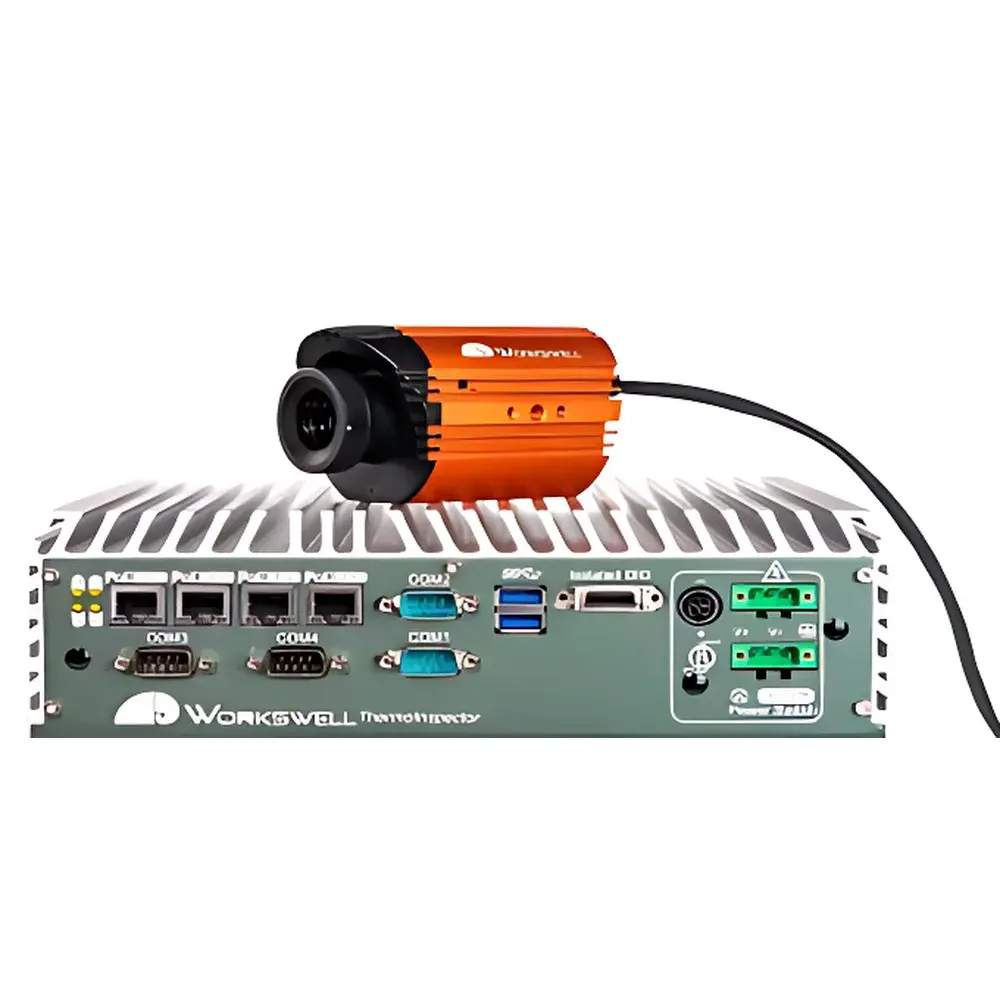
Workswell ThermoInspector 2nd Generation Thermal Imaging Camera System
| Origin | Czech Republic |
|---|---|
| Manufacturer Type | Authorized Distributor |
| Origin Category | Imported |
| Model | 2nd Generation |
| Pricing | Upon Request |
| Resolution | 640×480 (512), 320×240 (256), or 160×128 pixels |
| Temperature Range | −25 °C to +2000 °C |
| Thermal Sensitivity | ≤30 mK @ 30 °C |
| Accuracy | ±2 % or ±2 °C |
| Frame Rate | Up to 30 Hz |
| Detector Type | Uncooled VOx Microbolometer FPA |
| Lens Options | 17°, 25°, 35°, 45° FOV (manual focus, interchangeable) |
| Digital Zoom | 1–14× (sustained 1–11×) |
| IP Rating | IP65 (camera housing & touchscreen controller), IP40 (passive controller) |
| Power Supply | 6–36 VDC or optional 230 VAC adapter |
| PoE Support | 4× Gigabit PoE ports (camera interface), 2× Gigabit Ethernet (PLC integration) |
| Digital I/O | 8× isolated 24 VDC inputs, 8× open-collector outputs |
| Operating Environment | Industrial-grade, DIN-rail compatible mounting, RS232/RS485 serial interfaces |
| Software Compliance | Supports audit trail logging, user role management, and configurable alarm triggers for GLP/GMP-aligned workflows |
Overview
The Workswell ThermoInspector 2nd Generation is a high-performance, industrial-grade thermal imaging camera system engineered for real-time non-contact temperature monitoring, process validation, and automated thermal quality control. Based on uncooled vanadium oxide (VOx) microbolometer focal plane array (FPA) technology, it delivers calibrated radiometric imaging with sub-30 mK thermal sensitivity and traceable accuracy across an extended range from −25 °C to +2000 °C. Unlike generic IR cameras, the ThermoInspector 2nd Gen integrates directly into factory automation infrastructure—supporting deterministic synchronization with PLCs, motion controllers, and MES platforms via Gigabit Ethernet and isolated digital I/O. Its architecture enables closed-loop thermal feedback in continuous manufacturing environments, including injection molding, laser welding, thermal spraying, heat treatment, and metallurgical casting. The system complies with core requirements of ISO 18434-1 (condition monitoring), ASTM E1934 (infrared thermography standards), and supports configuration for FDA 21 CFR Part 11-compliant data integrity when deployed with validated software protocols.
Key Features
- Modular hardware design with three selectable resolutions (640×480, 320×240, 160×128) to balance spatial detail, frame rate, and computational load
- Real-time radiometric streaming at up to 30 Hz with full-frame calibration and non-uniformity correction (NUC) performed without interrupting measurement continuity
- Dual-controller options: compact passive central unit (IP40, DIN-rail mountable) or integrated touchscreen controller (IP65, 538 mm × 329 mm × 53 mm, 5.8 kg)
- Eight programmable digital inputs and eight open-collector outputs for direct interfacing with safety relays, solenoids, and PLC logic circuits
- Four Gigabit PoE ports supporting up to four synchronized thermal cameras—enabling multi-angle thermal profiling of complex geometries
- Comprehensive emissivity modeling with user-defined parameters: atmospheric transmission, window transmittance, reflected apparent temperature, humidity, and object distance
- Fourteen standardized palettes and fully configurable isotherms (upper/lower/mid-band), plus six geometric measurement tools (point, line, rectangle, ellipse, polygon, profile cross-section)
Sample Compatibility & Compliance
The ThermoInspector 2nd Gen is optimized for use across heterogeneous industrial substrates—including polymers, ferrous and non-ferrous metals, ceramics, composites, and organic materials—without requiring surface preparation or emissivity coating. Its spectral response (7.5–13.5 µm) minimizes atmospheric absorption interference and accommodates common industrial viewing windows (e.g., germanium, zinc selenide). Each unit ships with a NIST-traceable calibration certificate and embedded per-camera calibration file, enabling field recalibration using three user-defined reference points. The system supports ISO/IEC 17025-aligned calibration maintenance schedules and integrates with enterprise asset management (EAM) systems for lifecycle traceability. For regulated environments, firmware and software configurations support electronic signatures, change control logs, and 21 CFR Part 11 audit trails when used with validated third-party data acquisition modules.
Software & Data Management
The native ThermoInspector Control Suite provides a deterministic, low-latency graphical interface for setup, visualization, and rule-based analytics. All thermal data—including raw radiance values, ROI statistics (min/max/mean/std dev/median), time-series profiles, and thermal gradients—is timestamped with microsecond precision and stored in vendor-neutral HDF5 or CSV formats. The software supports simultaneous display of up to four synchronized camera feeds, dynamic ROI repositioning via product selector functionality, and latched thermal snapshots triggered by external events (e.g., part presence sensor, cycle start signal). Alarm conditions are defined per ROI using Boolean logic (e.g., “T_max > 1200 °C AND dT/dt > 50 °C/s”) and propagated as discrete signals to PLCs or SCADA systems. Configuration files, calibration metadata, and operator actions are version-controlled and exportable for internal review or regulatory submission.
Applications
- Plastic processing: Monitoring melt front progression, mold cavity temperature uniformity, and post-ejection cooling rates in injection molding
- Metal joining: Validating preheat/interpass temperatures in arc welding, detecting thermal runaway during laser beam welding, and assessing seam integrity in friction stir welding
- Thermal treatment: Mapping soak zone stability in batch furnaces, verifying quench uniformity in heat-treating lines, and identifying hot spots in induction hardening
- Safety-critical infrastructure: Continuous surveillance of ladle refractory integrity, slag layer detection in blast furnaces, and conveyor belt fire risk assessment in coal handling systems
- Automated finishing: Ensuring flame spray torch stability prior to robotic painting, confirming adhesive activation temperature in composite layup, and validating UV-cure lamp output distribution
- Quality gate testing: Final thermal signature verification of assembled components (e.g., battery modules, power electronics housings, brake calipers) before shipment
FAQ
Can the ThermoInspector 2nd Gen operate in hazardous areas?
The base camera unit meets IP65 ingress protection but does not carry ATEX or IECEx certification. Intrinsically safe operation requires integration with certified barrier systems and consultation with Workswell’s application engineering team for zone-specific deployment guidance.
Is remote firmware update supported over Ethernet?
Yes—firmware updates are delivered via secure HTTPS and applied through the central controller’s embedded Linux OS without requiring physical access or system downtime.
How is measurement traceability maintained across multiple cameras?
Each camera retains its unique calibration file; the controller applies per-sensor correction matrices in real time. Synchronized timestamps and shared reference geometry ensure spatially registered multi-camera analysis.
Does the system support custom alarm logic beyond simple thresholding?
Yes—users can define compound conditions combining temporal derivatives (dT/dt), statistical outliers, and inter-ROI correlations using the built-in rule engine.
What documentation is provided for regulatory submissions?
Standard delivery includes calibration certificates, CE/UKCA declarations of conformity, RoHS compliance statements, and technical files covering electromagnetic compatibility (EMC) and low-voltage directive (LVD) compliance. Custom validation packages (IQ/OQ/PQ) are available upon request.