
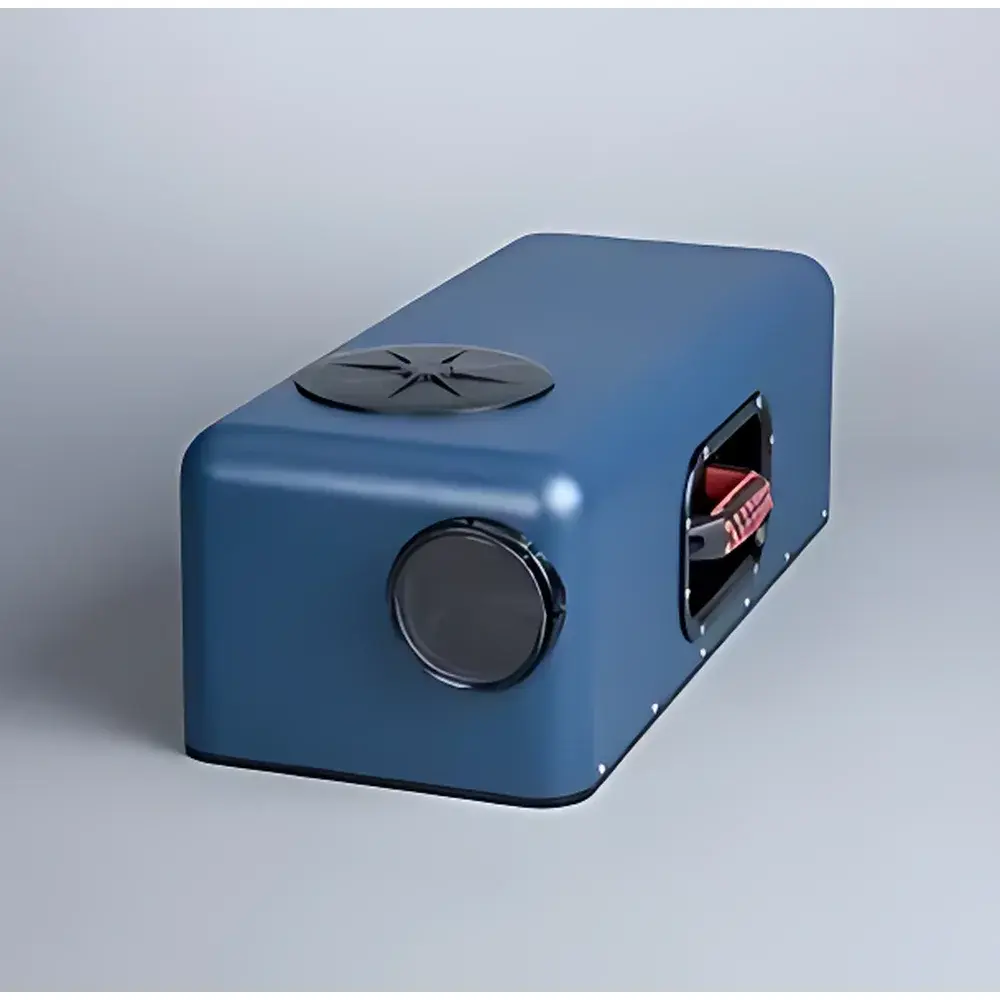
SOC SurfaceOptics SOC720SW Shortwave Infrared Hyperspectral Imaging Spectrometer
| Brand | SOC/SurfaceOptics |
|---|---|
| Origin | USA |
| Manufacturer Type | Authorized Distributor |
| Import Status | Imported |
| Model | SOC 720 |
| Operating Principle | Push-broom |
| Imaging Method | Interferometric |
| Deployment Mode | Ground-based |
| Spectral Range | 900–1700 nm |
| Spectral Resolution | 6.25 nm |
| Spatial Resolution (IFOV) | 0.79 mrad (configurable) |
| Field of View (TFOV) | 29° (configurable) |
| Spatial Sampling | 640 × 640 pixels |
| Frame Rate | 30 fps |
| Detector | InGaAs linear array, D* = 1.5 × 10¹³ cm·√Hz/W @ 1550 nm |
| Bit Depth | 14-bit |
| Data Format | Open BIL binary |
| Interface | Camera Link |
| Power Supply | AC / 12 V DC |
| Weight | 13.6 kg (30 lbs) |
| Dimensions | 178 × 356 × 559 mm (7″ × 14″ × 22″) |
Overview
The SOC SurfaceOptics SOC720SW is a high-performance, ground-deployable shortwave infrared (SWIR) hyperspectral imaging spectrometer engineered for precision spectral-spatial data acquisition across the 900–1700 nm range. Utilizing a push-broom scanning architecture coupled with an interferometric imaging spectrometer design, the SOC720SW captures contiguous spectral bands at 6.25 nm resolution—enabling quantitative identification and discrimination of material-specific absorption features in solid, liquid, and particulate samples. Its core optical path integrates a high-throughput F/2.4 fore-optics train, a stabilized diffraction-limited imaging spectrometer, and a thermoelectrically cooled InGaAs linear detector array (640 pixels) with demonstrated detectivity (D*) of 1.5 × 10¹³ cm·√Hz/W at 1550 nm. This configuration ensures low-noise, high-dynamic-range radiometric performance under ambient and controlled laboratory or field conditions. The system operates at 30 spatial lines per second, supporting real-time cube acquisition at up to 20 seconds per full hyperspectral data cube (640 × 640 × 128). All optical and electronic subsystems are factory-aligned and calibrated, minimizing post-deployment setup requirements.
Key Features
- Push-broom acquisition with integrated line-scanning mechanics—no external translation stages required
- Interferometric spectral dispersion delivering <1.5 nm smile distortion and spectral fidelity validated per ASTM E275 and ISO 13694
- 14-bit digitization with on-board non-uniformity correction (NUC) and dark-current compensation
- Camera Link interface (Base or Medium configuration) enabling deterministic, low-latency frame transfer to host PC or embedded MIDIS™ processor
- Modular fore-optics support for configurable TFOV (standard 29°; optional 10°, 15°, or 45°) and IFOV (0.79 mrad nominal; scalable via lens interchange)
- Self-contained thermal management: passive heatsinking + optional Peltier cooling for extended dynamic range in variable ambient environments
- Compliance-ready firmware architecture supporting audit trails, user access control, and time-stamped metadata embedding per FDA 21 CFR Part 11 guidelines
Sample Compatibility & Compliance
The SOC720SW is optimized for reflective and emissive measurements of non-destructive, macro-scale samples—including agricultural canopies, semiconductor wafers, polymer films, pharmaceutical tablets, and geological specimens. Its SWIR sensitivity enables detection of overtone and combination vibrations of C–H, O–H, and N–H bonds, critical for moisture content mapping, chemical composition analysis, and stress physiology assessment. The instrument meets electromagnetic compatibility (EMC) requirements per FCC Part 15 Class A and CE EN 61326-1. Optical calibration traceability is maintained to NIST-traceable standards (e.g., tungsten-halogen and blackbody sources), and spectral calibration certificates include uncertainty budgets compliant with ISO/IEC 17025. For regulated environments (e.g., GLP/GMP labs), optional validation packages include IQ/OQ documentation templates aligned with USP and ASTM E2594.
Software & Data Management
System operation and calibration are managed through SOC’s HyperSpect™ software suite—a Windows-native application providing real-time preview, exposure control, spectral binning, and automated flat-field correction. HSAnalysis™ delivers comprehensive pre-processing tools including radiometric calibration, atmospheric correction (using MODTRAN-based look-up tables), spectral unmixing (via constrained least-squares and vertex component analysis), and endmember extraction. All acquired data are stored in open-band-interleaved-by-line (BIL) format—natively readable by ENVI, Python (spectral, scikit-image), MATLAB, and QGIS without format conversion. The optional MIDIS™ real-time processing unit implements FPGA-accelerated spectral normalization, anomaly detection (RX algorithm), and multi-channel correlation monitoring—reducing latency from acquisition to actionable output to <50 ms per line. Audit logs record all parameter changes, calibration events, and user sessions, supporting regulatory review and reproducibility verification.
Applications
- Agriculture & Environmental Monitoring: Crop health assessment (chlorophyll, water index), soil organic carbon estimation, precision irrigation scheduling, and invasive species detection
- Industrial Process Control: Real-time polymer identification, coating thickness verification, tablet coating uniformity, and contaminant detection in food-grade packaging
- Defense & Security: Camouflage detection, explosive residue screening, and long-range target discrimination under degraded visual conditions
- Materials Science: Semiconductor wafer defect mapping, metal alloy sorting, and battery electrode homogeneity analysis
- Biomedical Research: Non-invasive tissue oxygenation monitoring, glucose concentration modeling in dermal layers, and contrast-agent tracking in preclinical models
FAQ
Is the SOC720SW compatible with third-party hyperspectral analysis platforms?
Yes—the native BIL binary format is fully supported by ENVI, PCI Geomatica, Python (via spectral, GDAL, or h5py), and MATLAB Image Processing Toolbox without proprietary plug-ins or converters.
Does the system require external calibration sources for routine operation?
No—factory-applied radiometric and spectral calibrations are stable for ≥12 months under normal operating conditions. Optional on-site recalibration kits (NIST-traceable reflectance panels and lamp standards) are available for mission-critical deployments.
Can the SOC720SW be mounted on UAV or mobile platforms?
While designed primarily for tripod- and lab-bench deployment, the system’s mechanical footprint, weight (<13.6 kg), and shock-rated enclosure permit integration into stabilized gimbal systems. Vibration isolation and GPS/IMU synchronization modules are available as OEM add-ons.
What level of spectral calibration uncertainty is documented in the certificate?
The standard calibration report includes expanded uncertainty (k=2) of ±0.35 nm for wavelength assignment and ±2.1% for relative spectral responsivity across the 900–1700 nm band.
Is FDA 21 CFR Part 11 compliance built into the software?
HyperSpect™ and HSAnalysis™ support electronic signatures, role-based access control, and immutable audit trails—meeting functional requirements for Part 11 compliance when deployed on validated IT infrastructure per organizational SOPs.




