
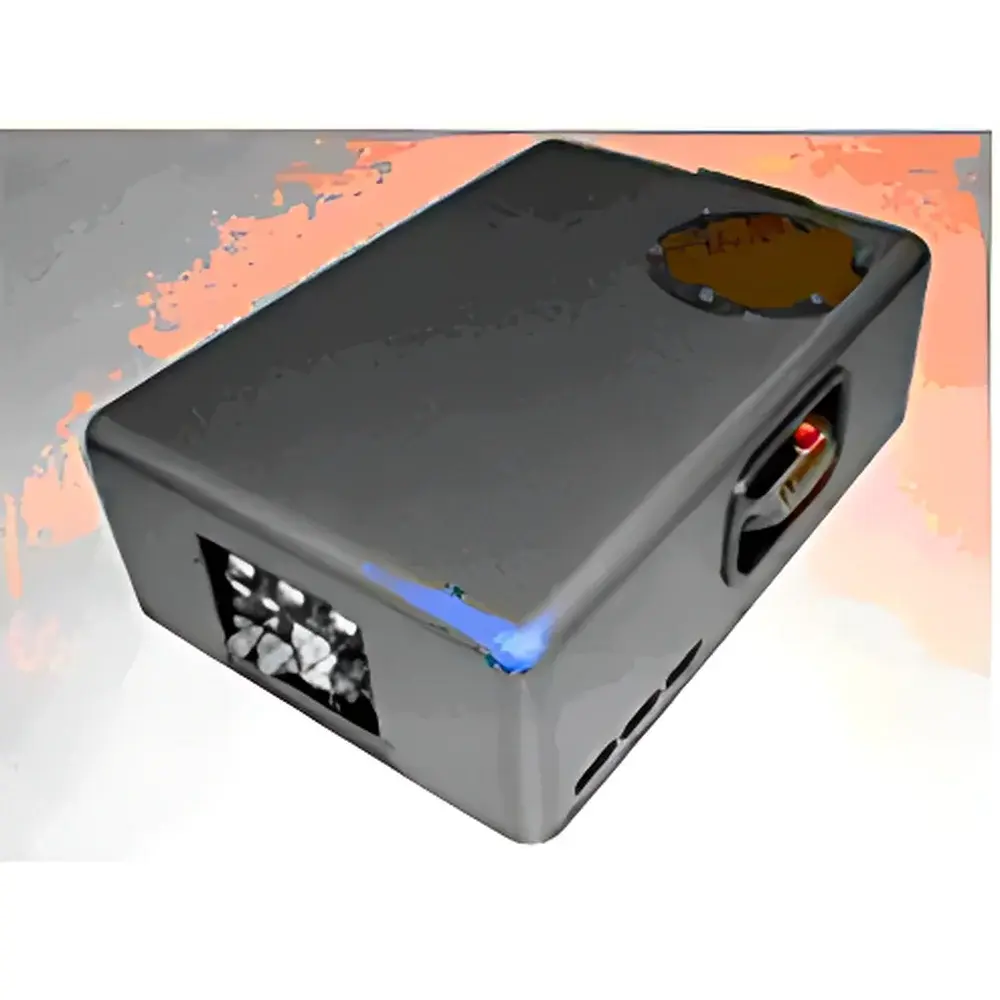
SOC SurfaceOptics SOC740 SWIR Hyperspectral Imaging Spectroradiometer
| Brand | SOC/SurfaceOptics |
|---|---|
| Origin | USA |
| Manufacturer Type | Authorized Distributor |
| Origin Category | Imported |
| Model | SOC740 |
| Pricing | Available Upon Request |
| Spectral Range | 1.0–2.35 µm |
| Detector | Cryogenically Cooled InSb (60 K) |
| Cut-off Filter | Integrated 2.35 µm Longpass Filter |
| Spatial Resolution | 640 × >2048 pixels (push-broom configuration) |
| Spectral Sampling Options | 100, 200, or 400 bands |
| Interchangeable Lenses | 28 mm, 50 mm, 200 mm (motorized lens rail for focus/FOV alignment) |
| Integration Time | Programmable |
| Optical Distortion Correction | Sub-pixel smile and keystone correction |
| Data Format | Open binary (BSQ/BIL-compatible) |
| Optional Processing Unit | SOC MIDIS™ Real-Time Onboard Processor |
| Software Compatibility | SOC Spectral Studio, ENVI, MATLAB, Python (GDAL, SciPy) |
Overview
The SOC SurfaceOptics SOC740 SWIR Hyperspectral Imaging Spectroradiometer is a laboratory- and field-deployable push-broom imaging spectrometer engineered for quantitative reflectance and radiance measurements of terrestrial and airborne targets in the short-wave infrared (SWIR) spectral region. Operating across a calibrated spectral range of 1.0–2.35 µm, the instrument leverages a high-performance, cryogenically cooled indium antimonide (InSb) focal plane array maintained at 60 K via a closed-cycle Stirling cooler. This thermal stabilization ensures low dark current, high signal-to-noise ratio (SNR), and long-term radiometric stability—critical for repeatable spectral signature acquisition under variable ambient conditions. The integrated 2.35 µm cut-on filter eliminates higher-order spectral overlap beyond the detector’s native response, preserving spectral fidelity without post-acquisition correction artifacts. Designed as a modular, radiometrically traceable system, the SOC740 complies with NIST-traceable calibration protocols and supports bidirectional reflectance distribution function (BRDF) characterization when coupled with goniometric stages.
Key Features
- Cryogenic InSb detector (60 K) with closed-cycle cooling—no liquid nitrogen handling required
- Sub-pixel-level smile and keystone distortion correction applied in real time or during post-processing
- Three interchangeable f/#-matched telecentric lenses (28 mm, 50 mm, 200 mm) mounted on a motorized translation rail for rapid optical path optimization
- User-selectable spectral sampling: 100, 200, or 400 bands—configurable to balance spectral resolution, SNR, and data throughput
- Programmable integration time (microsecond to second range) synchronized with precision scan mirror motion
- Open binary data output (BSQ/BIL layout) compliant with GDAL, ENVI header conventions, and HDF5 wrappers for scalable I/O
- Optional SOC MIDIS™ onboard processor enabling real-time spectral unmixing, endmember extraction, and three-channel simultaneous integration (e.g., VNIR-SWIR-MWIR co-registration readiness)
Sample Compatibility & Compliance
The SOC740 is optimized for non-contact, non-destructive analysis of heterogeneous natural and engineered surfaces—including soils, vegetation canopies, mineral outcrops, painted coatings, semiconductor wafers, and pharmaceutical tablets. Its spectral sensitivity aligns with key absorption features of hydroxyl (-OH), aliphatic C–H, and carbonate (CO₃²⁻) functional groups, supporting ASTM E1777 (Standard Guide for Hyperspectral Imaging), ISO 18593 (Remote Sensing—Calibration and Validation of Airborne Sensors), and USP (Near-Infrared Spectroscopy). Radiometric calibration is performed using NIST-traceable integrating sphere sources (e.g., Labsphere Spectralon® panels), with full uncertainty budgets documented per ISO/IEC 17025 requirements. System validation reports include linearity, spatial uniformity, spectral bandpass verification, and stray light characterization—essential for GLP/GMP-regulated environmental monitoring and materials QA/QC workflows.
Software & Data Management
Data acquisition and preprocessing are managed through SOC Spectral Studio—a cross-platform application supporting automated dark/reference collection, flat-field correction, and geometric rectification. All raw and processed datasets embed EXIF-style metadata (GPS, IMU, UTC timestamp, lens ID, integration time, detector temperature), ensuring auditability under FDA 21 CFR Part 11-compliant environments when deployed with electronic signature modules. The open binary format enables direct ingestion into ENVI, MATLAB, Python (via spectral, scikit-learn, or PyTorch-based deep learning pipelines), and cloud-native platforms (e.g., Google Earth Engine, AWS Open Data Registry). MIDIS™-equipped units support on-device spectral library matching (USGS, JPL, ECOSTRESS) and export of georeferenced GeoTIFF cubes with embedded projection metadata (WGS84, UTM, or custom CRS).
Applications
- Mineralogical mapping and lithological discrimination in geological surveying and mining exploration
- Plant stress detection via chlorophyll, water content, and cellulose/lignin ratio analysis (NDVI, NDWI, SIPI indices)
- Soil organic carbon and moisture quantification for precision agriculture and carbon sequestration monitoring
- Counterfeit detection in pharmaceuticals and agrochemicals through spectral fingerprint matching
- Non-invasive inspection of polymer degradation, coating delamination, and composite material defects
- Airborne and UAV-mounted hyperspectral surveys requiring high radiometric accuracy and spatial registration robustness
FAQ
What calibration standards are supported for field deployment?
NIST-traceable Spectralon® reflectance panels (2%, 50%, 99%) and calibrated blackbody sources (250–500 K) are recommended; factory calibration certificates include uncertainty budgets per ISO/IEC 17025.
Is the SOC740 compatible with third-party goniometers or motion control systems?
Yes—the instrument provides TTL trigger I/O, RS-422 serial interface, and Ethernet-based command protocol (SOC Command Language) for synchronization with rotary stages, linear actuators, and inertial measurement units.
Can spectral data be exported in ENVI-compatible format without proprietary software?
Yes—raw binary files include embedded header structures readable by ENVI’s “Build Header File” utility; no SOC software license is required for basic data access.
Does the system meet aerospace-grade vibration or EMI specifications?
The SOC740 chassis conforms to MIL-STD-810G for shock/vibration and meets FCC Class A and CE EMC Directive 2014/30/EU requirements; optional ruggedized enclosures available for UAV integration.
How is radiometric stability verified over extended measurement campaigns?
Built-in shutter-based dark reference acquisition occurs before each scan; detector temperature is monitored continuously with ±0.1 K resolution, and drift compensation algorithms are applied during radiometric correction.
Related Products





