
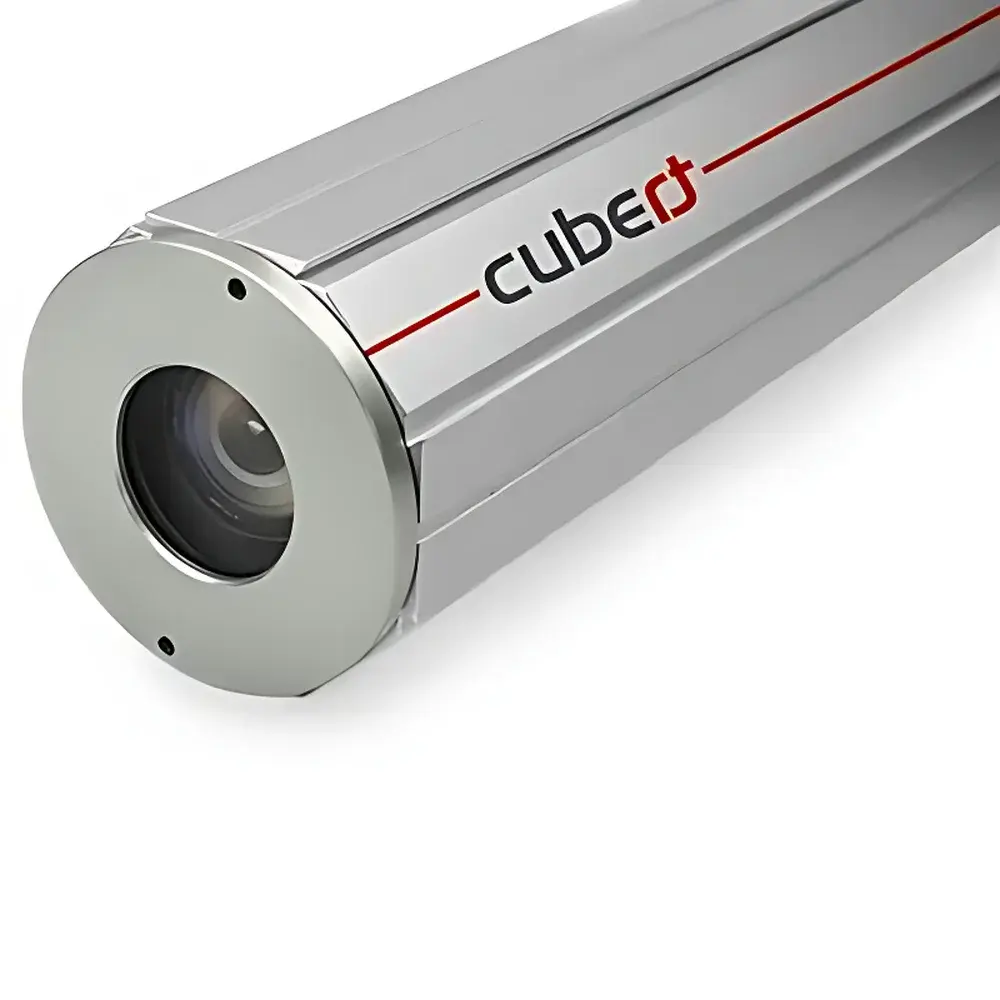
Cubert S685 Underwater High-Speed Hyperspectral Imaging System
| Brand | Cubert |
|---|---|
| Origin | Germany |
| Model | S685 |
| Spectral Range | 450–950 nm |
| Spectral Resolution | 8 nm @ 532 nm |
| Spatial Resolution | 1024 × 1024 pixels × 2 CCDs |
| Frame Rate | 20 Hyperspectral Cubes/s |
| Exposure Time | 0.1–1000 ms |
| Digital Resolution | 14-bit |
| Interface | Dual Gigabit Ethernet |
| Shutter Type | Global Shutter |
| IP Rating | IP69 |
| Operating Temperature | −10 to +50 °C |
| Weight | 4500 g |
| Power Supply | DC 12 V, 15 W |
| Lens Options | 10 mm / 23 mm / 35 mm focal length |
Overview
The Cubert S685 Underwater High-Speed Hyperspectral Imaging System is the world’s first snapshot-based hyperspectral imager engineered for submersible operation up to 5 m water depth for durations exceeding 60 minutes. Unlike scanning-based (push-broom or whisk-broom) systems, the S685 employs a patented frame-based spectral imaging architecture—realizing full 3D data cubes (x, y, λ) in a single exposure without mechanical motion. This eliminates motion-induced artifacts and enables true high-speed spectral video acquisition at up to 20 complete hyperspectral cubes per second. Its optical design integrates two synchronized silicon CCD sensors, each delivering 1024 × 1024 pixels, with spectral sampling at 4 nm intervals across the 450–950 nm visible-to-near-infrared (VNIR) range. The system’s core measurement principle is snapshot Fourier-transform-free spectral dispersion via integrated micro-optical filter arrays—ensuring high photon throughput, radiometric stability, and temporal coherence across all spectral bands. Designed from the industrial-grade Q285 platform, the S685 maintains metrological integrity under dynamic underwater conditions, making it suitable for quantitative in situ studies of phytoplankton dynamics, benthic community mapping, coral fluorescence phenotyping, and rapid-response marine environmental monitoring.
Key Features
- First commercially available hyperspectral imager certified for sustained underwater deployment (IP69-rated pressure housing, 5 m depth rating)
- Snapshot acquisition: Full 125-band hyperspectral cube captured in ≤1 ms—enabling artifact-free imaging of fast-moving aquatic organisms
- Dual-sensor architecture: Two 1024 × 1024-pixel Si CCDs operating in parallel for redundancy, polarization-insensitive capture, and improved SNR
- Global electronic shutter with adjustable exposure (0.1–1000 ms), supporting low-light and high-contrast underwater scenes
- Modular lens system with interchangeable 10 mm, 23 mm, and 35 mm focal lengths—optimized for varying field-of-view (TFOV) and instantaneous field-of-view (IFOV) requirements
- Dual GigE Vision-compliant interface for deterministic data streaming, hardware synchronization, and integration into ROV/AUV control stacks
- 14-bit digitization with on-board non-uniformity correction (NUC) and dark current compensation—ensuring consistent radiometric fidelity across thermal and illumination gradients
Sample Compatibility & Compliance
The S685 is designed for direct immersion in natural seawater, brackish, and freshwater environments without external housings or optical windows that degrade transmission or induce chromatic aberration. Its pressure-compensated optical path maintains spectral calibration stability under hydrostatic load. The system complies with IEC 60529 (IP69 ingress protection), EN 61000-6-2/6-4 (EMC immunity/emission), and RoHS 2011/65/EU directives. While not intrinsically certified for ATEX or IECEx zones, its 12 V DC power architecture supports safe integration into Class I, Division 2 marine electronics frameworks. Data acquisition workflows align with ISO/IEC 17025 traceability principles when paired with NIST-traceable reflectance standards (e.g., Spectralon®). Firmware and SDK support audit-ready metadata embedding—including GPS time stamps, depth sensor inputs (via optional analog/digital I/O), and environmental telemetry—for GLP-compliant field deployments.
Software & Data Management
The S685 ships with Cubert’s open-source SDK (C++/Python/C# bindings) and GUI application HyperSpectra Studio. The SDK exposes low-level register access, real-time cube buffering, and hardware-triggered acquisition modes—facilitating integration into custom MATLAB, LabVIEW, or ROS 2 pipelines. HyperSpectra Studio supports batch spectral extraction, endmember identification (using N-FINDR and VCA algorithms), supervised classification (SVM, Random Forest), and spectral angle mapper (SAM) analysis. All raw cubes are saved in standard BSQ/BIL ENVI format with embedded geotags and calibration headers. The software enforces FDA 21 CFR Part 11–compliant user authentication, electronic signatures, and immutable audit trails for spectral processing steps—meeting QA/QC requirements in regulated marine research programs.
Applications
- In vivo chlorophyll-a fluorescence kinetics and photoacclimation profiling in phytoplankton blooms
- Real-time discrimination of invasive vs. native macroalgae and seagrass species using spectral unmixing
- Quantitative mapping of coral bleaching stress indicators (e.g., photoprotective pigment ratios, NPQ dynamics)
- Underwater object detection and material classification for UXO surveys and pipeline inspection
- Calibration/validation of satellite-derived ocean color products (e.g., Sentinel-3 OLCI, Landsat-9 OLI-2)
- Synchronization with acoustic Doppler velocimeters (ADVs) or PIV systems for coupled bio-hydrodynamic studies
FAQ
Is the S685 compatible with autonomous underwater vehicles (AUVs) and remotely operated vehicles (ROVs)?
Yes—the dual GigE interface, compact form factor (140 × 140 × 180 mm), and DC 12 V power requirement enable seamless integration into industry-standard vehicle telemetry and power distribution architectures.
Does the system require external lighting for underwater operation?
It operates effectively under ambient sunlight down to ~20 m depth; for deeper or turbid conditions, optional calibrated LED illumination modules (450 nm, 532 nm, 660 nm) can be synchronized via TTL triggers.
How is spectral calibration maintained after repeated pressure cycles?
Factory-applied wavelength and radiometric calibration matrices are stored in non-volatile memory and applied in real time during acquisition; periodic verification using submerged NIST-traceable standards is recommended every 12 months.
Can the S685 be used above water?
Yes—the same optical and electronic architecture supports terrestrial, airborne, and laboratory applications; lens options and mounting interfaces are identical across operational domains.





