
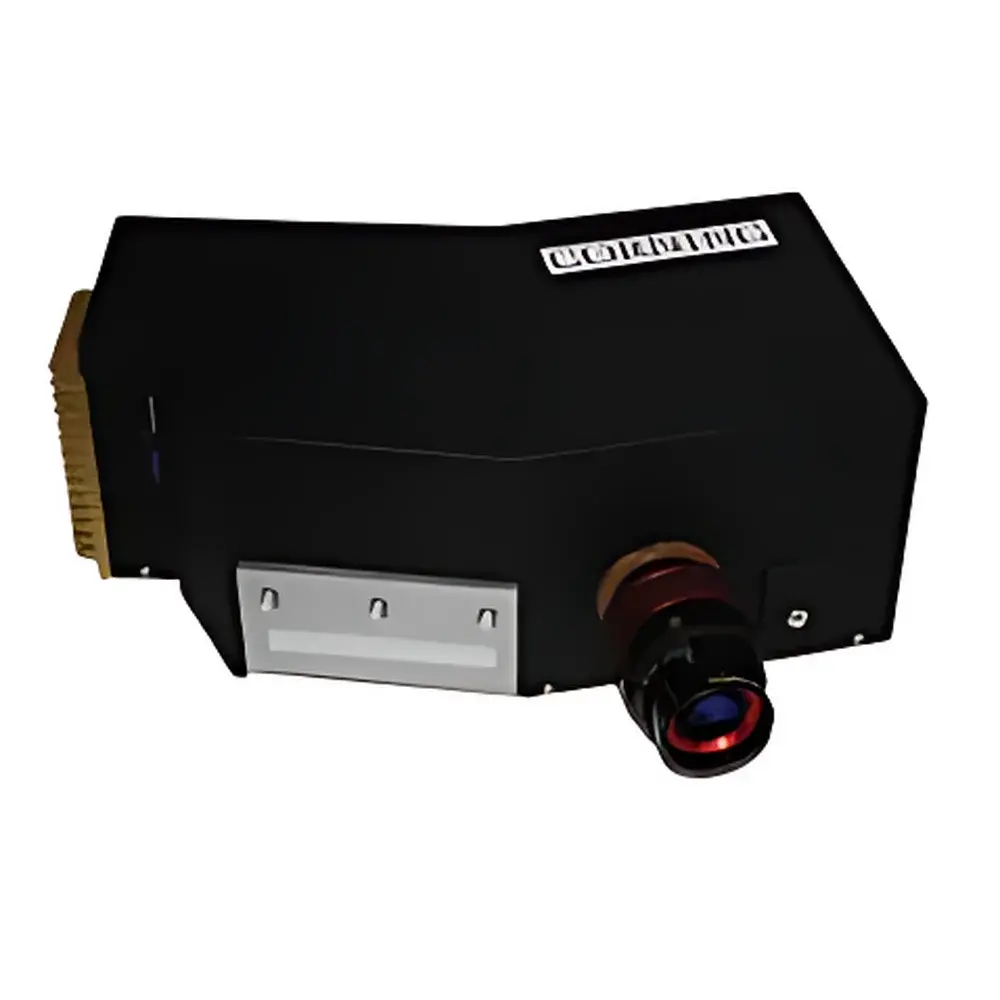
Corning 425shark Vis-NIR-SWIR Hyperspectral Imaging System
| Brand | Corning |
|---|---|
| Origin | USA |
| Manufacturer Type | Authorized Distributor |
| Import Status | Imported |
| Model | 425shark |
| Spectral Range | 400–2500 nm |
| Spectral Resolution | 4.1 nm (full band) |
| Platform Compatibility | Ground-based and airborne deployment |
| Optical Architecture | Single FPA, single-lens, single-optical-path push-broom imaging |
Overview
The Corning 425shark is a commercially engineered, single-detector push-broom hyperspectral imaging system designed for high-fidelity spectral data acquisition across the full visible-to-short-wave infrared (Vis-NIR-SWIR) spectrum—from 400 nm to 2500 nm. Unlike dual-detector or hybrid-configured systems requiring mechanical alignment, radiometric co-registration, and post-acquisition spectral stitching, the 425shark employs a monolithic optical architecture: one focal plane array (FPA), one collimating objective lens, and a single dispersive optical path. This unified design eliminates inter-sensor misregistration, polarization sensitivity discrepancies, and wavelength-dependent focus shifts inherent in multi-module instruments. As a result, the system delivers intrinsically aligned spatial-spectral cubes with pixel-level geometric fidelity and consistent spectral sampling—critical for quantitative reflectance modeling, material identification, and time-series change detection in both laboratory and field-deployed environments.
Key Features
- Full-range spectral coverage (400–2500 nm) in a single acquisition sweep, enabling seamless analysis from chlorophyll absorption bands (650–700 nm) through cellulose and lignin features (1600–1700 nm) to water vapor and mineral absorption features (1900–2500 nm)
- Fixed spectral resolution of 4.1 nm across the entire band—achieved via optimized grating dispersion and detector pixel binning strategy, ensuring uniform spectral sampling without interpolation artifacts
- Compact, rigid-monocoque mechanical housing engineered for thermal stability and vibration resilience; suitable for integration onto UAV gimbals, ground-based scanning rigs, and fixed-mount lab platforms
- No moving parts in the core optical train—enhancing long-term calibration retention and reducing maintenance requirements in remote or unattended deployments
- Native support for IEEE 1394b (FireWire) and GigE Vision interfaces, facilitating deterministic frame timing, hardware triggering, and synchronization with auxiliary sensors (e.g., GPS-IMU, laser altimeters)
Sample Compatibility & Compliance
The 425shark is compatible with reflective, transmissive, and emissive sample modalities under controlled illumination or ambient conditions. Its spectral response has been validated against NIST-traceable standard reflectance tiles (e.g., Spectralon® 99% and 20%) and calibrated blackbody sources across its operational range. The system complies with ISO 17025 requirements for measurement traceability when used with certified calibration procedures. For regulated applications—including environmental monitoring per EPA Method 184.108.40.206 and agricultural product quality assessment under USDA AMS guidelines—the instrument supports audit-ready metadata embedding (wavelength, exposure time, integration gain, temperature, GPS position) within each acquired ENVI-compatible .hdr/.bil file pair. All firmware and acquisition software adhere to IEC 61508 functional safety principles for embedded control systems.
Software & Data Management
The 425shark ships with Corning Hyperspectral Acquisition Suite (CHAS) v3.x—a cross-platform application supporting real-time preview, non-uniformity correction (NUC), dark current subtraction, and radiometric calibration. CHAS exports fully georeferenced hypercubes compliant with ENVI, HDF5, and GeoTIFF standards. Advanced processing workflows—including PCA, MNF transformation, spectral angle mapper (SAM), and endmember extraction via n-FINDR—are accessible via Python API bindings (corning-hsio), enabling integration into automated QA/QC pipelines. All raw and processed datasets retain immutable acquisition metadata, satisfying FDA 21 CFR Part 11 requirements for electronic records and signatures when deployed in GLP-compliant laboratories.
Applications
- Remote sensing: Vegetation stress mapping, soil organic carbon estimation, and mineralogical surveying using airborne or drone-mounted configurations
- Pharmaceutical manufacturing: Real-time tablet coating uniformity assessment and counterfeit drug detection via spectral fingerprint matching
- Food safety: Detection of mycotoxin contamination in grains and surface spoilage in produce using SWIR absorption features
- Materials science: Spatially resolved analysis of polymer degradation, composite delamination, and thin-film thickness variation
- Forensics: Non-destructive ink differentiation, document alteration detection, and latent trace evidence enhancement
FAQ
Does the 425shark require external calibration before each acquisition?
No—factory-performed radiometric and spectral calibration is stored onboard and applied automatically during acquisition. Field recalibration is recommended only after significant thermal cycling (>15°C ambient shift) or mechanical shock events.
Can the system operate in real time at full spectral resolution?
Yes—maximum line rate is 300 Hz at native 640×512 spatial resolution with 256 spectral bands, enabling real-time streaming to solid-state storage or GPU-accelerated on-the-fly processing.
Is the 425shark compatible with third-party flight controllers or ground stations?
Yes—via TTL trigger input and ASCII command protocol over RS-232 or USB-CDC, supporting integration with Pixhawk, DJI SDK, and custom telemetry systems.
What spectral libraries are included with the software?
CHAS includes the USGS Digital Spectral Library v7, ECOSTRESS spectral database, and a curated subset of the JPL Spectral Library—expandable via user-defined .sig files.
How is thermal drift managed during extended outdoor operation?
An integrated thermoelectric cooler (TEC) stabilizes the InGaAs and Si FPAs within ±0.1°C of setpoint; internal temperature logs are embedded in every metadata header for post-hoc drift correction.





