
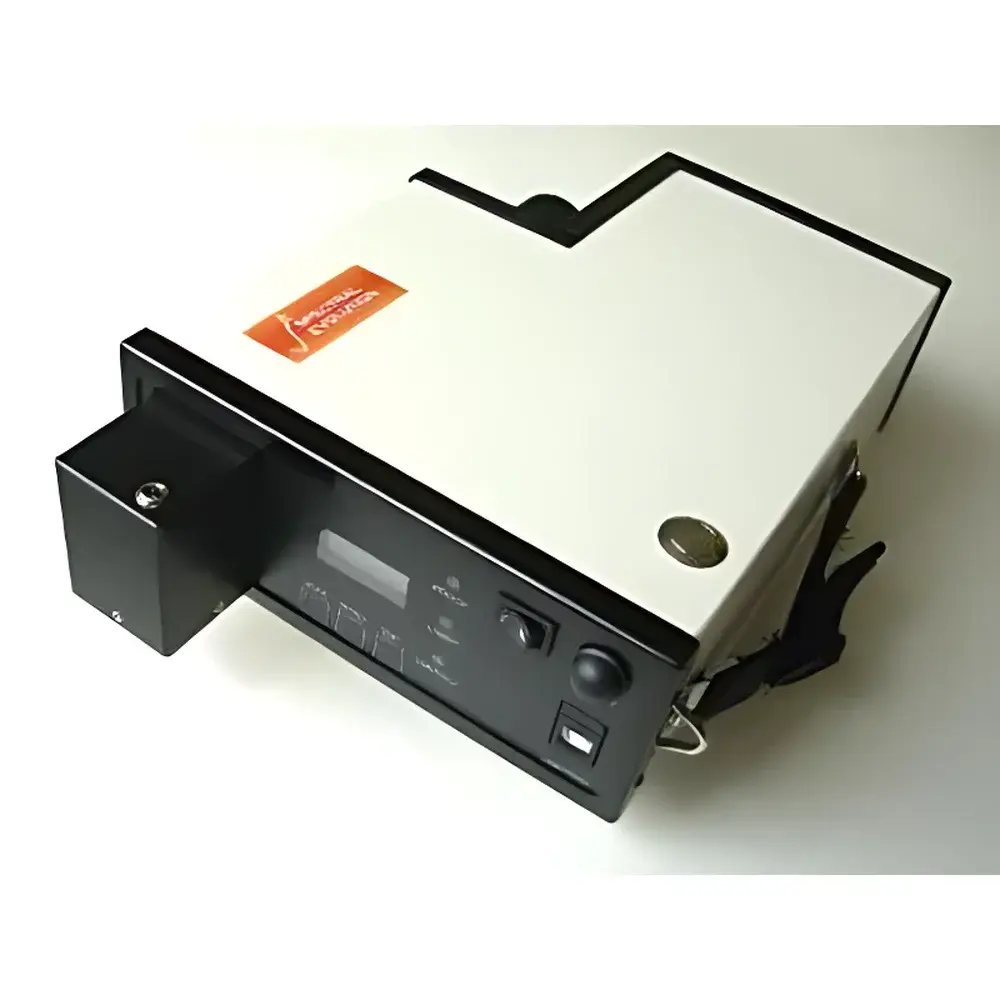
Spectral Evolution PSR-2500 Portable Field Spectroradiometer
| Brand | Spectral Evolution |
|---|---|
| Origin | USA |
| Model | PSR-2500 |
| Spectral Range | 350–2500 nm |
| Spectral Resolution | 3.5 nm (350–1000 nm), 22 nm @ 1500 nm and 2100 nm |
| Optical Design | Filter-based with fixed holographic grating |
| Detection Architecture | Dual-detector Si (350–1000 nm) + thermoelectrically cooled InGaAs (970–2500 nm), full-array |
| Field of View (TFOV) | 4° (standard), optional 8° or 14° lenses, fiber optic or integrating sphere accessories |
| Integration Time | As low as 10 ms |
| Data Storage | Onboard memory for 500 spectra |
| Interface | USB 2.0 and Bluetooth 4.0 |
| Calibration | NIST-traceable, factory-calibrated with drift-lock auto-compensation |
| Weight | 3.3 kg (7.3 lbs) |
| Power | Dual Li-ion batteries (7.4 V), ≥2 hours continuous operation |
| Operating Environment | Ground-based field use only |
| Compliance | Designed for ASTM E275, ISO 13406-2, and USGS Spectral Library protocol alignment |
Overview
The Spectral Evolution PSR-2500 Portable Field Spectroradiometer is a high-fidelity, dual-detector spectroradiometric instrument engineered for quantitative ground-based spectral measurements across the ultraviolet, visible, and shortwave infrared (UV-VIS-SWIR) domains (350–2500 nm). Unlike scanning or moving-grating spectrometers, the PSR-2500 employs a fixed holographic grating and two synchronized full-array detectors — a 512-element silicon CCD for 350–1000 nm and a 256-element thermoelectrically cooled InGaAs array for 970–2500 nm — eliminating mechanical wear, wavelength drift, and calibration instability associated with dynamic optical elements. Its filter-based spectral separation architecture ensures high photometric fidelity and repeatability under variable ambient conditions. The system delivers calibrated radiance, reflectance, and irradiance spectra with NIST-traceable accuracy (±5% at 400 nm, ±4% at 700 nm, ±7% at 2200 nm), making it suitable for field-deployable validation of airborne and satellite remote sensing data, as well as for rigorous laboratory-grade spectral characterization in situ.
Key Features
- Fixed-optics design with no moving parts: Enhances long-term calibration stability and field reliability
- Dual-detector architecture: Si CCD (350–1000 nm) and TE-cooled InGaAs (970–2500 nm) enable seamless broadband coverage without spectral gaps
- High-speed acquisition: Full 350–2500 nm spectrum captured in ≤100 ms, supporting up to 10 Hz measurement rate for dynamic scene monitoring
- Onboard intelligence: Integrated drift-lock auto-calibration, real-time dark current subtraction, and shutter-controlled reference measurement
- Field-optimized ergonomics: Aluminum alloy chassis (thermal mass-stabilized), integrated laser targeting module, ergonomic nylon carrying strap, and tripod-mountable ¼-20 threads
- Wireless & standalone operation: Bluetooth 4.0 and USB 2.0 connectivity; 500-spectrum onboard memory; dedicated keypad interface eliminates dependency on external computers during acquisition
- Modular optical interface: Interchangeable fore-optics (4°, 8°, or 14° FOV lenses), fiber-optic probe, cosine corrector, and optional integrating sphere for diverse sampling geometries
Sample Compatibility & Compliance
The PSR-2500 is designed for non-contact, non-destructive spectral measurement of natural and engineered surfaces under ambient daylight or controlled illumination. It supports reflectance (via reference panel), radiance (via fore-optic), and irradiance (via cosine diffuser) configurations per ASTM E275 and ISO 13406-2 methodologies. Its spectral calibration is traceable to NIST Standard Reference Materials (SRMs), and raw data output conforms to ENVI, ASCII, and NASA’s ASD-compatible formats — ensuring interoperability with USGS Spectral Library, ESA’s PRISMA, and NASA’s AVIRIS-NG validation workflows. While not certified for GMP/GLP environments out-of-the-box, its audit-ready data logs (timestamped, GPS-tagged when paired with optional PDA), exposure metadata, and calibration history support compliance with FDA 21 CFR Part 11 requirements when deployed within validated SOPs.
Software & Data Management
Data acquisition is managed via DARWin SP (Windows desktop) and DARWin CE Mobile (for Windows CE PDAs such as the Getac PS236). Both platforms provide real-time spectral visualization, automated exposure control, batch processing, and export to CSV, ENVI, or MATLAB-compatible formats. DARWin SP includes spectral smoothing, derivative analysis, vegetation index calculation (e.g., NDVI, PRI, WBI), and spectral angle mapper (SAM) tools. All raw and processed data retain embedded metadata: GPS coordinates (when linked), UTC timestamp, integration time, detector temperature, and calibration file ID. Optional LabVIEW drivers are available for custom integration into automated test benches or IoT-enabled environmental monitoring networks. No cloud storage or proprietary SaaS components are required — all data remains under user control.
Applications
- Earth observation validation: Cross-calibration of multispectral/hyperspectral airborne and satellite sensors (e.g., Sentinel-2, Landsat 9, ECOSTRESS)
- Agricultural phenotyping: Canopy-level chlorophyll, water content, nitrogen status, and stress detection via SWIR absorption features (1400 nm, 1900 nm, 2100 nm)
- Geological and mineral mapping: Identification of hydroxyl-, carbonate-, and iron-bearing minerals using diagnostic absorption bands between 2100–2500 nm
- Ecological monitoring: Leaf optical properties, litter decomposition stages, and wetland vegetation classification
- Marine and limnological optics: Water-leaving radiance, CDOM and chlorophyll-a retrieval algorithm development
- Photovoltaic materials testing: Spectral responsivity mapping of solar cells and anti-reflective coatings from UV to SWIR
- Food quality assessment: Non-invasive detection of moisture, starch, protein, and adulterants in grains, fruits, and dairy products
FAQ
Is the PSR-2500 suitable for laboratory use?
Yes — while optimized for field deployment, its thermal stability, NIST-traceable calibration, and fixed-optics architecture make it equally appropriate for controlled lab environments requiring portable spectral validation.
What spectral calibration standards are included?
Each unit ships with a factory-applied, NIST-traceable radiometric calibration certificate and a removable calibrated reference panel (99% BaSO₄ or Spectralon®) for field reflectance normalization.
Can the PSR-2500 measure absolute irradiance?
Yes — when used with the optional cosine-corrected irradiance collector, it delivers spectrally resolved irradiance (W·m⁻²·nm⁻¹) traceable to NIST SRM 2201 and aligned with ISO/CIE spectral irradiance measurement protocols.
Does it support GPS-geotagged measurements?
GPS tagging is enabled via Bluetooth pairing with compatible Windows CE PDAs (e.g., Getac PS236) or external GNSS receivers; raw spectral files embed latitude, longitude, altitude, and heading metadata.
How is thermal drift managed during extended field sessions?
The InGaAs detector incorporates thermoelectric cooling (−5°C stabilized), and the onboard drift-lock algorithm performs periodic dark/reference updates using the internal shutter — maintaining radiometric stability over multi-hour acquisitions.




