
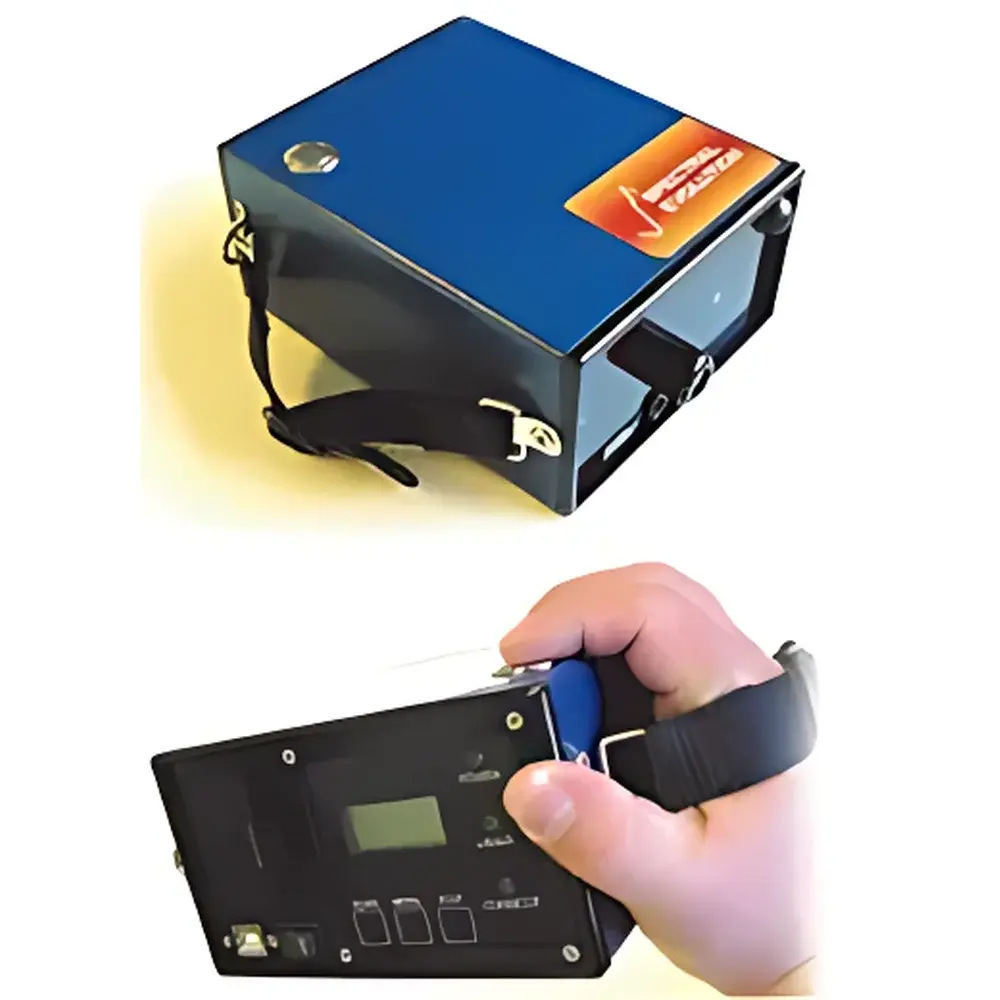
Spectral Evolution PSR-1100 Field-Portable Hyperspectral Radiometer
| Brand | Spectral Evolution |
|---|---|
| Origin | USA |
| Model | PSR-1100 |
| Operating Principle | Filter-based spectral dispersion with grating spectrometer |
| Imaging Mode | Non-imaging (point-spectra acquisition) |
| Deployment | Ground-based handheld |
| Spectral Range | 320–1100 nm |
| Spectral Resolution | 3.2 nm (FWHM) |
| Field of View (TFOV) | 4° (interchangeable optics available) |
| Detector | 512-element silicon photodiode array |
| Pixel Size | 25 µm × 2.5 mm |
| A/D Conversion | 16-bit |
| Wavelength Accuracy | ±0.5 nm |
| Wavelength Repeatability | ±0.1 nm |
| Integration Time | 8–2000 ms |
| NEΔL @400 nm (1 s) | 8.0×10⁻¹⁰ W/cm²/nm/sr |
| NEΔL @700 nm (1 s) | 7.0×10⁻¹⁰ W/cm²/nm/sr |
| NEΔL @900 nm (1 s) | 1.5×10⁻⁹ W/cm²/nm/sr |
| Max Radiance @700 nm | 1.5×10⁻⁴ W/cm²/nm/sr |
| Slit Width | 50 µm |
| Calibration | NIST-traceable radiance calibration |
| Internal Memory | 2500 spectra |
| Battery | Rechargeable 2800 mAh Li-ion, >4 h continuous operation |
| Weight | <1.8 kg |
| Dimensions | 17.8 × 8.3 × 14.6 cm |
| Interface | USB 2.0, Bluetooth 4.0 |
| Software | DARWin SP (Windows), DARWin CE (PDA) |
Overview
The Spectral Evolution PSR-1100 is a field-portable, non-imaging hyperspectral radiometer engineered for high-fidelity in situ measurement of spectral reflectance, radiance, and irradiance across the ultraviolet–visible–near-infrared (UV-VNIR) domain (320–1100 nm). Unlike scanning or push-broom imaging systems, the PSR-1100 employs a fixed-grating, filter-enhanced optical architecture with a 512-element silicon photodiode array detector—optimized for point-source spectroscopy under variable ambient lighting conditions. Its core measurement principle relies on calibrated spectral radiometry: incident light is collimated through a 4° full-angle fore-optic (or optional fiber optic input), dispersed via a ruled diffraction grating, and resolved at 3.2 nm FWHM resolution with sub-nanometer wavelength stability (±0.1 nm repeatability, ±0.5 nm absolute accuracy). All factory calibrations are NIST-traceable, ensuring metrological integrity for quantitative remote sensing validation, biophysical parameter retrieval, and cross-platform sensor intercomparison.
Key Features
- Self-contained operation: Integrated LCD interface and button-driven control enable autonomous spectral acquisition—no laptop or external power required.
- Onboard storage: 2500 spectra retained in non-volatile memory with timestamping, integration time tagging, and metadata logging (e.g., GPS coordinates when paired with PDA).
- Intelligent exposure control: Auto-exposure, auto-shutter, and real-time signal optimization execute in single-button sequence—critical for rapid field deployment across heterogeneous targets.
- Robust optical design: All-reflective fore-optics minimize chromatic aberration and stray light; 50 µm entrance slit ensures optimal throughput–resolution trade-off.
- Field-ready ergonomics: Weighing under 1.8 kg with integrated laser aiming module, wrist strap, and compact form factor (17.8 × 8.3 × 14.6 cm) for one-handed operation in rugged terrain.
- Flexible connectivity: Dual-interface support (USB 2.0 + Bluetooth 4.0) enables wireless synchronization with GETAC PS236 rugged PDA—capturing synchronized geotagged imagery, voice annotations, elevation, and compass heading.
- Low-noise detection: 16-bit A/D conversion coupled with thermally stabilized detector electronics delivers radiometric sensitivity down to 7.0×10⁻¹⁰ W/cm²/nm/sr at 700 nm (1 s integration).
Sample Compatibility & Compliance
The PSR-1100 is designed for direct contact-free measurement of natural and anthropogenic surface materials—including vegetation canopies, soil substrates, aquatic surfaces, snow/ice, mineral outcrops, and painted or coated industrial samples. Its 4° TFOV lens provides standardized angular sampling aligned with common satellite and airborne sensor footprints (e.g., Landsat OLI, Sentinel-2 MSI), facilitating vicarious calibration and validation workflows. Optional 25° fiber optic input extends versatility to confined or irregular geometries (e.g., leaf cuvettes, laboratory reflectance standards). The instrument complies with ASTM E275, ISO 9001:2015 (calibration traceability), and supports GLP/GMP-aligned data integrity through DARWin SP’s audit-trail-enabled acquisition logs. Radiometric calibration certificates include uncertainty budgets per ISO/IEC 17025 requirements.
Software & Data Management
DARWin SP (v5.x+) serves as the primary Windows-based acquisition and analysis platform—supporting real-time spectral preview, batch processing, multi-curve overlay, normalization (e.g., to reference panel), and derivative analysis. Raw data export is ASCII-compatible (tab-delimited), enabling seamless ingestion into ENVI, MATLAB, Python (NumPy/Pandas), or R for advanced modeling (e.g., PROSAIL inversion, NDVI derivation, chlorophyll index computation). DARWin CE extends functionality to Windows Mobile PDAs, embedding GPS metadata, image capture, and voice annotation directly within the spectral record. All software modules enforce file-level integrity checks, session-level metadata tagging, and user-accessible calibration history—facilitating FDA 21 CFR Part 11–compliant environments where electronic records require attributable, legible, and contemporaneous documentation.
Applications
- Remote sensing ground truthing: Validation of atmospheric correction algorithms and top-of-canopy reflectance products from UAV, aircraft, and satellite platforms.
- Agricultural phenotyping: Quantification of leaf-level pigment content (chlorophyll a/b, carotenoids), water stress indices (NDWI, PRI), and nitrogen status via narrow-band spectral features.
- Environmental monitoring: Discrimination of algal bloom species in inland waters using characteristic absorption troughs near 620 nm and 675 nm; sediment load estimation via NIR scattering response.
- Ecological assessment: Forest canopy structure analysis through red-edge inflection point (REIP) tracking and lignin/cellulose ratio estimation in litter layers.
- Geological surveying: Identification of iron oxide/hydroxide minerals (hematite, goethite) and clay species (kaolinite, smectite) via diagnostic absorption features between 700–1000 nm.
- Material science: Spectral fingerprinting of coatings, pigments, and solar absorber surfaces for quality control and aging studies.
FAQ
Does the PSR-1100 support radiometric calibration traceable to NIST?
Yes—each unit ships with a full NIST-traceable radiance calibration certificate, including spectral responsivity curves, uncertainty budgets, and verification against standard lamps (FEL, QTH) per ISO/IEC 17025 guidelines.
Can the PSR-1100 operate without external power or a connected computer?
Yes—the integrated 2800 mAh rechargeable lithium-ion battery enables >4 hours of continuous autonomous operation, including display, storage, and laser targeting functions.
What accessories are recommended for long-term field campaigns?
Spectral Evolution offers weather-resistant transit cases, spare batteries with smart chargers, calibrated reference panels (99% BaSO₄, 50% ceramic), tripod adapters, and armored 1-m fiber optic probes rated for UV-VNIR transmission stability.
Is DARWin SP compatible with modern Windows OS versions and scripting environments?
DARWin SP v5.8+ supports Windows 10/11 (64-bit) and provides COM automation interfaces for MATLAB and Python (via pywin32), enabling automated batch acquisition and real-time spectral QA/QC pipelines.
How does the PSR-1100 handle varying solar illumination during daylight measurements?
The auto-exposure algorithm dynamically adjusts integration time (8–2000 ms) based on real-time signal-to-noise optimization, while the built-in dark-current shutter corrects for thermal drift—ensuring consistent radiometric fidelity across diurnal cycles.



