
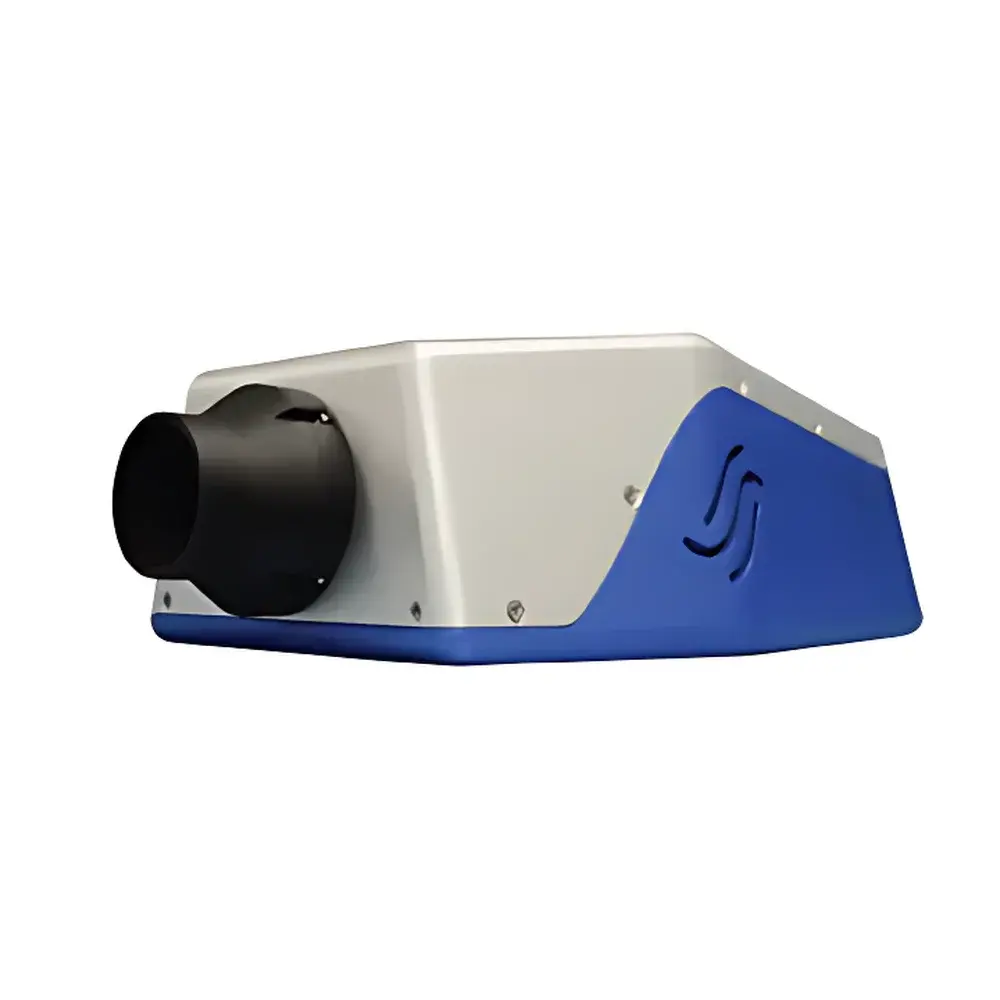
SOC LightShift Hyperspectral Light-Field Polarization Imaging Spectrometer
| Brand | SOC/SurfaceOptics |
|---|---|
| Origin | USA |
| Manufacturer Type | Authorized Distributor |
| Import Status | Imported |
| Model | LightShift |
| Spectral Range | 400–1000 nm |
| Spectral Resolution | ~25 nm (average) |
| Imaging Modality | Snapshot-based Hyperspectral + Light-Field + Polarimetric Fusion |
| Configurable Channel Options | 16 spectral channels OR 12 spectral + 4 polarization channels |
| Modular Channel Array | Interchangeable 4×4 micro-optical channel grid |
Overview
The SOC LightShift Hyperspectral Light-Field Polarization Imaging Spectrometer is an advanced snapshot multispectral imaging platform engineered for simultaneous acquisition of spatial, spectral, angular (light-field), and polarization-resolved information at video frame rates. Unlike scanning or tunable-filter-based hyperspectral systems, LightShift employs a monolithic micro-optical array integrated with a high-quantum-efficiency CMOS sensor to capture full 4D radiometric data—(x, y, λ, θ)—in a single exposure. Its core optical architecture leverages computational imaging principles grounded in plenoptic sampling and Mueller matrix-inspired polarization encoding, enabling quantitative analysis of material birefringence, surface scattering anisotropy, and subsurface chromophore distribution without mechanical scanning or temporal multiplexing. Designed for laboratory-based remote sensing validation, biomedical tissue characterization, precision agriculture phenotyping, and defense-related target discrimination, LightShift delivers deterministic data fidelity under ambient illumination and dynamic conditions.
Key Features
- Snapshot acquisition architecture: Captures complete hyperspectral cubes (up to 1000 spectral bands across 400–1000 nm) at native camera frame rates—no moving parts, no wavelength scanning, no trade-off between speed and spectral fidelity.
- Integrated light-field capability: Resolves directional radiance variations per pixel via microlens array calibration, supporting depth estimation, refocusing, and 3D scene reconstruction from single-shot data.
- Polarization-aware detection: Supports dual-state (linear) or full-Stokes polarization measurement modes; configurable 4-channel polarization subarray enables rapid assessment of diattenuation, retardance, and depolarization metrics.
- Modular 4×4 optical channel grid: Users may physically swap micro-optical filter arrays to reconfigure spectral band selection—enabling application-specific optimization (e.g., chlorophyll-a/b peaks at 430/650 nm, hemoglobin absorption at 540/577 nm, or SWIR-edge features near 980 nm).
- Ruggedized optomechanical housing: Aluminum alloy chassis with NIST-traceable alignment fixtures; compatible with standard C-mount lenses and motorized translation stages for macro-to-micro scale integration.
Sample Compatibility & Compliance
LightShift operates in reflectance, transmittance, and epi-illumination configurations, accommodating solid, semi-transparent, and turbid biological samples—including leaf discs, tissue sections, polymer films, and painted surfaces—without contact or vacuum requirements. The system complies with ISO 17025 calibration traceability protocols for spectral responsivity verification. All firmware and software components adhere to FDA 21 CFR Part 11 requirements for electronic records and signatures when deployed in GLP/GMP-regulated environments. Data output formats conform to HDF5 v1.10+ and ENVI-compatible BIL/BIP standards, ensuring interoperability with third-party analysis toolchains including MATLAB Image Processing Toolbox, Python scikit-image, and ENVI/IDL.
Software & Data Management
LightShift PRO is a native 64-bit Windows application built on Qt and CUDA-accelerated compute kernels. It provides two primary operational modes: real-time streaming and post-acquisition analysis. In real-time mode, users configure ROI-based spectral binning, live polarization contrast enhancement, and on-the-fly spectral unmixing using constrained non-negative matrix factorization (cNMF). The dual-view interface allows concurrent display of live feed and time-synchronized playback of previously acquired datasets—including synchronized multi-session comparisons. All processing pipelines generate audit-trail logs compliant with ALCOA+ principles (Attributable, Legible, Contemporaneous, Original, Accurate, Complete, Consistent, Enduring, Available). Raw data are stored with embedded metadata (wavelength calibration coefficients, polarization orientation angles, lens distortion maps) in self-describing HDF5 containers.
Applications
- Agricultural science: Quantitative monitoring of nitrogen status, water stress, and fungal infection onset via spectral slope analysis in the red-edge (680–750 nm) and NIR (750–1000 nm) regions, augmented by polarization contrast to detect cuticle micro-fracture patterns.
- Biomedical research: Label-free discrimination of collagen fiber orientation in histological sections using polarization-resolved second-harmonic generation (SHG)-compatible spectral windows; tumor margin delineation via hemoglobin oxygenation mapping.
- Materials inspection: Detection of subsurface delamination in carbon-fiber composites through angular-dependent scattering signatures captured in light-field mode; identification of counterfeit pharmaceutical tablets via spectral fingerprinting combined with surface gloss polarization response.
- Environmental remote sensing simulation: Ground-truth validation of airborne/satellite hyperspectral sensors using calibrated reflectance targets imaged under controlled illumination with simultaneous polarization correction.
FAQ
What calibration standards are supported for spectral radiometric accuracy?
LightShift includes factory-applied NIST-traceable reflectance and irradiance calibration using certified Spectralon® panels and tungsten-halogen reference lamps. Users may perform field recalibration using optional portable integrating sphere sources.
Is GPU acceleration required for real-time processing?
Yes—LightShift PRO requires an NVIDIA GPU with Compute Capability ≥ 6.0 (e.g., GTX 1060 or higher) to sustain full-resolution video-rate spectral cube reconstruction and polarization demodulation.
Can LightShift be synchronized with external triggers or other instruments?
The system features TTL-compatible input/output ports for hardware triggering, frame synchronization with laser pulse sources, and lock-in timing with fluorescence lifetime systems.
Does the software support batch processing of large hyperspectral time-series datasets?
Yes—LightShift PRO includes a headless CLI module (lightshift-cli.exe) enabling script-driven batch analysis, spectral library matching, and PCA-based anomaly detection across hundreds of acquisitions.
What is the maximum spatial resolution achievable with standard optics?
With a 50 mm f/2.8 macro lens and 4.6 µm pixel pitch sensor, the system achieves ≤ 25 µm ground sampling distance (GSD) at 10 cm working distance; resolution scales linearly with magnification and inversely with working distance.
Related Products



