
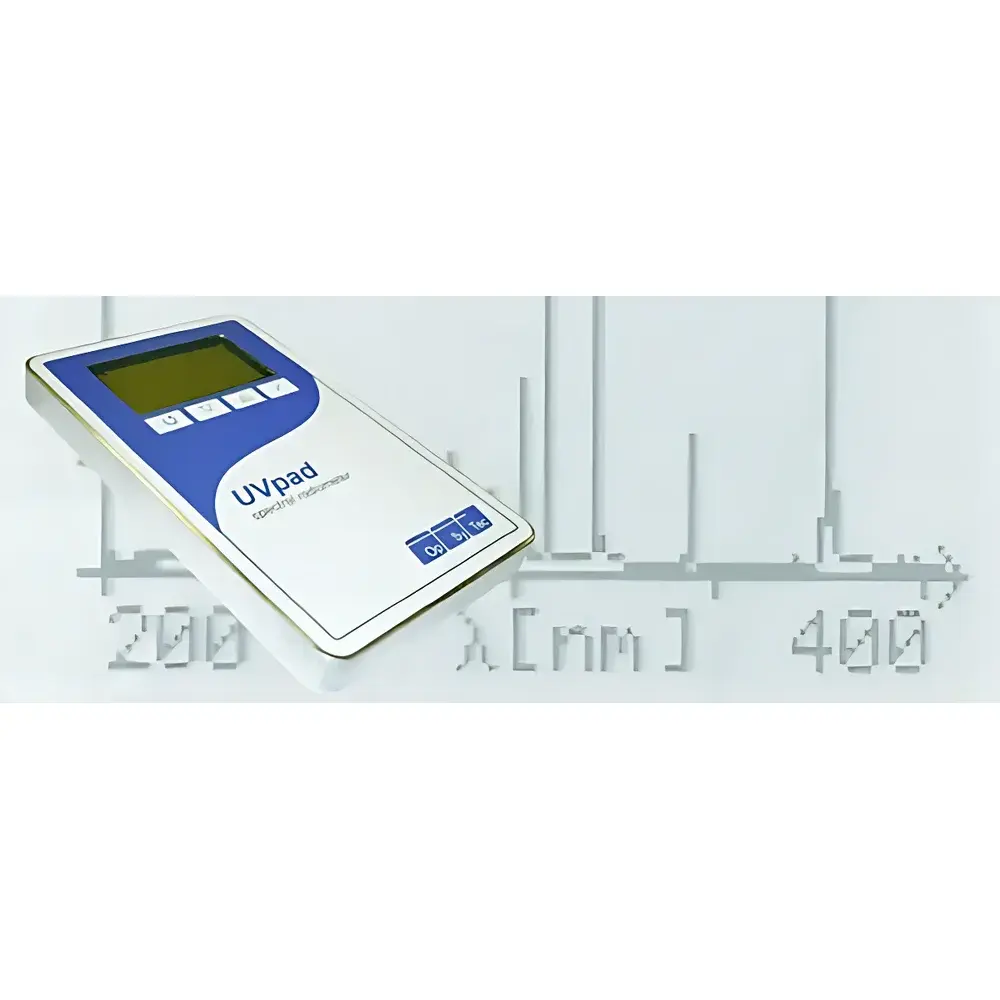
UVpad Ultraviolet Spectroradiometer by Opsytec
| Origin | Germany |
|---|---|
| Manufacturer Type | Authorized Distributor |
| Origin Category | Imported Instrument |
| Model | UVpad |
| Price Range | USD 9,200 – 13,200 (est.) |
| Optical Design | Single-Beam |
| Detector | Photomultiplier Tube (PMT) |
| Wavelength Range | 200–440 nm |
| Wavelength Selection | Manual |
| Spectral Bandwidth | 2 nm |
| Wavelength Accuracy | Not Specified |
| Stray Light (S.L.) | Not Specified |
| Irradiance Range | 2–5000 mW/cm² (UVA–UVC) |
| Energy Dose Range | 1 mJ/cm² – 600 J/cm² (standard) |
| Calibration Traceability | PTB/NIST |
| Cosine Correction | Integrated Diffuser (CIE-compliant) |
| Measurement Duration | 0–120 s |
| Sampling Interval | 10 ms – 1000 ms |
| Display | Monochrome Graphic LCD (128 × 64 px) |
| Dimensions | 160 × 100 × 14.4 mm (L × W × H) |
| Operating Temperature | Up to 70 °C |
| Weight | 375 g |
| Interface & Storage | USB 2.0 |
| Power | 3 × CR2032 Lithium Coin Cells (≥300 measurements |
Overview
The UVpad Ultraviolet Spectroradiometer by Opsytec is a compact, self-contained, single-beam spectroradiometric instrument engineered for high-fidelity spectral irradiance measurement across the deep ultraviolet to near-visible range (200–440 nm). Unlike broadband UV radiometers or filter-based photometers, the UVpad employs a fixed-grating monochromator coupled with a high-gain photomultiplier tube (PMT) detector to deliver true spectral resolution—2 nm full width at half maximum (FWHM)—enabling quantitative discrimination of emission peaks, spectral shifts, and relative intensity distributions from diverse UV sources including mercury-vapor lamps, excimer lamps, and narrowband UV-LEDs. Its design adheres to CIE S 026/E:2019 and ISO/CIE 13370:2023 requirements for spectral irradiance measurement systems, ensuring traceable, repeatable, and physically meaningful data for process validation, lamp aging studies, and photopolymerization optimization.
Key Features
- Ultra-Compact Form Factor: At just 14.4 mm thick and weighing 375 g, the UVpad is the thinnest portable spectroradiometer commercially available—designed for in-line integration into UV curing conveyors, glovebox environments, and confined reactor chambers without optical coupling via fiber or cables.
- CIE-Compliant Cosine Response: Equipped with an integrated diffuser calibrated to CIE standard observer functions, enabling accurate angular response correction for non-normal incidence and spatially non-uniform fields—critical for conformal UV dose mapping.
- Real-Time Spectral Processing: Onboard firmware performs continuous spectral acquisition, irradiance integration per band (UVA/UVB/UVC/VIS), time-resolved irradiance profiling, and cumulative radiant exposure calculation—all computed and displayed within the instrument without external software dependency.
- Photoinitiator Matching Capability: Users may import reference absorption spectra (e.g., Irgacure 819, TPO, DETX) into device memory to compute spectral match factors and relative quantum efficiency indices—supporting empirical optimization of photoinitiator selection and dosage in UV-curable formulations.
- Traceable Metrology Foundation: Factory calibration is traceable to Physikalisch-Technische Bundesanstalt (PTB) and NIST standards, with documented uncertainty budgets provided in the included calibration certificate. All spectral data retain full wavelength and irradiance metadata for audit readiness.
Sample Compatibility & Compliance
The UVpad is compatible with all common UV-emitting sources used in industrial, academic, and regulatory settings—including low-pressure Hg lamps (254 nm), medium-pressure Hg lamps (broadband 200–400 nm), UV-A LED arrays (365/385/395 nm), UV-C LEDs (265–280 nm), and pulsed xenon excilamps. It meets functional requirements outlined in ASTM E2914–22 (Standard Practice for Spectral Irradiance Measurements of UV Lamps), ISO 11664-3:2019 (Colorimetry — Part 3: Spectral matching), and supports GLP/GMP-aligned workflows through deterministic timestamping, immutable onboard storage, and exportable CSV/JSON datasets. While not a Class I medical device, its metrological rigor supports FDA 21 CFR Part 11-compliant data handling when paired with validated PC software (optional).
Software & Data Management
Data retrieval is performed via USB 2.0 interface using Opsytec’s cross-platform UVpad Control Suite (Windows/macOS/Linux), which enables batch export of spectral scans, temporal irradiance curves, and energy dose logs with embedded calibration parameters. The suite supports user-defined spectral weighting functions (e.g., erythemal action spectrum, DNA-damage spectrum), comparative overlay analysis of up to eight datasets, and automated report generation compliant with internal QA templates. All measurements stored onboard (up to 50 full records) retain raw spectra (1024-point array), irradiance-time vectors (10 ms resolution), and environmental metadata (timestamp, battery level, temperature). No cloud upload or telemetry is performed—the system operates fully offline to preserve data sovereignty.
Applications
- Quantitative validation of UV lamp output stability during production curing cycles
- Comparative spectral characterization of UV-LED modules across manufacturing lots
- Determination of effective radiant exposure (J/cm²) for photopolymer crosslinking kinetics studies
- Verification of UVC disinfection system performance against ISO 15714:2020 requirements
- Optimization of photoinitiator concentration and spectral overlap in inkjet, coating, and 3D printing resins
- Field-deployable auditing of UV safety interlocks and enclosure leakage in Class 3B/4 laser labs
FAQ
Is the UVpad suitable for measuring pulsed UV sources?
Yes—the 10 ms minimum sampling interval and real-time buffer architecture enable reliable capture of pulse profiles, peak irradiance, and integrated fluence for flash-lamp and pulsed-LED systems.
Can calibration be performed in-house?
No—calibration requires PTB/NIST-traceable reference sources and vacuum UV-capable monochromators. Opsytec recommends biennial recalibration at authorized service centers; certificates include full uncertainty analysis per ISO/IEC 17025.
Does the instrument support external triggering?
Not natively—the UVpad operates autonomously with internal timing. Synchronization with external processes must be achieved via post-acquisition temporal alignment using embedded timestamps.
What is the operational lifetime of the PMT detector?
The sealed, side-on PMT is rated for ≥10⁹ total photoelectron counts under typical UV curing conditions; accelerated aging tests indicate >5 years of daily industrial use before measurable gain drift occurs.
How is cosine error minimized at high angles of incidence?
The integrated diffuser is characterized per CIE 177:2006 and provides <±3% deviation from ideal cosine response up to 75° off-axis—validated using goniophotometric testing at PTB.




