
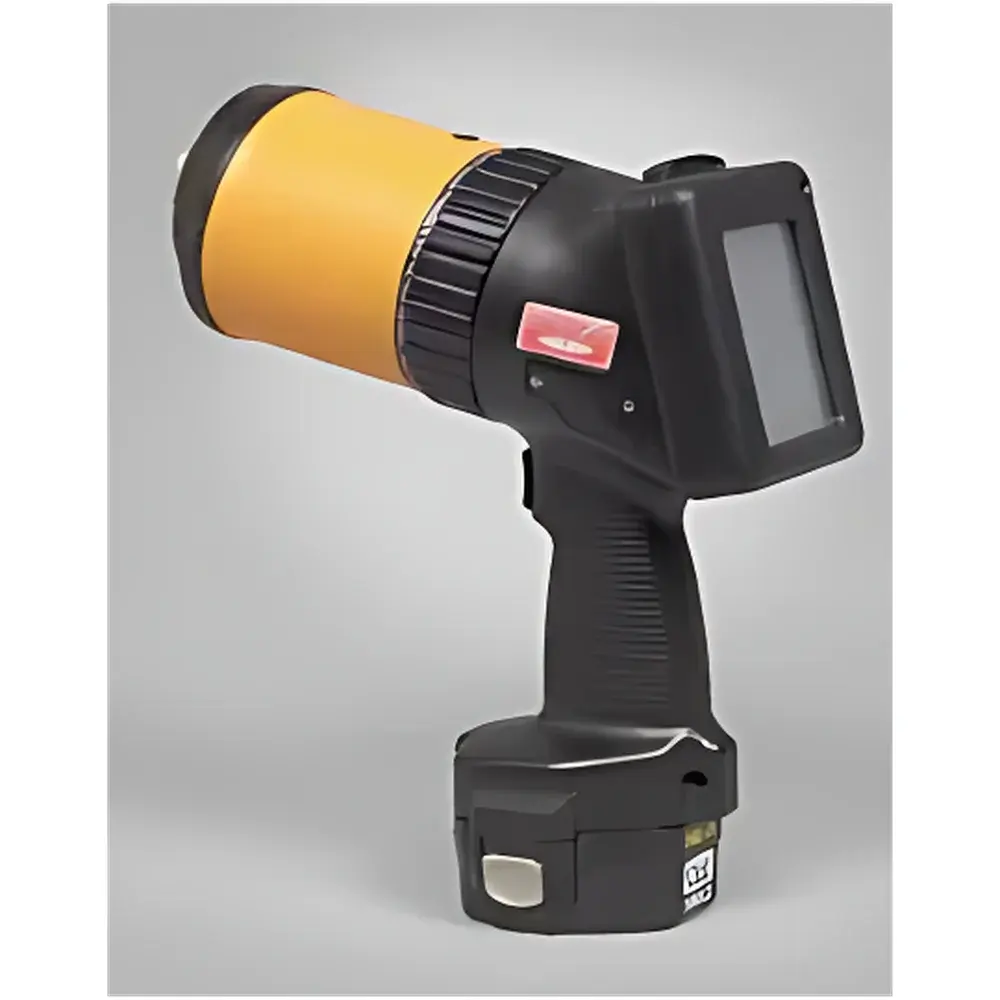
SurfaceOptics 410 Solar Portable Spectral Reflectometer
| Brand | SurfaceOptics |
|---|---|
| Origin | USA |
| Model | 410 Solar |
| Wavelength Range | 335–2500 nm |
| Wavelength Bands | 7 discrete bands (335–380, 400–540, 480–600, 590–720, 700–1100, 1000–1700, 1700–2500 nm) |
| Incident Angle | 20° from normal |
| Measurement Modes | Total reflectance, diffuse reflectance, and 20° specular reflectance |
| Repeatability | ±0.5% (within 10 s per measurement |
| Calibration Traceability | NIST-traceable gold reference standard included |
| Compliance | ASTM E903, ASTM C1549 |
| Spot Size | 0.250" diameter at 20° incidence |
| Beam Divergence | 3° half-angle |
| Operating Temperature | 0–40 °C (non-condensing) |
| Storage | −25 to 70 °C |
| Power | Dual rechargeable NiMH batteries |
| Weight | 2.1 kg (with batteries) |
| Display | Integrated PDA-style touchscreen interface with on-board SD card data storage |
Overview
The SurfaceOptics 410 Solar is a field-deployable, portable spectral reflectometer engineered for high-fidelity optical characterization of material surfaces across the ultraviolet–visible–near-infrared–shortwave-infrared (UV-VIS-NIR-SWIR) spectrum (335–2500 nm). It operates on the principle of directional-hemispherical reflectance (DHR) measurement using a fixed 20° angle of incidence—optimized for solar-weighted reflectance evaluation in accordance with ASTM E903 and ASTM C1549. The instrument integrates a tungsten-halogen VIS-NIR source, a precision-engineered integrating sphere, a thermoelectrically stabilized InGaAs/Si photodetector array, and an embedded microcontroller architecture. Unlike benchtop spectrophotometers requiring sample extraction or vacuum environments, the 410 Solar enables direct, non-contact, in-situ measurement on substrates ranging from flat panels to curved architectural glazing (up to 6″ convex or 12″ concave radius), making it uniquely suited for both laboratory metrology and outdoor field validation.
Key Features
- Modular probe design with interchangeable measurement heads for application-specific optical alignment and surface geometry adaptation
- NIST-traceable gold-coated reference standard shipped with each unit, enabling on-site calibration verification and long-term measurement stability
- Seven discrete spectral bands aligned to key solar irradiance and thermal emission regions—enabling calculation of solar absorptance (αsolar), thermal emittance (ε), and spectral selectivity ratios
- Integrated touchscreen PDA interface with real-time spectral preview, onboard data logging to SD card, and configurable report export (CSV, XML)
- Low thermal drift architecture: 90-second warm-up stabilizes source output and detector baseline prior to measurement initiation
- Robust mechanical housing rated for transport and operation in non-condensing ambient conditions (0–40 °C), with IP54-rated ingress protection for dust and light splashing
Sample Compatibility & Compliance
The 410 Solar accommodates heterogeneous material classes—including anodized aluminum, low-emissivity (low-E) coated glass, polymer-based solar absorbers, ceramic thermal barrier coatings, and space-grade optical mirrors—without requiring conductive backing or vacuum mounting. Its 0.250″ beam spot and 3° half-angle illumination ensure uniform irradiance distribution even on moderately textured or slightly curved surfaces. All measurements conform to ASTM E903 (Standard Test Method for Solar Absorptance, Reflectance, and Transmittance of Materials Using Integrating Spheres) and ASTM C1549 (Standard Test Method for Determination of Solar Reflectance Near Ambient Temperature Using a Portable Solar Reflectometer). Instrument firmware supports audit-ready metadata tagging (operator ID, GPS coordinates, timestamp, ambient RH/temperature) to meet GLP-aligned documentation requirements for building envelope certification (e.g., LEED v4.1, Cool Roof Rating Council) and aerospace optical qualification (MIL-PRF-13830B).
Software & Data Management
Data acquisition and post-processing are managed via the proprietary SurfaceOptics Reflectance Suite (SRS) software, compatible with Windows 10/11. The software imports raw spectral files directly from the SD card and applies factory-applied spectral response correction factors, dark-current subtraction, and sphere efficiency compensation. Users can compute weighted integrals—such as solar-weighted reflectance (ρsolar), near-infrared reflectance (NIRref), and emissivity-equivalent values—using built-in CIE standard illuminants and ASHRAE solar spectral irradiance models. Export options include ANSI-compliant CSV for integration into energy modeling platforms (e.g., EnergyPlus, WINDOW), as well as PDF summary reports with embedded spectral plots and uncertainty propagation estimates per GUM (Guide to the Expression of Uncertainty in Measurement). All software modules support 21 CFR Part 11–compliant electronic signatures and audit trails when deployed in regulated QC environments.
Applications
- Solar energy: Quantifying spectral reflectance of photovoltaic module backsheets, concentrator optics, and selective solar absorber coatings for thermal efficiency optimization
- Building science: Validating cool roof and façade materials per CRRC Product Rating Program and ASHRAE 90.1 compliance protocols
- Aerospace: In-field inspection of telescope mirror coatings, spacecraft thermal control surfaces, and radar-absorbing material (RAM) integrity
- Optical manufacturing: Rapid QA screening of anti-reflective (AR), high-reflective (HR), and dichroic thin-film stacks during coating line commissioning
- Materials R&D: Correlating surface morphology (via AFM/SEM) with directional-hemispherical optical response for next-generation metamaterials and plasmonic absorbers
FAQ
Does the 410 Solar require external power or PC connectivity during operation?
No. The instrument operates autonomously on dual rechargeable NiMH batteries, supporting ≥120 measurements per full charge. All processing, display, and storage occur internally.
Can it measure highly absorbing or blackbody-like surfaces accurately?
Yes. The integrating sphere design and calibrated gold reference enable reliable reflectance quantification down to ρ ≈ 0.02 (2%) with <±0.8% absolute uncertainty in the 700–1100 nm band.
Is spectral interpolation between the seven discrete bands supported?
No. The 410 Solar does not perform continuous scanning; its bandpass filters are fixed and optimized for solar-weighted integrals. Interpolation is neither performed nor recommended per ASTM guidance.
How is traceability maintained over time?
Users may re-validate calibration annually using the included NIST-traceable gold standard. Optional factory recalibration services include full spectral responsivity mapping and certificate issuance compliant with ISO/IEC 17025.
What accessories are available for extended field use?
Optional accessories include a ruggedized carrying case with shock-absorbing foam, tripod mount adapter, GPS-enabled Bluetooth module for geotagged measurements, and temperature/humidity sensor add-on for environmental metadata correlation.





