
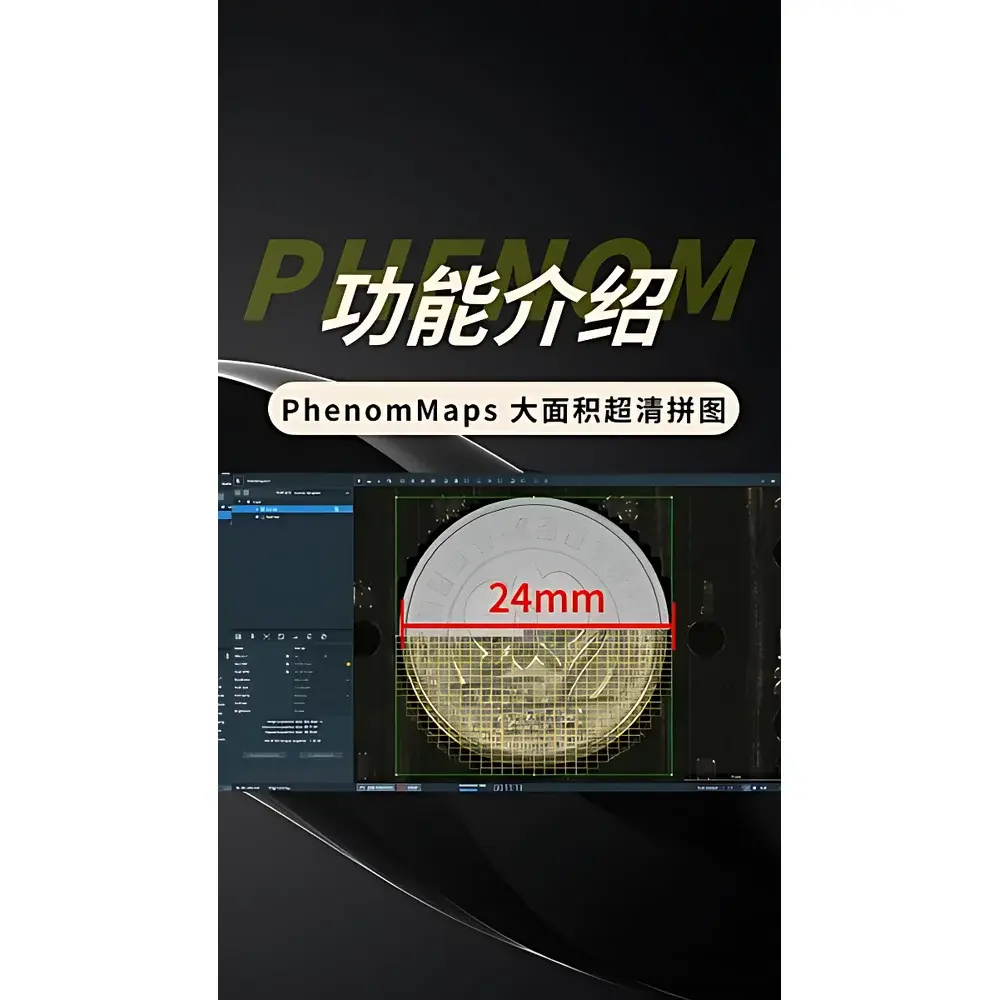
Phenom MAPS Large-Area Image Mosaic Software
| Brand | Phenom |
|---|---|
| Origin | Netherlands |
| Model | Phenom MAPS |
| Type | Automated Multimodal Mapping & Stitching Software for Desktop SEM |
Overview
Phenom MAPS is a purpose-built, multimodal mapping and stitching software platform engineered for desktop scanning electron microscopes (SEM) in the Phenom product family. It implements automated, tile-based image acquisition and geometrically robust mosaic reconstruction—leveraging high-precision stage positioning, real-time beam synchronization, and sub-pixel registration algorithms—to generate seamless, gigapixel-scale SEM images and correlated spectral datasets. Unlike manual stitching workflows, MAPS operates on a sample-centric data architecture that preserves metadata integrity across magnifications, detectors (secondary electron, backscattered electron, EDS), and acquisition parameters. Its core functionality bridges nanoscale structural imaging with macroscale contextual analysis, enabling quantitative material characterization across length scales—from micrometer-level fiber morphology to centimeter-scale device layouts.
Key Features
- Automated Large-Area Imaging: Configurable tile grids with adaptive focus correction and dynamic drift compensation ensure consistent resolution and contrast across stitched fields up to 100 mm × 100 mm (dependent on stage travel limits of Phenom XL G2, ProX G6, and Pharos G2 systems).
- Integrated EDS Mosaic Acquisition: Synchronized acquisition of energy-dispersive X-ray spectroscopy (EDS) maps across multiple tiles; supports quantifiable elemental distribution visualization with pixel-aligned spectral data export (e.g., .eds, .spc, .csv).
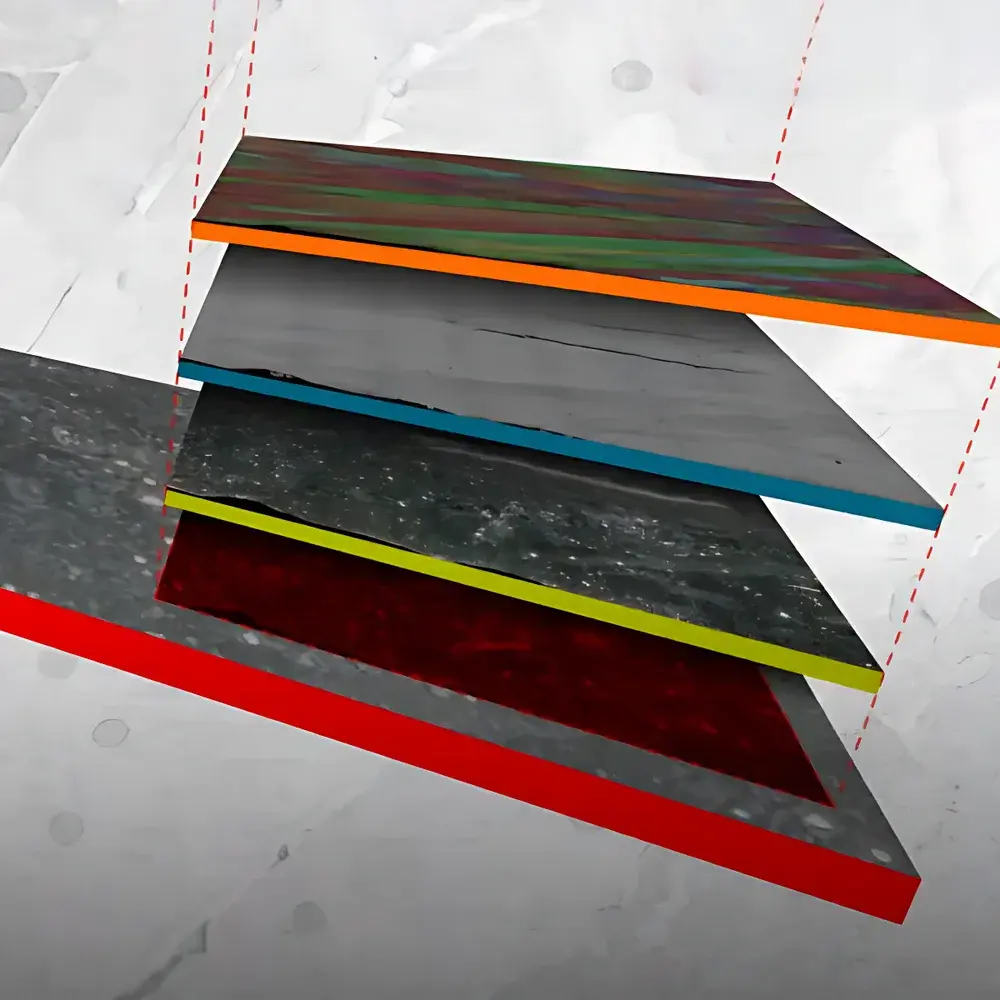
- CISA Cross-Instrument Spatial Alignment (CISA): Proprietary spatial registration framework enabling precise overlay of SEM imagery with optical microscopy (OM), Raman spectroscopy, FTIR, XPS, CAD schematics, or hand-drawn annotations—all referenced to a common coordinate system defined by fiducial markers or feature-based matching.
- Multi-Scale Workflow Automation: Hierarchical imaging protocols: low-magnification survey → region-of-interest (ROI) selection → high-resolution imaging/EDS → auto-stitching → annotation-driven re-acquisition planning.
- Offline Data Processing Engine: Standalone Windows-compatible application supporting post-acquisition mosaic refinement, ROI labeling, spectral deconvolution, batch export (RAW, tiled TIFF, HD-view JPEG/PNG), and report generation without instrument connection.
Sample Compatibility & Compliance
MAPS is validated for use with all current-generation Phenom desktop SEM platforms—including Phenom XL G2 (large-chamber industrial SEM), Phenom ProX G6 (high-resolution analytical SEM), and Phenom Pharos G2 (CE-validated SEM for regulated environments). The software adheres to ISO/IEC 17025:2017 principles for measurement traceability in materials testing laboratories. While MAPS itself is not a medical device, its output data may support GLP-compliant documentation when used in conjunction with validated SEM hardware and documented SOPs—for example, in wound dressing quality control per ASTM F2458 (Standard Guide for Characterization of Silver-Containing Antimicrobial Medical Devices). All exported image and spectral files retain embedded EXIF-like metadata (acquisition time, kV, dwell time, working distance, detector type) required for audit trails under FDA 21 CFR Part 11 when deployed in regulated QA/QC settings.
Software & Data Management
MAPS employs a modular client-server architecture: acquisition modules run natively on the SEM host PC, while offline processing occurs via a separate installation. Data files follow vendor-neutral conventions—TIFF-based mosaics include embedded GeoTIFF tags for spatial referencing; EDS datasets comply with the Bruker ESPRIT and Thermo Pathfinder interoperability standards. Version-controlled project files (.maps) store acquisition logs, calibration history, and user-defined ROIs. The software supports role-based access control (administrator/user modes) and generates timestamped audit logs for every action—including stitching parameter changes, ROI edits, and export events—facilitating compliance with ISO 9001 internal audit requirements. Export formats include lossless RAW (16-bit), pyramidal tiled TIFF (compatible with QuPath and HALO), and publication-ready HD-view exports with scalable vector overlays.
Applications
- Medical Device Characterization: Quantitative mapping of silver nanoparticle distribution in antimicrobial wound dressings—correlating Ag concentration gradients (via EDS mosaic) with polyethylene mesh geometry (via SEM mosaic) to assess controlled-release performance and cytotoxicity risk.
- Geoscience & Mineral Processing: Centimeter-scale mineral phase identification across heterogeneous rock sections using BSE contrast + EDS mosaic overlays, aligned with petrographic thin-section optical images via CISA.
- Battery Material Analysis: Cross-correlation of cathode particle cracking (SEM mosaic) with transition-metal leaching patterns (EDS mosaic) and surface chemistry (XPS map alignment via CISA) for failure mode analysis.
- Advanced Polymer Composites: Fiber orientation mapping across macroscopic composite laminates, combined with localized Raman strain mapping and SEM-derived porosity metrics.
FAQ
Which Phenom SEM models are compatible with MAPS?
Phenom MAPS supports Phenom XL G2, Phenom ProX G6, and Phenom Pharos G2 systems running Phenom Desktop Software v3.5 or later.
Does MAPS require continuous instrument connection during offline analysis?
No—the offline version operates independently on any Windows 10/11 PC with ≥16 GB RAM and ≥500 GB SSD storage; no license dongle or network tie-in is required.
Can MAPS export data for third-party analysis tools like MATLAB or Python?
Yes: EDS spectra are exported as ASCII .csv with channel-energy calibration; mosaic images are saved as georeferenced TIFFs with world files (.tfw) for GIS integration; metadata is accessible via XML sidecar files.
Is CISA alignment performed automatically or manually?
CISA supports both fully automated feature-matching (for high-contrast, repeatable landmarks) and semi-automatic point-pair registration (for low-signal or non-reproducible samples), with residual error reporting in µm.
How does MAPS handle stage drift during long-duration mosaic acquisitions?
MAPS implements real-time drift correction using frame-to-frame cross-correlation of live SE/BSE preview frames, updating stage position at user-defined intervals (default: every 30 seconds) without interrupting dwell time continuity.




