
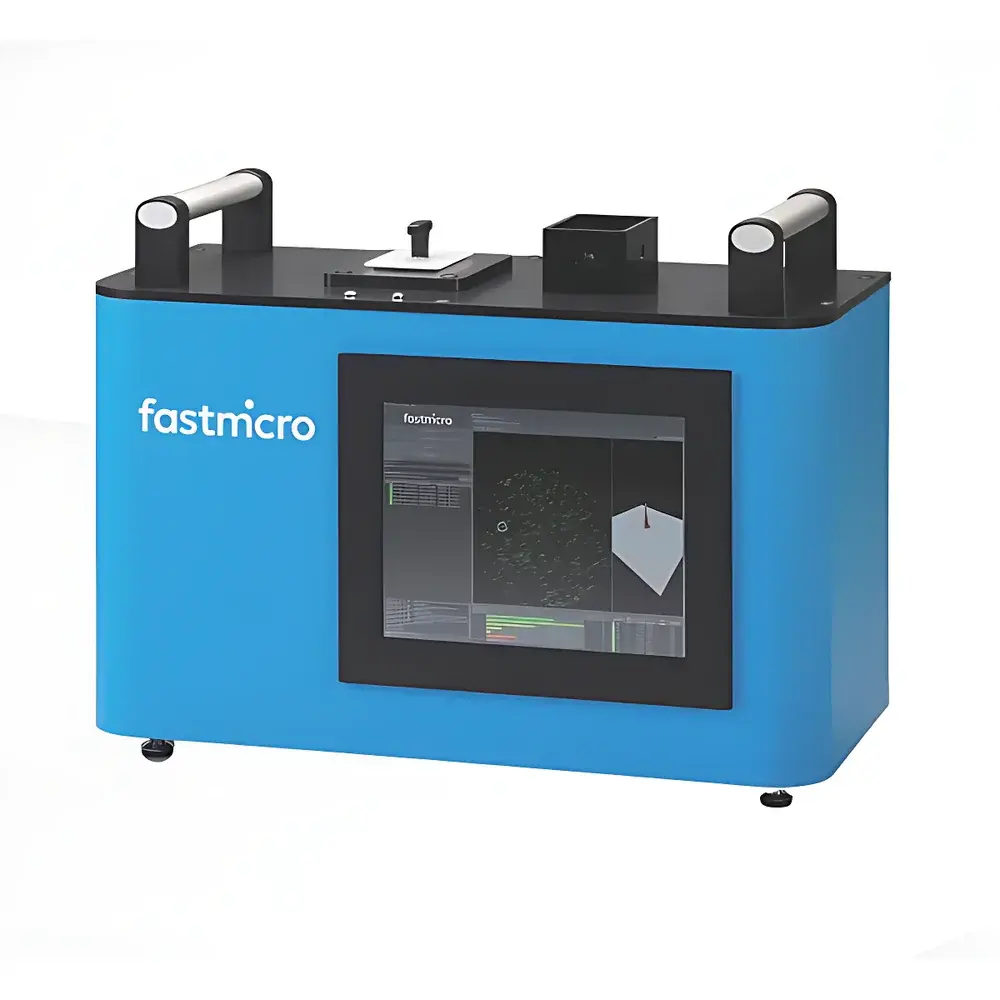
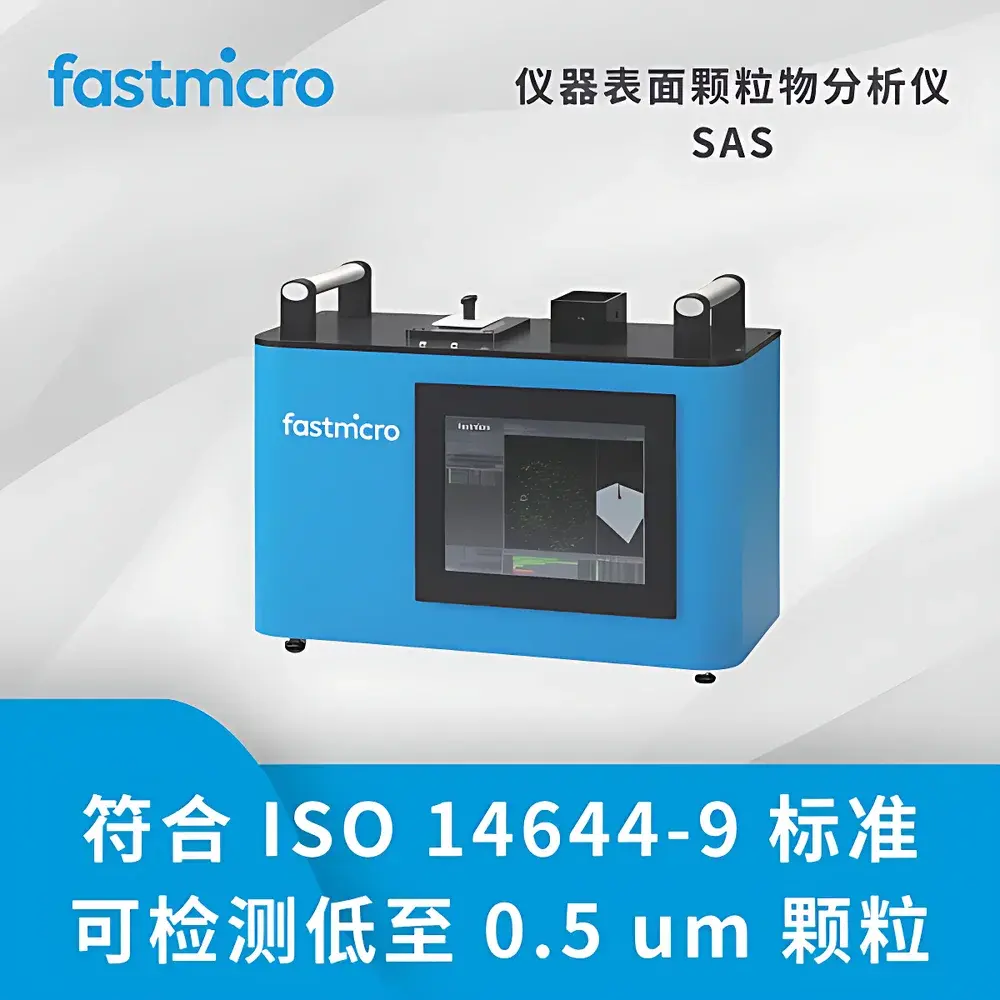
Fastmicro FM-PS-SAS-V01 Surface Particle Analysis System
| Brand | Fastmicro |
|---|---|
| Country of Origin | Netherlands |
| Instrument Type | Optical Particle Counter |
| Model | FM-PS-SAS-V01 |
| Sampling Principle | Tape-based Indirect Extraction |
| Minimum Detectable Particle Size | 0.5 µm |
| Field of View | 225 mm² per scan |
| Scan Time | <5 seconds |
| Sample Carriers | Certified PMC Adhesive Cards & 2-inch Wafer Kit |
| Compliance | ISO 14644-1, ISO 14644-7, USP <788>, ASTM E2457 |
Overview
The Fastmicro FM-PS-SAS-V01 Surface Particle Analysis System is a high-speed, non-destructive optical particle counter engineered for quantitative surface contamination assessment in controlled environments. Unlike direct imaging systems constrained by surface geometry or reflectivity, the FM-PS-SAS-V01 employs a certified pressure-sensitive adhesive (PMC) sampling card to physically extract particulate matter from substrates—enabling reliable measurement across high-roughness surfaces (e.g., machined metals, textured polymers), confined geometries (e.g., boreholes, microfluidic channels), and thermally sensitive components. The extracted particles remain immobilized on the card without displacement or agglomeration, preserving spatial distribution and size integrity for traceable metrology. Detection is performed via high-magnification brightfield microscopy coupled with automated image segmentation and morphological classification algorithms compliant with ISO 21501-4 for particle sizing accuracy. This indirect extraction methodology ensures measurement independence from operator technique, substrate optical properties, or ambient lighting—making it suitable for GLP/GMP-regulated cleanroom qualification, semiconductor component release testing, and medical device packaging validation.
Key Features
- Sub-micron resolution: Detects and classifies particles ≥0.5 µm with calibrated pixel-to-size mapping traceable to NIST-traceable reference standards.
- High-throughput analysis: Full-field imaging and quantification of 225 mm² in under 5 seconds—enabling ≤60-second total workflow time including sampling, loading, and reporting.
- Multi-surface adaptability: PMC cards conform to curved, porous, or irregular topographies without residue or substrate damage; validated on Ra >3.2 µm metallic finishes and silicone elastomers.
- Modular sampling architecture: Interchangeable carriers include ISO 14644-7–compliant adhesive cards (with barcoded traceability) and a dedicated 2-inch wafer holder for airborne particle deposition studies.
- Robust repeatability: CV <3.2% across ten replicate measurements on identical sample cards—demonstrated per ISO/IEC 17025 intra-laboratory precision protocols.
- Zero cross-contamination design: Single-use, pre-sterilized PMC cards sourced from ISO 9001-certified suppliers; no solvent cleaning or reusable probes required.
Sample Compatibility & Compliance
The FM-PS-SAS-V01 supports sampling from stainless steel, aluminum alloys, glass, silicon wafers, polymer films (e.g., PET, PTFE), and coated medical substrates (e.g., anodized titanium implants). All PMC cards meet ISO 14644-7 Annex B requirements for electrostatic charge control (<500 V) and outgassing limits (<1.0 µg/cm² total mass loss). The system’s measurement protocol aligns with ISO 14644-1 Class 5–8 cleanroom monitoring, ASTM E2457 for pharmaceutical packaging particulate testing, and USP particulate matter in injectables—where surface-derived contaminants may migrate into sterile barriers. Data output includes full audit trails compliant with FDA 21 CFR Part 11 (electronic signatures, user access logs, immutable result archives).
Software & Data Management
The embedded SAS Control Suite v3.2 provides real-time particle enumeration, size histogram generation (binned at 0.5–100 µm), spatial density mapping (particles/mm²), and ISO class equivalence reporting. Raw TIFF images and metadata (timestamp, operator ID, card lot number, calibration epoch) are stored in encrypted SQLite databases with SHA-256 hashing. Export formats include CSV (for SPC charting in Minitab/JMP), PDF certificates (with digital signature), and XML for LIMS integration (ASTM E1482-compliant schema). Software validation documentation (IQ/OQ/PQ) and electronic record retention policies are provided to support GxP audits.
Applications
- Semiconductor manufacturing: Post-etch, pre-bonding wafer surface cleanliness verification; bump height interference particle screening.
- Medical device production: Final assembly station monitoring for ISO 13485 cleanroom compliance; particulate shedding assessment of catheter hubs and syringe plungers.
- Aerospace component QA: Verification of turbine blade cooling hole cleanliness prior to thermal barrier coating application.
- Pharmaceutical packaging: Quantitative assessment of stopper crimping residue and blister foil delamination debris.
- R&D process optimization: Correlation of cleaning cycle parameters (sonication time, detergent concentration) with residual particle load reduction rates.
FAQ
How does the FM-PS-SAS-V01 differ from direct surface scanning microscopes?
It eliminates focus drift, reflection artifacts, and topographic shadowing by transferring particles to a flat, optically uniform substrate—ensuring consistent magnification and contrast across all particle sizes.
Can the same PMC card be re-analyzed after initial measurement?
Yes—cards are stable for ≥72 hours post-sampling and can be re-scanned for trend analysis or secondary review without degradation.
Is calibration required before each use?
No—system-level calibration is performed during factory certification and verified annually; daily verification uses NIST-traceable 5.0 µm polystyrene latex standard cards.
Does the instrument support multi-site network deployment?
Yes—centralized database hosting via secure TLS 1.3 connection enables synchronized firmware updates, remote diagnostics, and enterprise-wide SPC dashboarding.
What regulatory documentation is supplied with delivery?
Includes EU Declaration of Conformity (CE), ISO/IEC 17025 test report, 21 CFR Part 11 software validation package, and ISO 14644-7 sampling card certification dossier.
Related Products



